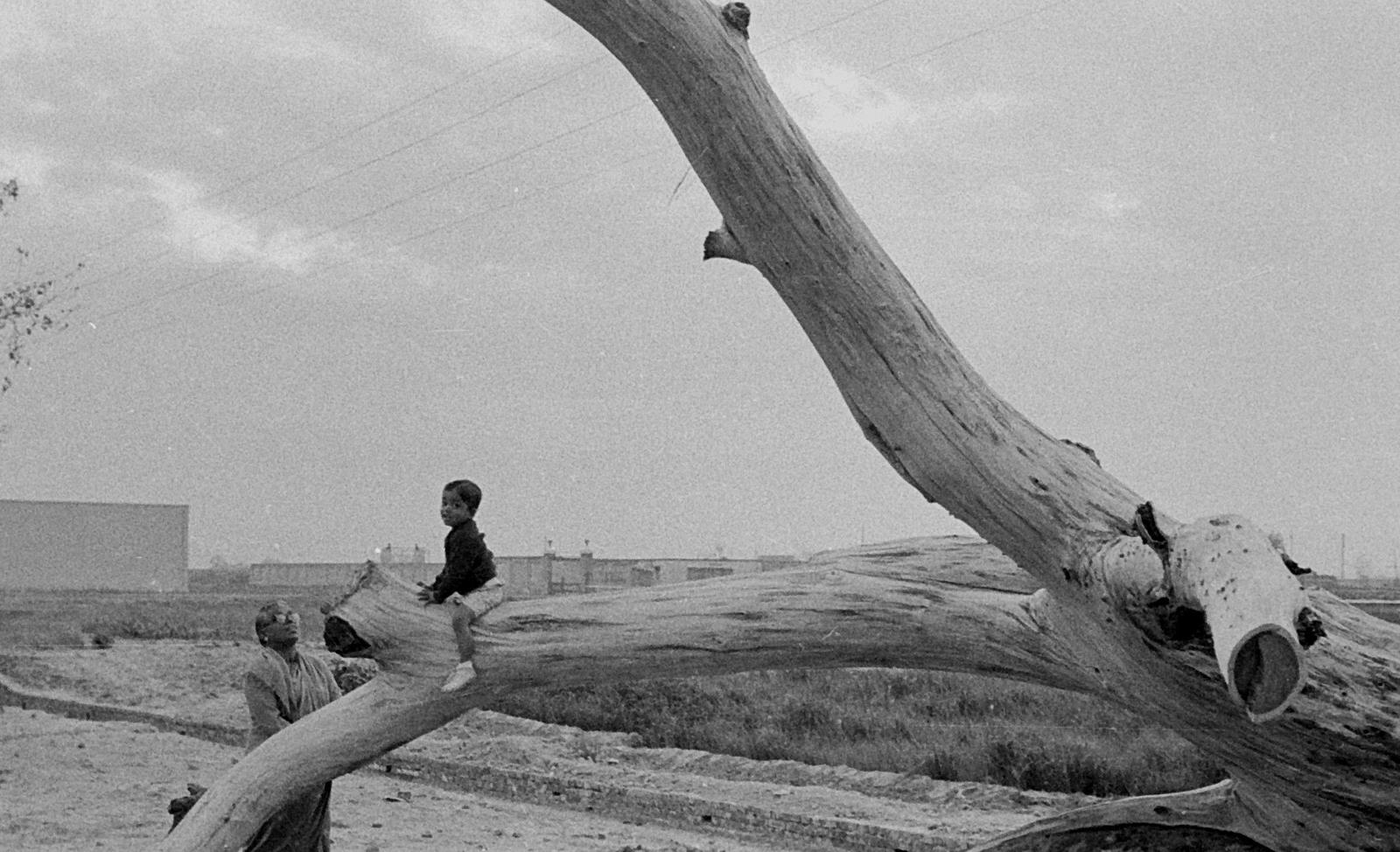
A tender, risky moment on a giant fallen tree, held together by a bold diagonal frame.
You’ve seen the moment well, Tagore. The child perched on the fallen trunk and the elder’s upward gaze give the scene a clear emotional thread, and the huge tree does act as the “massive frame” you describe. This reads as candid street/documentary work, and the environment—the open ground, distant buildings and wires—adds a sense of place without feeling staged. What I enjoy most is the scale: the dead tree dwarfs them, turning a family beat into something almost mythic. Did you consider stepping a little left or back to give the grandmother more breathing room while keeping that powerful diagonal?
TECHNICAL EXECUTION ★★★
The file has noticeable grain and a slightly thin tonal range, which suits the documentary mood but also leaves faces a touch flat. Focus is acceptable—sharp along the trunk—though the child’s face looks a bit soft at this resolution. Exposure is safe; the overcast sky holds detail but dominates a large portion of the frame without much texture. I can also see a few tiny specks consistent with dust on a scan. With a little micro‑contrast and selective dodging/burning, you could give the people more presence without losing the film feel. Next time, a faster shutter (around 1/250–1/500) would help if the child is fidgeting, and f/8 would keep both subjects crisp on the same plane.
COMPOSITION ★★★★
The sweeping diagonal of the trunk is a strong backbone and cleverly creates a natural frame above the child. Placing the boy on the lower branch with the elder tucked under works conceptually—small humans beneath a giant form. Where it slips is at the edges: the grandmother is cramped against the left border and partly hidden by the tree, and the heavy branch stub on the right pulls the eye away from the relationship. A step to your left, or simply leaving more space on the left edge, would ease the tension without losing the structure. Consider lowering your viewpoint slightly so the child’s legs separate from the horizon line and feel less fused with the background. The bones of the frame are strong; refine the edges and it sings.
LIGHTING ★★★
Overcast light keeps contrast gentle, which is kind to skin and helps hold detail on the pale timber. However, it’s flat across the faces and doesn’t shape them, so the expressions don’t land as strongly as the composition deserves. A small shift to place the faces against a slightly darker background would create separation even in flat light. In post, a subtle S‑curve and selective dodge on the faces (about 0.3–0.5 stop) would give them life. Burning the bright sky band a touch would also prevent it from stealing attention from the human moment.
STORY ★★★★
The narrative reads clearly: an elder’s watchfulness versus a child’s carefree climb. Her upturned face and the boy’s relaxed posture do the heavy lifting, while the monumental trunk sets the stakes. One extra beat—eye contact between them, the child leaning down, or a hand reaching—would lift this to a standout frame. The setting, a rough field with distant buildings, supports the story by feeling ordinary and unforced. It feels truthful and respectful; you’ve not intruded on their dignity.
IMPACT ★★★★
The scale of the tree and the clean diagonal give the image presence; it sticks longer than a typical family snapshot. The moment is gentle rather than dramatic, which suits the black‑and‑white treatment. Technical softness and the busy right‑hand branch keep it just short of unforgettable, but the core idea is strong. With tidier edges and a touch more bite in the tones, this could be a print‑worthy frame from the series. What title would you give it if it were on a wall—does that influence how you’d refine the final edit?
CONSTRUCTIVE NEXT STEPS
- Reframe to give the grandmother more space on the left and reduce the dominance of the branch stub on the right; one step left or a slightly wider focal length would help while keeping the big diagonal.
- Wait for a micro‑gesture—eye contact, a hand reaching, or the boy glancing down—to lock the relationship; shoot a short burst to catch the exact beat.
- Post‑process: add a gentle S‑curve, dodge the faces by ~0.3–0.5 stop, and burn the upper sky edge; heal obvious dust spots to keep attention on the moment.
- Technical safeguard when kids move: aim for around 1/250–1/500 sec at f/8 and raise ISO as needed to keep both subjects and the textured wood crisp.
AI Version 2.12