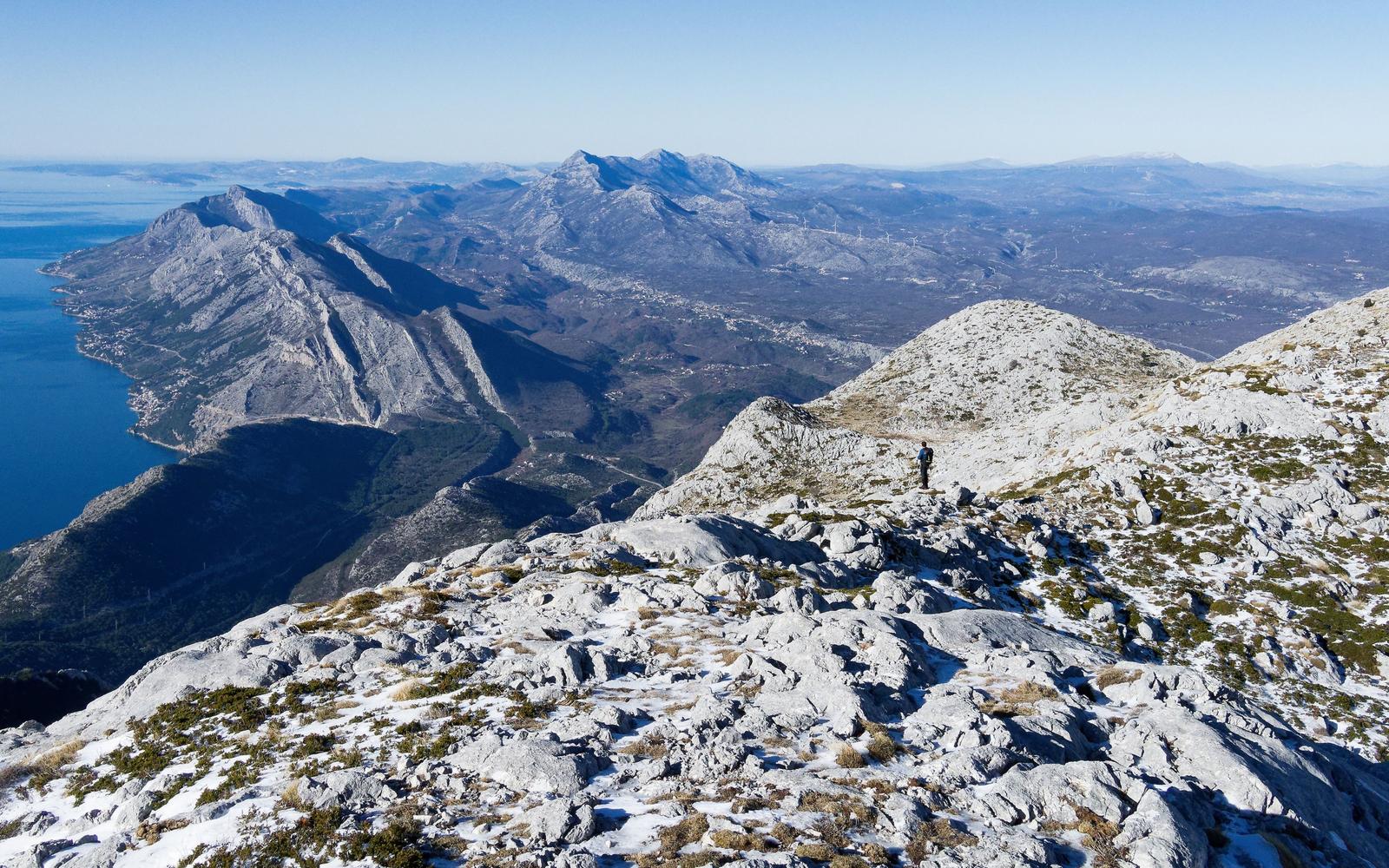
Epic vista, tiny human — strong sense of scale, but the figure needs cleaner separation.
Thanks for sharing this, Zoran. To your key question: the person is identifiable on a large view, but they don’t immediately pop at smaller sizes because their dark clothing sits against busy, similarly toned limestone. They do help the sense of scale, but the separation isn’t strong enough to make them an instant anchor. Overall this sits in landscape/travel territory: a confident high‑vantage panorama with excellent topographic layering and a coastline that guides the eye. The scene is impressive; refining the placement and visibility of your hiker would lift it from “grand view” to “grand story.” How much priority were you giving the person versus the sweeping geology, and would you feel comfortable directing your partner for thirty seconds to shape their placement?
TECHNICAL EXECUTION ★★★★
Sharpness is good across the frame; the foreground limestone and distant ridges hold detail without obvious haloing or heavy processing. Exposure is well managed given the reflective rock and snow patches — highlights are controlled and shadows retain texture. Colours feel natural and muted, which suits the winter air. There’s expected atmospheric haze in the distance, but nothing that spoils the view. A mild polariser or a touch of Dehaze on the far ridges could add bite, but go easy to keep it natural. For five stars I’d want micro‑contrast just a touch cleaner in the mid‑distance and the figure rendered a fraction crisper via local sharpening.
COMPOSITION ★★★
The coastline on the left forms a strong leading shape, stepping the eye through foreground, midground, and background. The horizon placement is deliberate and the limited sky keeps attention on the terrain. The weak point is the hiker’s placement: they’re small, mid‑slope, and merge with textured rock, so the intended anchor gets lost. The busy lower foreground also takes a lot of visual weight without adding a distinct shape. A lower or slightly left position to put the hiker on the skyline, or a tighter crop from the bottom, would clarify your centre of attention. To reach five stars, I’d want the human isolated against clean negative space and scaled a touch larger relative to the frame.
LIGHTING ★★★
The light is clean and wintry, giving crisp definition to the ridges and a deep blue sea. It’s also fairly high and even, which flattens the immediate foreground and doesn’t carve the hiker from the rock. Shadow shapes on the left slopes are pleasing, but the right side of the frame lacks strong modelling. Early or late side light would add relief and colour, especially on the limestone textures. A small local lift on the figure and a subtle dodge on the path could help with separation without looking forced.
STORY ★★★
There’s a clear theme: human versus mountain scale, a winter ascent above the sea. Because the person is tiny and static, the sense of a “moment” is faint — it reads as a grand vista with a person in it rather than a scene about that person in the landscape. A gesture (mid‑step, pause on the crest looking out, poles lifted) or placing them on the skyline would add tension and intention. The terrain itself is full of character; it just needs that human beat to become memorable. Consider: what single gesture would say “we made it” without feeling staged?
IMPACT ★★★★
The sweep of ridges into the Adriatic is striking and will hook most viewers. The cool palette and clarity give it a confident, natural look with no gimmicks. Impact is tempered slightly by the small, subdued figure — the promised scale cue takes a second to find. Strengthen that anchor and this becomes a wall‑worthy panorama. For five stars I’d want immediate read: the viewer sees the hiker at once, feels the height, and follows the ridge lines out to sea in one clean visual loop.
CONSTRUCTIVE NEXT STEPS
- Reposition for separation: when your partner reaches a small crest, move a metre or two lower/left so they sit against the sky; ask for a clear stance (mid‑step or facing the view). Even a bright hat or jacket would help against pale limestone.
- Refine framing: crop 10–15% from the bottom to reduce the busy rocks and pull more attention to the hiker and the sweeping ridges; keep the left coastline as your main leading line.
- Scale the person slightly larger without losing breadth: step closer or use a longer focal length, then stitch a simple two‑frame pano for the width — feasible with a static scene and cooperative subject.
- Subtle processing for legibility: a small radial mask over the hiker (+0.3–0.5 EV, +10 saturation, mild local sharpening) and a light Dehaze on the far mountains will make the anchor and depth read faster while staying natural.
AI Version 2.12