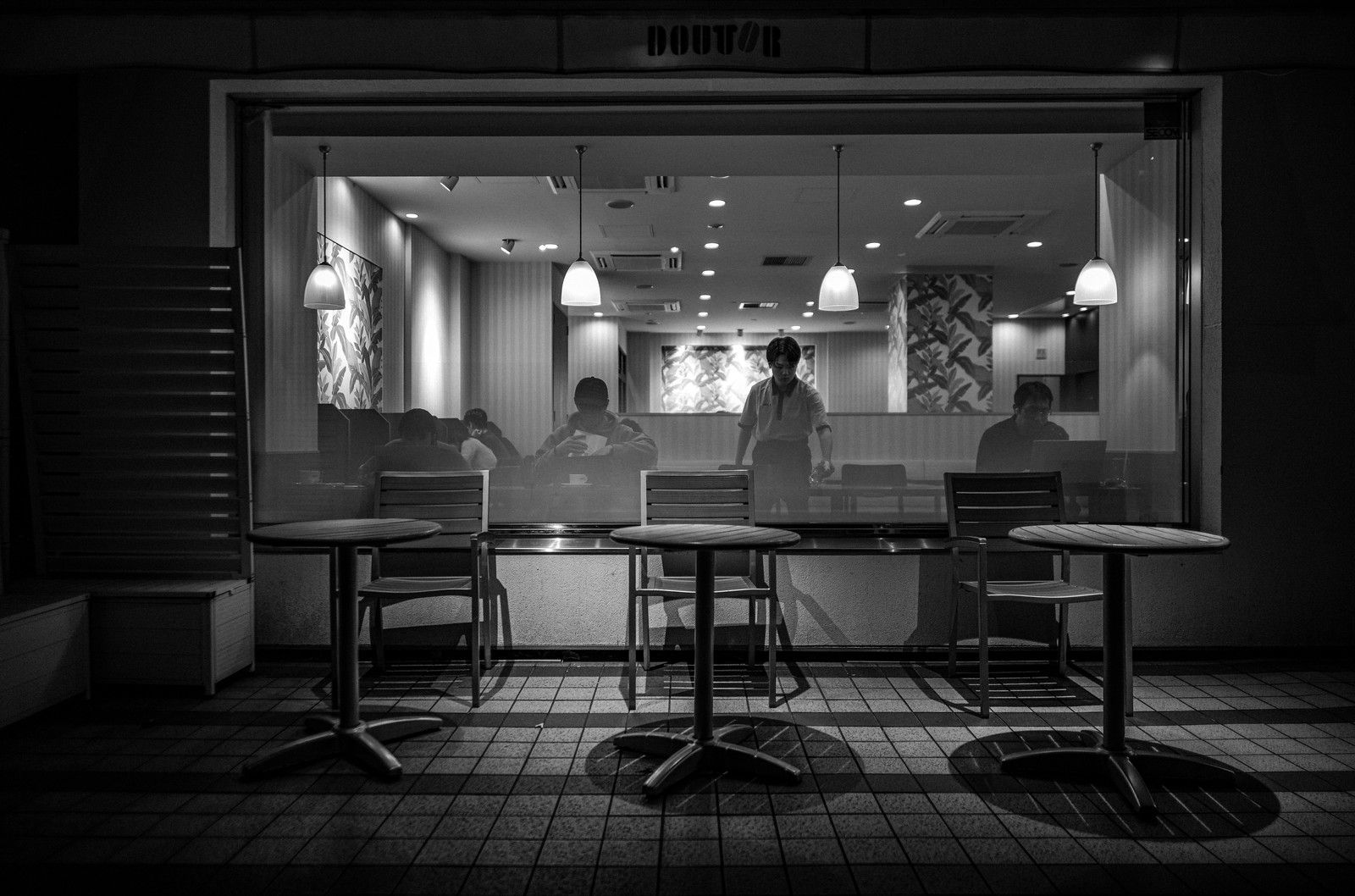
A quiet city nocturne: empty tables outside, life ticking on behind the glass.
Peter, you’ve got a solid urban/street frame here, and your choice of monochrome fits the fluorescent interior and the night mood. The window acts as a stage: the three outdoor tables create a front row, while the standing staff member inside becomes the key figure. Since you asked about processing, I’ll focus on getting cleaner separation between the exterior and interior, controlling the bright fixtures, and guiding the eye to that central gesture. I’ll also touch on composition decisions that post‑processing can reinforce. Before I dive in, what did you want the viewer to feel first — the emptiness of the terrace or the quiet work inside?
TECHNICAL EXECUTION ★★★★
The file looks clean with a good tonal range and no distracting artefacts; the black‑and‑white conversion is tasteful. The pane of glass adds a mild veiling haze to the interior, which softens local contrast around the seated figures; this is natural but slightly mutes the scene. Highlights in the hanging lamps are close to clipping, which is acceptable for practical bulbs but they pull attention. Edge‑to‑edge sharpness is decent, though the interior is a touch softer than the outdoor tables due to the glass and light scatter. With a little local dehaze/clarity inside and controlled highlights, this would move toward publication quality. Did you shoot through a perfectly clean pane? Even a quick wipe can reduce that low‑contrast veil next time.
COMPOSITION ★★★★
The window is a strong proscenium, and the rhythm of three outdoor tables and three pendant lights gives the frame structure. Placing the standing staffer off‑centre works; they balance the darker figure at far right. The left edge with the louvred panel and bench feels like extra baggage that doesn’t support the main idea. A slight crop from the left (and a hair from the bottom) would tighten attention on the window and reduce the heavy floor area. Consider whether a slightly lower viewpoint would have separated the table tops from the window ledge more clearly; as is, they stack a little.
LIGHTING ★★★★
The contrast between the dim terrace and the lit interior sets the mood nicely for night street work. The ceiling downlights and pendants create natural hotspots that draw the eye along the frame. However, the interior light is very even, so faces and gestures don’t pop on their own; they need a little help in processing. Gentle dodging on the standing staffer’s face and shirt, paired with slight burning on the pendants, would shift attention where you want it without looking manipulated. If you revisit a similar scene, waiting for a stronger shaft of light on a person or a darker moment outside would increase depth further.
STORY ★★★
The narrative rests on a simple but effective contrast: empty seats outside against quiet activity inside. The staffer mid‑action is the closest thing to a moment, yet their gesture is small and slightly ambiguous. A clearer action—placing a cup, wiping a table, or engaging a guest—would sharpen the story and give us a true beat to lock onto. Did you consider waiting for someone to step onto the terrace or for the staffer to lean into the light? Right now, the frame is atmospheric, but the moment is “almost.”
IMPACT ★★★
The image is pleasing and well‑built, and the monochrome treatment suits the scene. It holds attention for its geometry and mood rather than a decisive moment, so it lands as a strong study rather than a standout. Tighter processing that guides the eye to a clearer focal beat would raise its staying power. A small crop and targeted tonal work could turn this from “nice night scene” into something you remember for the human moment.
CONSTRUCTIVE NEXT STEPS
- Use two local masks: 1) interior mask with +10 to +20 Dehaze and a touch of Clarity/Texture to cut the window veil; 2) pendant lights mask with −0.3 to −0.5 EV and a bit of Highlights −30 to stop them stealing attention.
- Guide the eye to the standing staffer: a subtle radial dodge on face/torso (+0.2 to +0.4 EV, midtone contrast +5 to +10), then burn the lower corners and pavement with a graduated mask (−0.3 EV) to reduce the weight of the foreground tiles.
- Crop 5–8% from the left to lose the louvred panel and a sliver from the bottom to sit the table feet just above the frame edge; keep the right table fully in to maintain the visual rhythm.
- Finish with a restrained film‑style look: set a true black point (only the grout lines hit black), add a gentle S‑curve for midtone snap, and, if you like texture, add fine grain (15–20 amount, small size) for cohesion without crunch.
AI Version 2.12