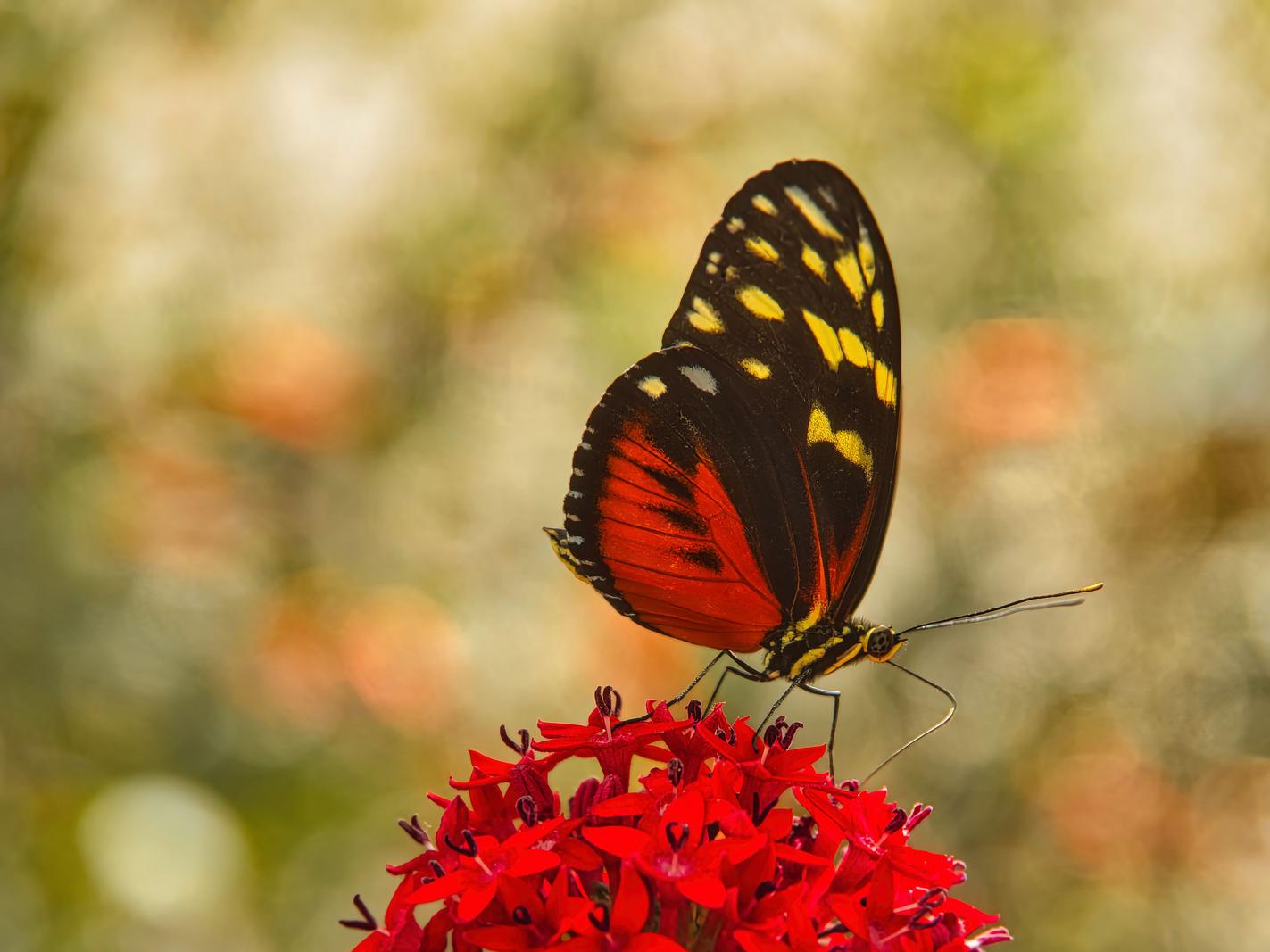
Bold colour, clean focus, and creamy bokeh make this a striking butterfly portrait.
Your intent reads clearly, Richard. The red flower and the butterfly’s warm markings pop beautifully against the soft, neutral background; your colour contrast strategy works. This sits comfortably in macro/wildlife portrait territory, and the image benefits from the shallow depth of field you’ve chosen. Two details worth praising: the crisp rendering of the head and forewing scales, and the elegant diagonal stance of the insect on the scarlet cluster. My critique below focuses on refining control of depth, spacing (especially around the right antenna), and keeping the saturated reds from stealing the show. Before we dive in—what made you choose this side-on pose over a head‑on or wings‑open moment that might shift the energy of the frame?
TECHNICAL EXECUTION ★★★★
Focus is reassuringly sharp where it counts—on the head, eye and the nearest wing surface—so the connection holds. The background is smooth and free from artefacts, and noise is very well controlled, suggesting a low ISO and solid exposure. The depth of field feels a touch too thin: the forward antenna and parts of the proboscis fall away more than needed, and the front edge of the flower is soft enough to compete with the crisp butterfly. Colour is rich without looking cartoonish, though the reds are close to clipping and could use a little restraint to retain petal texture. There are no obvious halos or sharpening rings, which keeps the file clean. To reach five stars, I’d like a fraction more depth and micro-contrast on the head/antenna while keeping the background creamy—think one stop more aperture or a slightly longer shooting distance with a small crop.
COMPOSITION ★★★★
The subject placement is strong: the butterfly occupies the right-hand side with generous negative space to the left, letting the viewer breathe. The red flower anchors the bottom nicely and creates a clear colour counterpoint. However, the right antenna is perilously close to the frame edge, which creates an unintended feeling of cramp; a centimetre more room on the right would relax the image. The flower is also cropped tightly at the base—another few millimetres of stem or petals would avoid that clipped feeling. Bright bokeh discs on the left mid-background pull the eye slightly; they’re minor but they do compete with the head. A small shift right or a looser crop would address most of these concerns and elevate the precision of the framing.
LIGHTING ★★★★
The light is soft and warm, flattering the butterfly’s colours and giving a gentle catchlight in the eye. Shadow detail on the body is retained, and there’s pleasing modelling across the wing that shows texture without harsh glare. Highlights on the yellow spots and the glossy petal edges are controlled and not blown. The light, however, is fairly even; a slight directional push would add shape—either by turning a fraction so the light rakes the wing, or by using a small diffuser/reflector to lift the head selectively. As it stands, it’s clean and natural, just shy of sculptural. A touch more directionality would make the insect feel more three‑dimensional.
STORY ★★★
There’s a clear moment: the butterfly is feeding, proboscis engaged, on a blazing cluster of blooms. It’s honest and pleasant to look at, but it stops short of a memorable behaviour frame. A wing flick, a head-on gaze with both antennae arced forward, or a second insect entering the scene would add tension or dialogue. Because the environment is a display rather than wild habitat, context is minimal, so the picture leans on gesture for narrative. Right now it works as a polished portrait rather than a story-led image. Consider waiting for a beat when the wings open or the antennae align to build a stronger “moment”.
IMPACT ★★★★
The colour contrast you aimed for delivers immediate punch—black and orange wing against scarlet petals, all floating over a gentle wash of green-beige. The simplicity and cleanliness make it memorable among garden butterfly portraits. What holds it back from five stars is the slight crowding at the right edge and the near-clipped reds, which feel a bit loud for the otherwise muted palette. A touch more breathing space and subtler colour would align the image with a more refined, natural style. Still, it’s a strong, gallery-friendly macro portrait with good presence.
CONSTRUCTIVE NEXT STEPS
- Give the antenna breathing room: reframe with 5–10% extra space on the right and include a little more of the flower base, or crop a tad looser from the original if available.
- Increase usable depth on the head/antennae: aim for around f/7.1–f/8 with a shutter near 1/500–1/1000s to counter micro-movements; raise ISO modestly if needed. Alternatively, back up slightly and crop to maintain background blur while gaining depth.
- Tame hot reds and bright bokeh: in HSL, drop red saturation −5 to −10 and lift red luminance +2 to +5; use a local brush to reduce exposure/clarity on the brightest background discs so the eye stays on the head.
- Shape the light subtly: if you can, use a small handheld diffuser or white card to add gentle direction onto the head, creating a more defined catchlight and separation without looking “flashy”.
AI Version 2.12