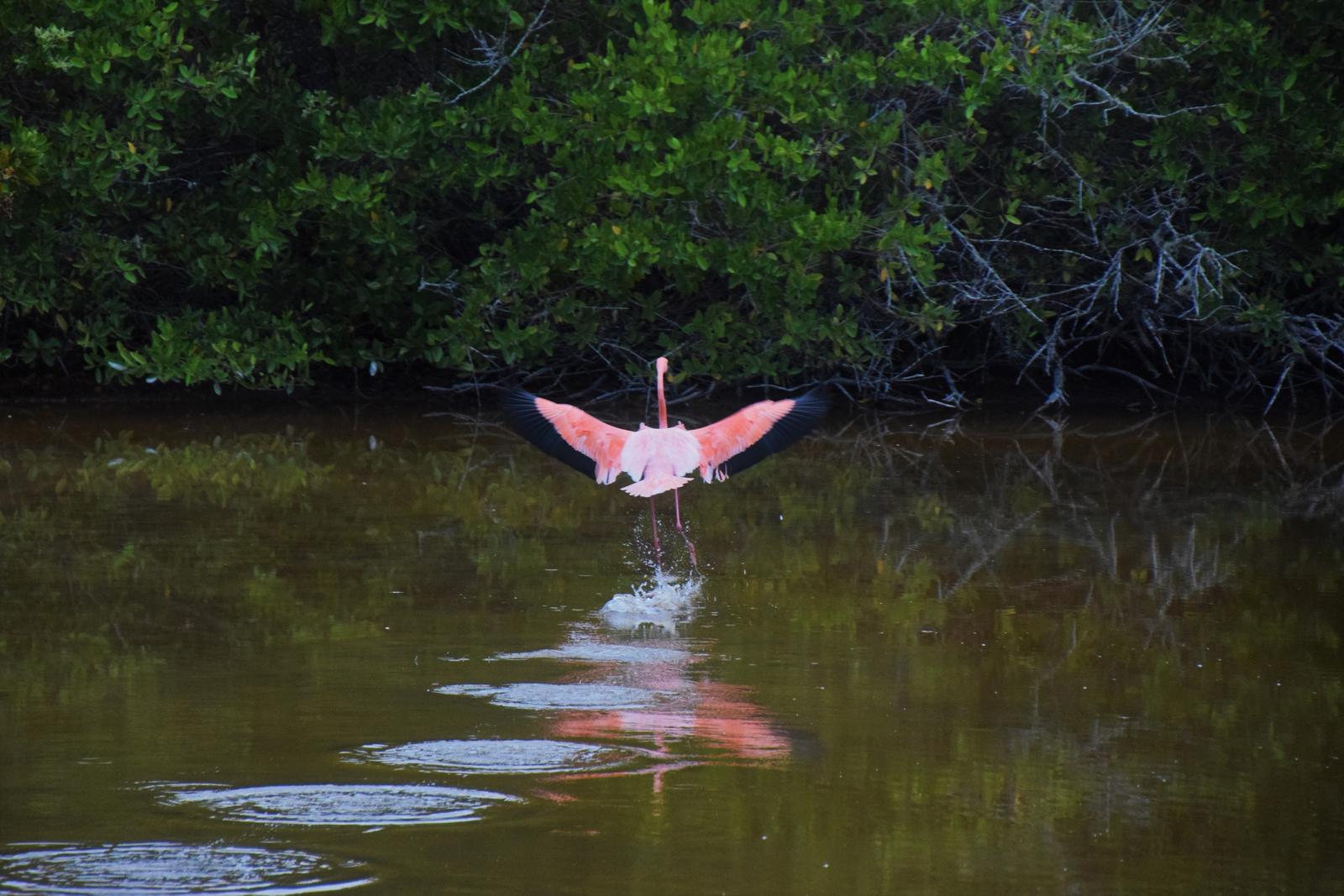
A graceful take‑off beautifully timed, but the bird is giving you its back rather than its face.
You’re not alone—getting wildlife moving toward you is hard, but there are reliable ways to stack the odds. Birds usually take off and land into the wind, so if you position yourself with the wind and light at your back, you’ll often get that approach and clean light. This frame sits firmly in wildlife photography: the flamingo mid‑lift with wings flared is a strong behavioural moment. I like the pink against the dark mangroves and the string of ripples and reflection leading from the splash. The limitation is simply that we’re looking at the retreating bird, so there’s no eye, no catchlight, and less connection. How often do you choose your spot based on wind direction and where you expect the take‑off or landing path to be?
TECHNICAL EXECUTION ★★★
Exposure looks sensible and the colours feel natural, which suits the scene. The splash is frozen well enough, suggesting a reasonably fast shutter, but the bird itself appears a touch soft—probably a mix of distance, motion, and AF not quite locking on. Noise is controlled and there’s no heavy processing, which I appreciate. The subject is small in the frame for the level of detail you want in a bird‑in‑flight moment. To hit five stars you’d need crisp feather detail on the head and primaries, ideally with a visible eye, using faster AF tracking and a higher shutter (around 1/2000s or more) with continuous burst.
COMPOSITION ★★★
The centred, symmetrical pose works—the black wing edges form a pleasing V and the wake creates a natural leading line. However, the dense mangrove directly behind the bird competes for attention and reduces separation; water behind the bird would have simplified things. The subject is also a little small; a closer position or tighter crop leaving space in front of the travel path would add presence. Consider placing the bird slightly higher in the frame to emphasise the trail of ripples. Would shifting a few metres to your right or left have given you more water as background rather than foliage?
LIGHTING ★★★
The light is gentle and even—no harsh hotspots—which keeps the pinks honest. That said, it’s quite flat, so there’s little modelling on the body and no catchlight in the eye (we can’t see it anyway). With the sun behind you at a low angle you’d get richer colour and more texture in the wings during take‑off. A touch more exposure on the bird relative to the background would help it pop. For five stars, aim for early or late light with the bird angled toward you.
STORY ★★★
Behaviour is the story here: the instant of lift‑off, splash, and mirrored wake. It’s readable and pleasant, but the narrative feels incomplete without a face or a hint of intent from the bird. An approach or banking turn toward you would add that extra note of character. Including more of the wake or another bird reacting could deepen the moment. Think about how long you can wait to predict a second take‑off in the same spot once a flock starts moving.
IMPACT ★★★
The scene is calm and attractive, and the pink against green has natural appeal. Still, the “away” angle and modest subject size keep it from being a standout wildlife frame. Clean background, eye contact, and sharper detail would lift this considerably. As it stands, it’s a solid behavioural record rather than a portfolio anchor.
CONSTRUCTIVE NEXT STEPS
✓ Position for approach: birds take off and land into the wind—stand with wind and sun at your back so flight paths come toward you; pre‑focus on the anticipated line over open water, not foliage.
✓ Dial in action settings: AF‑C/AI‑Servo with zone/expanded point, 1/2000–1/3200s, f/5.6–f/7.1, Auto ISO capped to your camera’s noise tolerance; use high‑speed burst and keep the frame slightly loose to avoid clipping wings.
✓ Simplify the background in the field: move a few metres to line the bird up against water rather than dark shrubs; shoot from a lower viewpoint near water level to strengthen the reflection and separation.
✓ Post‑processing: apply a subtle radial mask to lift exposure and micro‑contrast on the flamingo, and gently darken/suppress saturation in the background greens; clone out the bright twiggy highlights on the right edge to reduce distraction.
AI Version 2.1