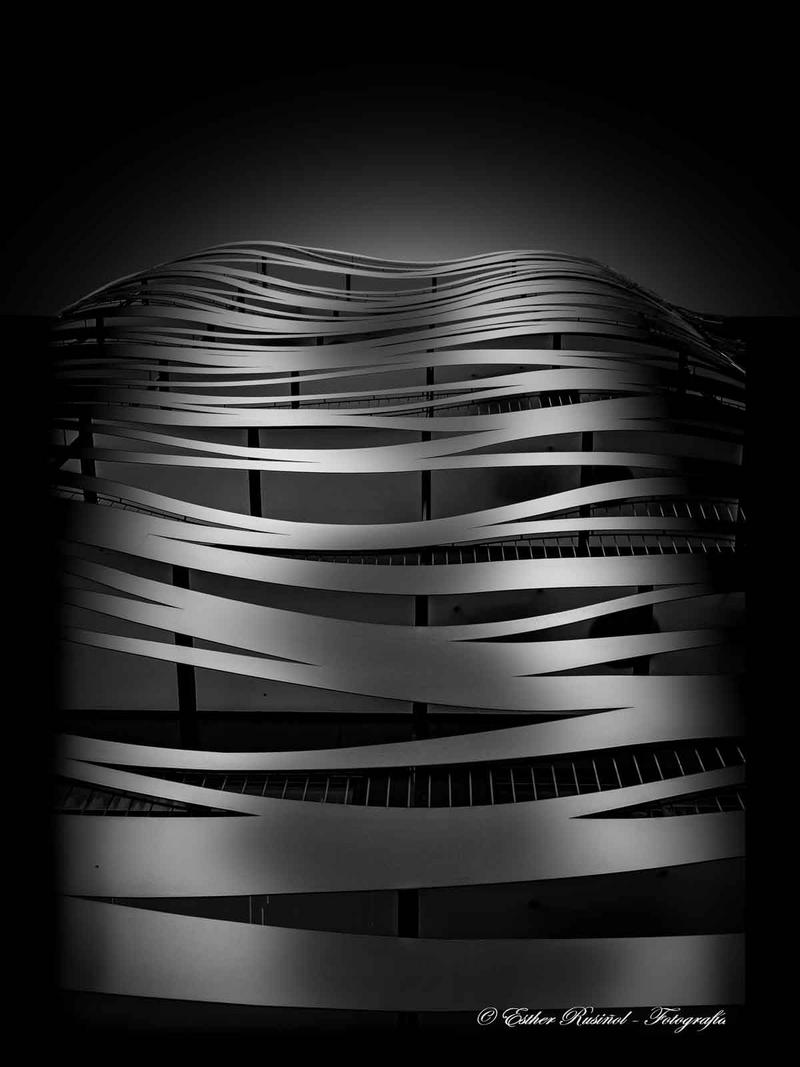
A bold, graphic study of rhythm and steel that turns a façade into sculpture.
You’ve clearly pursued that “special touch” here: the building becomes a series of flowing ribbons, and the camera angle compresses them into a striking wave. This sits comfortably in architectural photography with a fine‑art lean. The strong monochrome treatment and the deliberate choice to let the frame fall off to black emphasise form over context, which suits your intention to highlight characteristics rather than place. Two elements stand out: the disciplined repetition of the curved slats and the deep vignette that isolates the structure from the world. As you refine this direction, consider how much abstraction you want versus an accurate architectural rendering—both are valid, but the decisions affect how the image reads.
TECHNICAL EXECUTION ★★★★
Sharpness looks solid across the frame and the tonal control in the mid‑greys is clean, which keeps the metal feeling tactile rather than plastic. The conversion to black and white is confident, with good separation between the slats and the darker voids behind them. There’s noticeable keystoning as the vertical supports converge upwards; as a fine‑art choice it adds drama, but for purist architectural work you’d usually correct this. The heavy vignette that pushes the corners to pure black feels added in post and borders on a frame—effective, but a little heavy‑handed and it costs you technical points. The visible watermark also distracts in a gallery or portfolio context; keep a clean master and apply signatures only for final prints.
COMPOSITION ★★★★
The composition is disciplined and graphic: the ribbons stack in waves that carry the eye from bottom to top, and the slight central symmetry creates a calm spine through the chaos. Cropping tight to the edges accentuates the abstraction, though a couple of slats clip the borders sharply, which introduces small points of tension. The upward viewpoint adds momentum, inviting the viewer to “climb” the waves. I do wonder what a perfectly parallel, front‑on framing would do—trading perspective drama for a more meditative pattern—worth testing on this subject. The signature in the lower right competes with your strongest diagonals and weakens the otherwise clean edge discipline.
LIGHTING ★★★★
The light skims the metal beautifully, giving each ribbon a crisp top edge and a soft falloff that sells the three‑dimensional curve. The central glow against the darker corners helps shape the structure, but combined with the vignette it begins to feel stagey rather than purely photographic. Highlights are well contained—no ugly clipping—and the shadows hold just enough detail to suggest the internal grid without distracting. A lower sun angle or raking side light could carve even more definition into the curves, adding depth without relying on heavy corner darkening. As processed, the light is attractive and controlled, just shy of being truly sculptural.
STORY ★★★
The image communicates a clear idea: this building is about motion and rhythm, and you’ve distilled that into a wave. What’s missing is a sense of place or purpose—there’s little to tie it to Barcelona or to life within the apartments. That’s a valid fine‑art choice, but it keeps the narrative on the conceptual side rather than the human or contextual side. A hint of interior detail, a lit window, or a figure for scale could add a second layer of story without breaking the graphic spell. Ask yourself: do you want this to be a pure pattern study, or a portrait of a lived‑in structure?
IMPACT ★★★★
The wave motif and monochrome austerity hit hard on first viewing—this is a strong, memorable shape. The deliberate abstraction lifts it above a straightforward record shot and shows authorial intent. Impact is softened a touch by the heavy vignette and the watermark, which pull attention away from the beautiful lines you’ve built the image around. Refining presentation would let the form speak even louder. With a cleaner edge treatment and either truer verticals or an even bolder commitment to abstraction, this could reach the top tier.
CONSTRUCTIVE NEXT STEPS
- Export a clean version without the heavy vignette and watermark, and compare side‑by‑side; if you still want separation, keep the vignette subtle (e.g., −0.5 to −0.7 stop) and confine it to the corners using radial masks.
- Test two edits: one with full perspective correction (Transform/Vertical in Lightroom or a shift lens) for an architectural purist read, and one embracing the tilt but centred perfectly—decide which better suits your intent.
- On a reshoot, try front‑on alignment with the sensor parallel to the façade and shoot at golden hour; raking side light will sculpt the ribbons naturally and reduce the need for heavy post.
- If you want a touch of narrative, wait for a single lit interior strip or a small human presence for scale behind the slats; keep it tiny so the pattern remains the hero.
AI Version 2.12