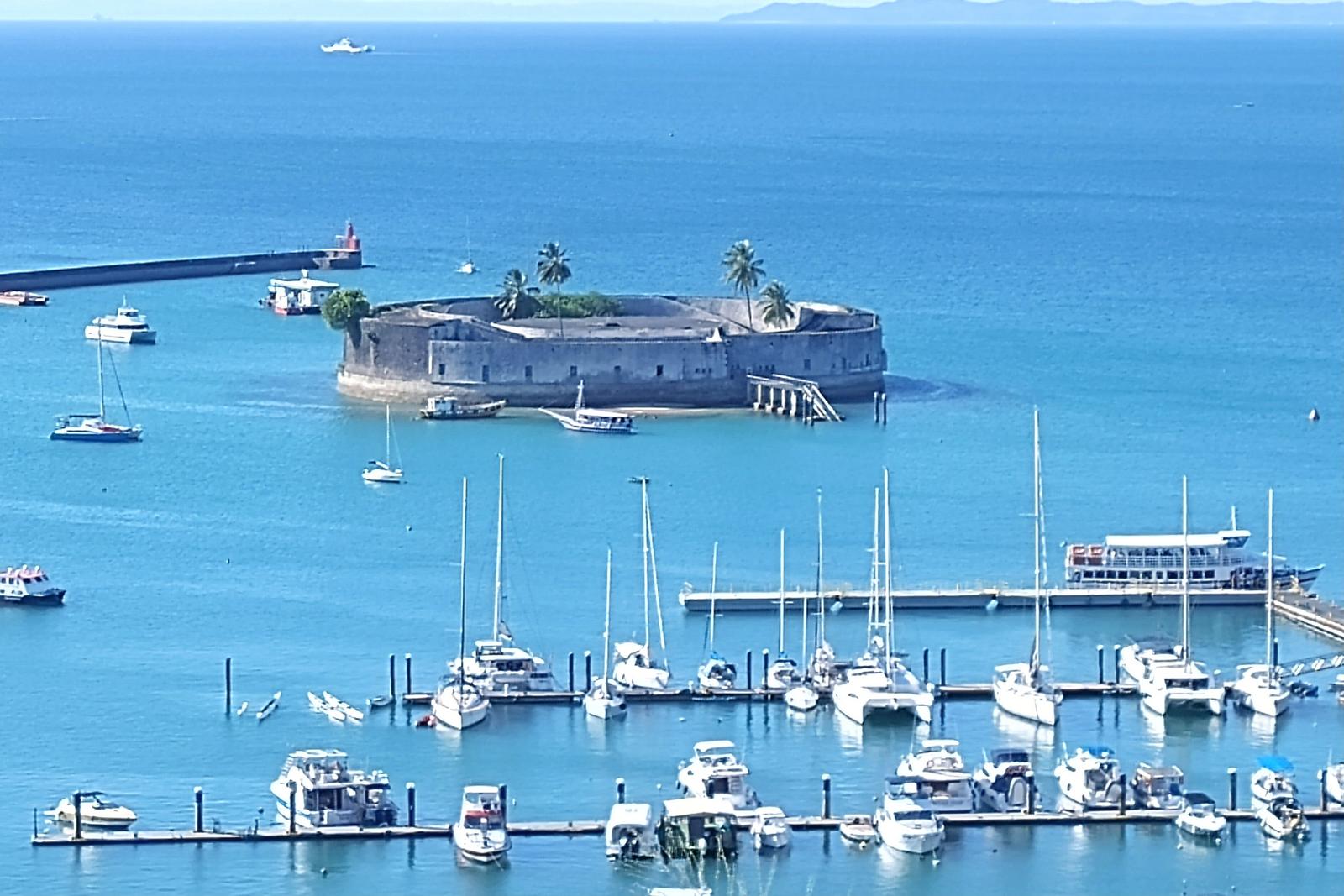
A calm harbour scene with a proud historic fort, let down by flat light and a busy foreground.
Salvador, Bahia, Brasil
Thanks Fred. You’ve clearly aimed to show the fort in its setting, anchoring it with the marina in the foreground — a classic travel/architecture approach. The turquoise water is inviting and the circular fort is an appealing subject with character. My comments below focus on making the fort read more decisively and turning a descriptive view into a photograph with presence. What story about São Marcelo did you want the viewer to feel first — the history of the fort, or the leisure vibe of the marina? Your answer to that question should drive framing, timing and light choice.
TECHNICAL EXECUTION ★★★
The exposure is safely handled; there’s usable detail on the fort’s stonework and no catastrophic clipping in the water highlights. Overall sharpness looks decent, though distant detail is a touch soft and there are hints of compression artefacts in the cyan water, suggesting a phone or heavy JPEG compression. Colour leans heavily into blue/cyan, which feels a little strong and masks subtle tones in the masonry and boats. There’s also a slight atmospheric haze over the horizon that flattens depth. With gentler colour grading and a bit more micro‑contrast on the fort, the file would hold together better. A polariser would also tame glare on the water without pushing saturation.
COMPOSITION ★★★
The fort is centred, which makes it clear but static, while the marina crowding the bottom third competes for attention. Many thin vertical masts and cut-off pontoons pull the eye from the main subject; the breakwater and red lighthouse on the left also “kiss” the fort, creating a merger that weakens its silhouette. There is good negative space of open sea above, yet the most interesting shape — the circular fort — would benefit from more separation and breathing room around its base. A tighter crop from the bottom to just above the first full row of boats simplifies the frame and strengthens the fort as the primary anchor. Alternatively, a longer lens or a slightly higher vantage to push the marina lower in frame could reduce clutter.
LIGHTING ★★
This looks like hard midday light: short, crisp shadows and a high sun giving the scene a flat, postcard feel. The fort’s texture is muted and the water reflections are a little harsh, so the eye skates across rather than landing on the subject. Early morning or late afternoon light would graze the stone, add shape to the walls and palms, and give you a gentler tonal roll-off on the water. Even light cloud can help by acting as a giant diffuser, revealing more detail without glare. Consider how the direction of light could create a shadowed arc on the fort to emphasise its round form.
STORY ★★
The image communicates “historic fort in a pleasant marina,” which is a clear sense of place but remains generic. There’s no decisive moment to hold the viewer — boats are static, and there are no people or weather cues to suggest time or activity. A passing tour boat docking at the fort, a fisherman casting from a dinghy, or even a gull flock cutting across the frame would give you a small but meaningful moment. Ask yourself: what single action would say “Salvador” here — history meeting everyday coastal life, or pure architectural solitude? Building a moment around that answer would lift the narrative.
IMPACT ★★
It’s a pleasant view, yet similar to many harbour snapshots and therefore easy to forget. The central placement, bright midday palette and busy foreground keep it in “record shot” territory rather than a striking photograph. With stronger light, a simplified foreground and a clear gesture (boat arriving, swimmer, dramatic cloud), this location could produce a memorable frame. Consider whether you want a bold, compressed portrait of the fort, or a wide scene where boats lead you towards it — committing to one vision will increase punch.
CONSTRUCTIVE NEXT STEPS
- Return at golden hour and position so the sun skims across the fort’s walls; aim for side‑light that reveals texture and separates the fort from the water.
- Simplify the frame: from this vantage, crop 15–20% off the bottom to lose the half‑boats and cluttered pontoons, or use a longer focal length to isolate the fort against open sea.
- Wait for a moment — a boat approaching the small pier on the fort, or a single sail aligned in the gap beside it — to provide a clear narrative hook.
- In post, cool down the cyan slightly and reduce overall saturation; add selective clarity/contrast to the fort only, and heal any stray posts or cut boat bits near the bottom edge.
AI Version 2.12