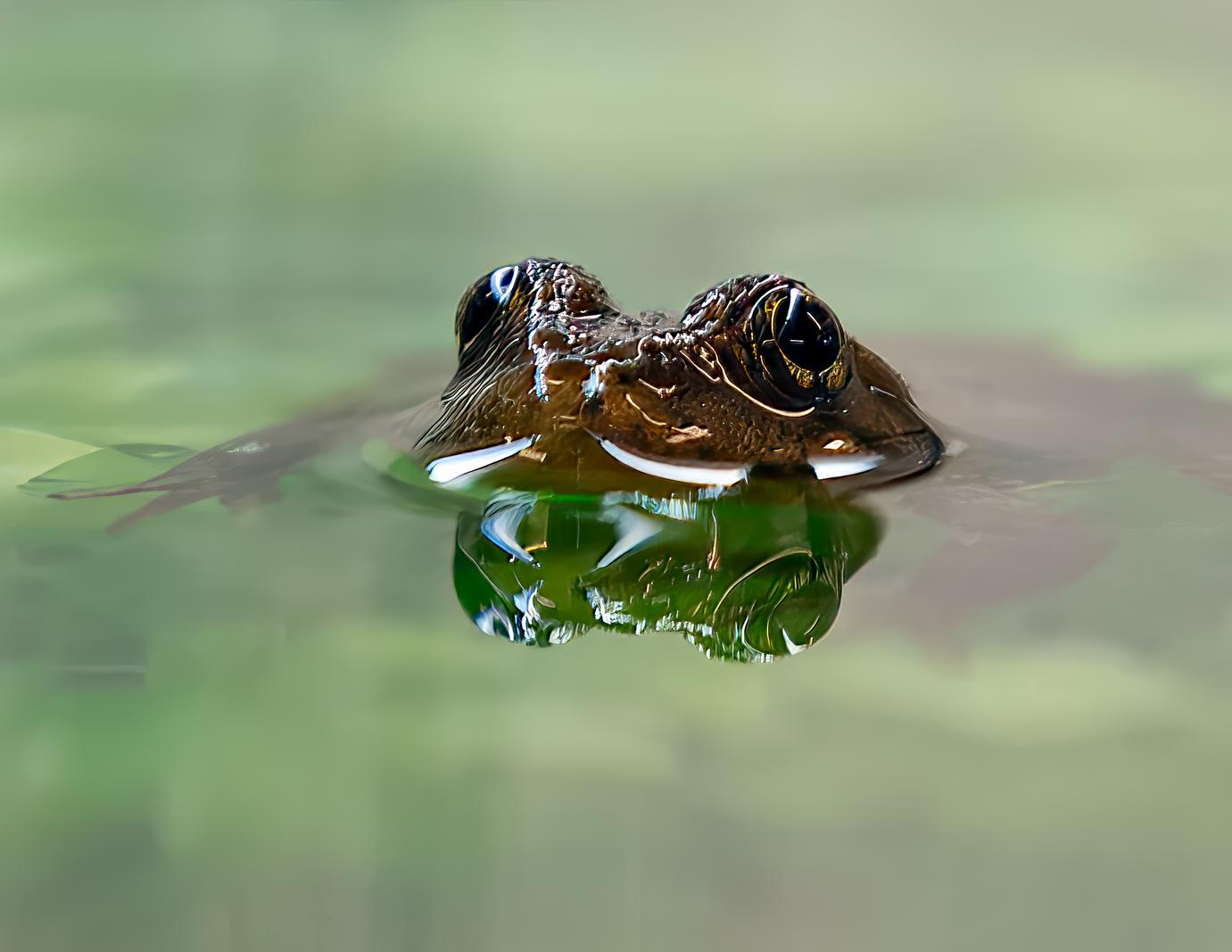
A quiet, watchful moment with a lovely mirror of the frog that nearly steals the show.
Is the reflection in the water too green or should I reduce the saturation of the natural reflection.
The green in the reflection reads natural for a vegetated pond, but it’s a touch stronger than the tones above the waterline and it competes with the frog’s face. I’d reduce saturation (or luminance) of the greens in the reflection slightly so the viewer’s eye lands on the eyes first, not on the bright emerald patch below—use a linear gradient from the bottom up and pull green saturation back around 10–20 points, or drop luminance by about 5–10. As a wildlife portrait this is clean and calm: you’ve nailed focus on the eyes and handled the waterline beautifully, with soft light and a tidy background. The mirrored shape adds a nice graphic hook. Did you consider a tighter, more vertical crop to lean harder into that reflection as a deliberate design choice?
TECHNICAL EXECUTION ★★★★
Focus looks crisply locked on the frog’s eyes and brow, which is the right priority at this distance. The exposure is steady with detail in the wet skin and no distracting noise in the smooth water. The specular highlights along the waterline are bright but controlled and contribute to the “just surfaced” feel. Processing appears restrained, though the saturation of the reflected greens runs a little hot compared to the muted tones above. Dialling back the local saturation in the reflection and adding a very light micro-contrast to the eye ridge would take this towards publication quality.
COMPOSITION ★★★★
The centred placement works because the subject is small in frame and echoed by the reflection, giving a tidy symmetry. The big wash of negative space keeps the scene calm and uncluttered. The faint shape on the left side of the water is the only minor distraction; a tighter crop from the left (and a little from the right) would simplify the edges. A portrait or square crop with the eyes on the upper third could emphasise the tension between frog and reflection even more. How might shifting to a slightly lower viewpoint have aligned the reflection with the head more perfectly and strengthened that symmetry?
LIGHTING ★★★★
Soft, diffuse light suits the damp skin textures and avoids harsh glare. Catchlights bring life to the eyes, and the subdued background keeps attention on the animal. The reflection picks up more saturated green than the scene above, likely from submerged vegetation; tonally it is a touch dominant compared to the subtler hues on top. A gentle dodge on the eyes and a small burn on the brightest water highlights would add shape without breaking the natural feel. For a five-star rating I’d want the light to carve just a bit more dimension into the head or create a more deliberate glow on the eyes.
STORY ★★★
The frame captures a clear, readable moment: a frog surfacing and assessing its surroundings. The stillness in the water and the careful eyes suggest alertness, which carries a quiet narrative. It remains a portrait rather than behaviour—no prey, call, leap or interaction—so the story is modest. Waiting for a ripple, breath bubble, or tongue flick would add that extra beat of life. What behaviour were you hoping for, and how long did you give this individual before moving on?
IMPACT ★★★★
The simplicity, smooth tones and strong mirror shape make this memorable among frog portraits. It holds attention without gimmicks, and the clean field craft shows. The slightly assertive green reflection pulls focus downward and softens the punch; tame that and the eyes will command the frame. A tighter crop and a tad more intent in the light around the face would push this to a portfolio highlight. Overall, a refined and respectful wildlife study.
CONSTRUCTIVE NEXT STEPS
✓ Locally reduce green saturation or luminance in the reflection (bottom linear gradient; Green/Yellow -10 to -20 Sat or -5 to -10 Lum) so the frog’s eyes remain the brightest, most colourful element.
✓ Add a subtle radial mask over the eyes/brow: +0.15 EV, +5–10 texture/clarity, and a touch of extra sharpening to strengthen the visual anchor.
✓ Crop in from the left and consider a square or 4:5 vertical with the eyes near the top third; clone or heal any small bright flecks near the snout and left edge.
✓ Field approach: wait for a small behaviour cue (bubble, blink, ripple); use 1/500–1/1000s to freeze micro‑movement at the waterline while keeping ISO low for clean tonal water.
AI Version 2.1