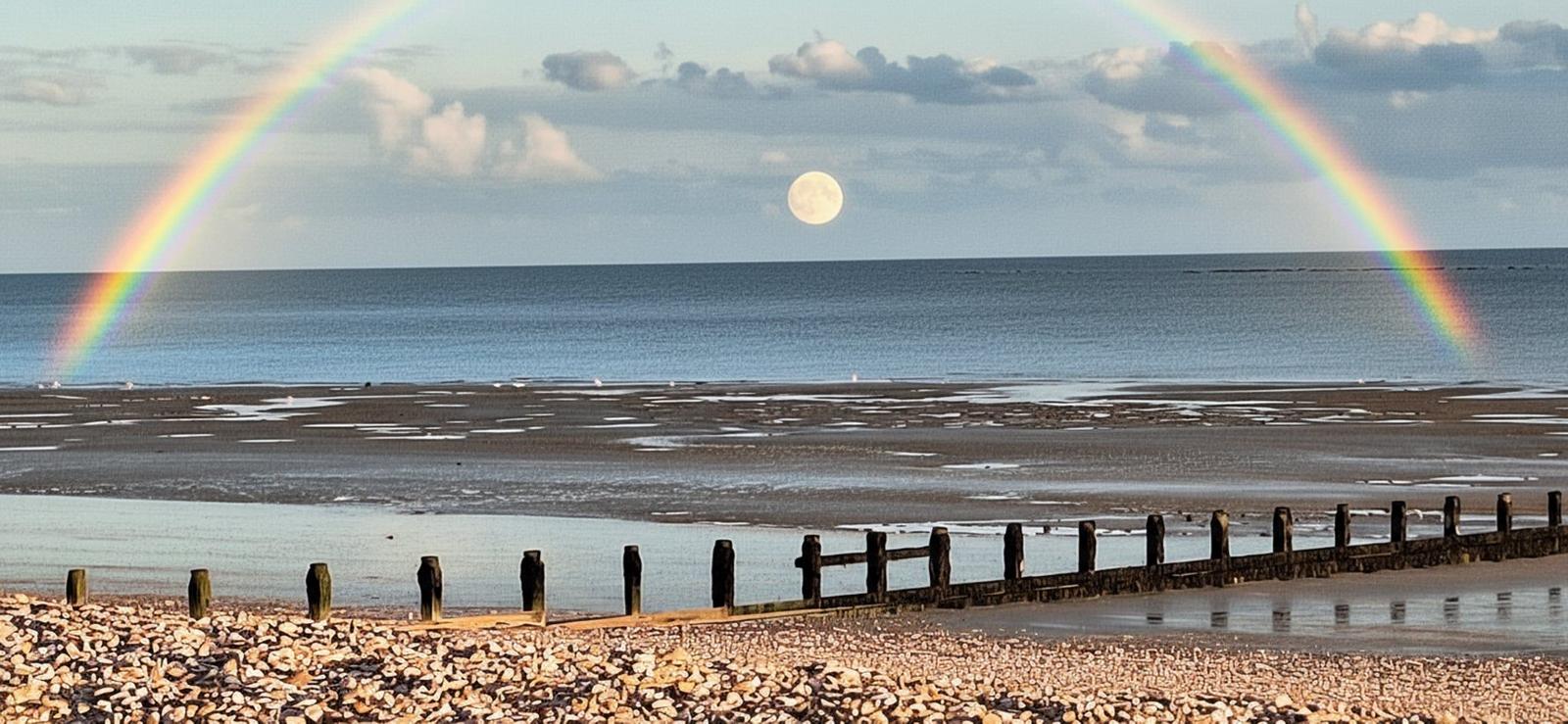
A rare weather alignment beautifully caught — moon framed by two rainbow ends over a calm shore.
Thanks for sharing this, Graham. You’ve clearly gone after the “wow” moment: moonrise and rainbows in one seascape. As a landscape, the scene is serene and unusual; the wooden breakwater gives the coast character while the rainbow ends act like bookends around the moon. Were you consciously centring the moon between the two rainbow feet, or did you react to a fleeting moment? I’m curious, too — did you use a polariser? (They can weaken rainbows depending on angle.)
TECHNICAL EXECUTION ★★★★
Exposure is well judged: the moon retains shape, the sea holds texture, and the highlights on the rainbow aren’t clipped. Detail across the frame is good, suggesting a mid‑range aperture and steady hand or tripod. Colours are on the punchy side, especially in the rainbow bands and warm pebbles; tasteful, but edging towards saturation that can feel digital. I can spot a few tiny bright specks on the distant waterline that read as distractions rather than detail. To reach five stars, rein in vibrance slightly and clean the small bright artefacts so nothing pulls the eye from the central alignment.
COMPOSITION ★★★
The central placement of the moon between the rainbow ends is a strong idea, but the frame feels static with the horizon almost mid‑height. The pebble strip occupies a large chunk of the bottom without adding much story, while the breakwater leads diagonally to the right and exits the frame before connecting with the main event. The rainbow tops are cropped, so we lose the satisfying arc; as presented, they feel like two separate streaks rather than a single phenomenon framing the moon. A lower viewpoint to emphasise the breakwater as a lead-in or a wider lens to include the full arc would add energy and cohesion. How might the picture change if the horizon sat on the upper third and the posts aimed directly at the moon?
LIGHTING ★★★★
Soft, low sun gives gentle colour and keeps contrast manageable across sea and sky. The moon’s glow sits naturally within that softness, and the wet sand plates reflect just enough to add texture. The light is even, which suits the calm mood, though the sky reads a touch flat toward the top of frame. A subtle darkening of the upper sky would deepen the atmosphere and put more emphasis on the moon. With a touch more depth and direction, this would be stellar.
STORY ★★★
The story is the meteorological coincidence — rain and sun producing rainbows while a full moon rises. It’s a strong “I was there for a rare moment,” but it stops short of a deeper narrative. The breakwater hints at human presence, yet there’s no scale or interaction to elevate the scene beyond the weather spectacle. A figure on the posts or a bird flock crossing the moon would add a layer of tension or timing. As is, it’s an attractive record rather than a moment that lingers.
IMPACT ★★★★
The double rainbow framing a full moon is undeniably eye‑catching and will make viewers pause. The calm palette and clean horizon help it read quickly. Composition and saturation keep it just shy of unforgettable; the cropped arcs and heavy foreground dilute the punch. Solve those and you’d have a print‑worthy keeper. What do you want the viewer to notice first — the moon, the rainbows, or the geometry of the posts? That decision should drive the framing.
CONSTRUCTIVE NEXT STEPS
✓ Commit to a bolder frame: either go wider (around 20–24mm) to capture the full rainbow arc around the moon, or go longer (85–135mm) to compress and emphasise the moon with a single, strong rainbow end; reposition so the breakwater points at the moon.
✓ Reduce the dead foreground: either crop 10–15% off the bottom to tighten the scene, or get low and close to the posts so they become a purposeful lead‑in; place the horizon on the upper third to prioritise the sky event.
✓ Post‑processing: pull global vibrance back by ~10–15; add a soft linear gradient to darken the upper sky by 0.3–0.5 stops; lightly dodge the moon (5–10% exposure) for presence; heal the small bright flecks near the horizon.
✓ Field craft: avoid a polariser when shooting rainbows (it can erase them); use ISO 100, f/8–f/11, and keep shutter at 1/60s or faster to keep the moon crisp if you’re longer than 50mm; tripod if the wind’s up.
AI Version 2.0