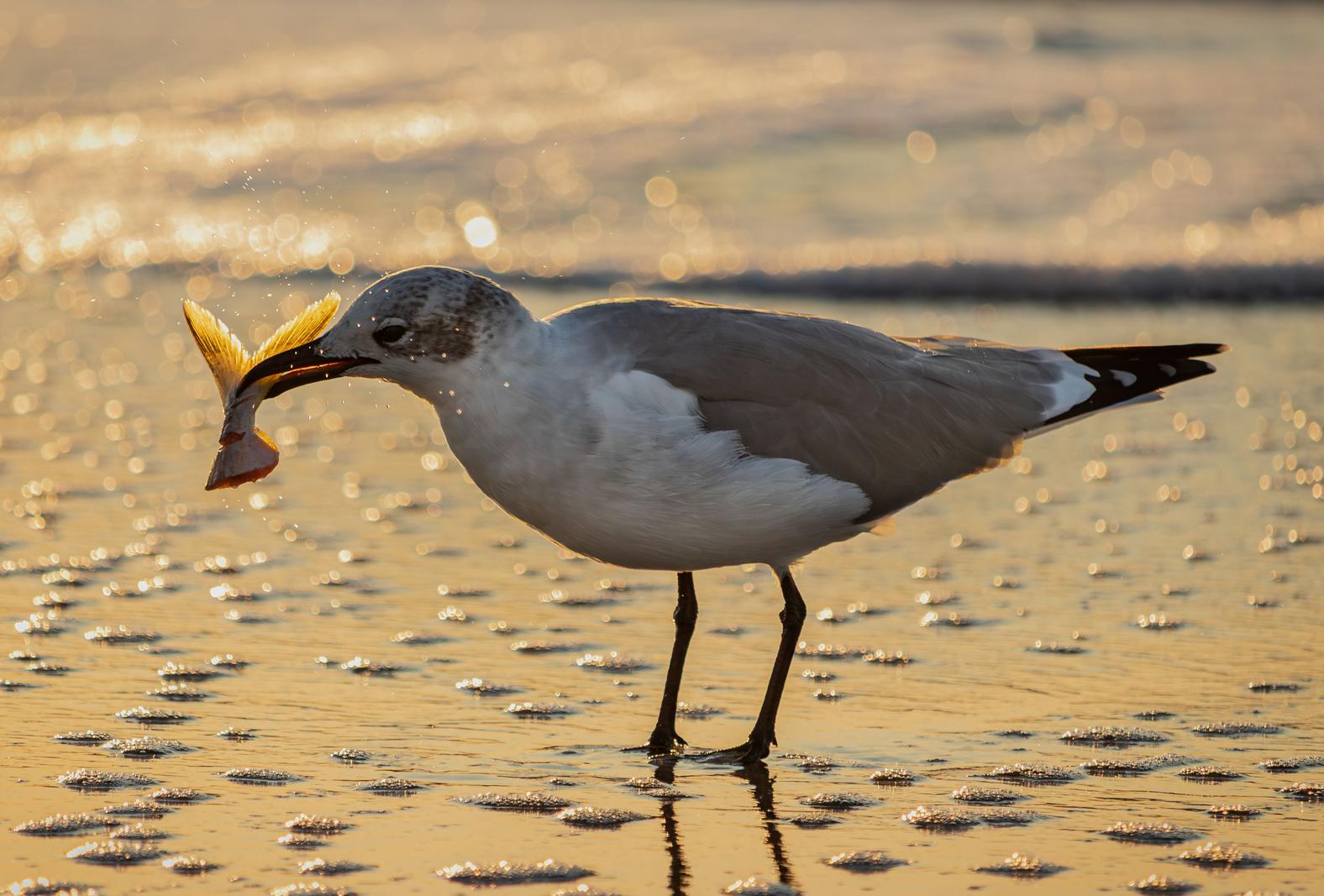
Golden backlight, a decisive gulp, and a frame that’s almost there.
Thanks for sharing this, Gordon. You’ve captured a clean wildlife behaviour moment: a gull with its catch, backlit at the waterline with droplets hanging in the air. The strengths are clear — timing, warm colour, and a tidy background. To improve it, think about space for the action to “breathe”, eye detail, and how your shooting height affects separation. A small shift in position and timing would lift this from a very good record to a standout frame. As you review it yourself, what did you prioritise in the moment — the backlight on the spray or the bird’s eye detail — and how might that choice change your next attempt?
TECHNICAL EXECUTION ★★★★
The file looks clean and well-exposed considering the strong backlight; the whites on the breast are controlled and the golden tones feel natural, not overcooked. Shutter speed was high enough to freeze the droplets nicely, and there’s decent feather detail along the flank. Where it falls short of top marks is the slight lack of bite around the eye and bill — the critical point in wildlife work — which sits a touch dark. A tiny bump in ISO with a faster shutter, or a fraction more light on the face, would secure tack-sharp eye detail. Processing is restrained; I see no distracting halos or heavy-handed sharpening. With a subtle dodge to the eye and bill you could add just enough snap without breaking the natural look.
COMPOSITION ★★★
The side-on pose reads clearly, and the elegant line of the shoreline makes a soft horizon. However, the beak and fish are crowded near the left edge, giving the action little room to travel into; the bird is looking out of the frame rather than into it. The rear of the bird is also close to the right border, creating a slightly boxed-in feeling from both sides. A looser crop with more space ahead of the beak, or shifting your framing to the right in-camera, would let the story breathe. A lower viewpoint would increase separation between the head and background bokeh, reducing the visual merger of the neck with the distant surf. Do you remember how much room you had to step or kneel — could you have got your lens a few centimetres lower without risking a wave?
LIGHTING ★★★★
The backlight is lovely — it rims the feathers, ignites the fish tail, and turns the water into a field of soft sparkles. It’s a strong choice that adds drama and a sense of late-day calm. The trade-off is the eye going a bit dull in shadow; a small head turn towards the sun or a slightly oblique angle would produce a clean catchlight and better facial shape. Consider tracking the bird until it gives you that micro-gesture where the eye catches the light for a moment. The overall warmth is believable and suits the scene. With that catchlight and a touch more modelling on the face, this would be top tier.
STORY ★★★★
This isn’t just a bird standing — it’s mid-meal, with droplets suspended and the fish tail gleaming, which gives the frame purpose. The timing communicates behaviour clearly and honestly. It could be pushed further by capturing the instant of swallow or a more dynamic struggle, but what you have already conveys a clear narrative. The low tide setting and wet sand complete the context without clutter. A different moment — wing lift, head toss, or a competing gull entering frame — would add an extra layer of tension and move this towards five stars.
IMPACT ★★★★
The combination of clean action, warm colour, and backlit spray makes this immediately appealing. It’s a cut above a standard gull shot because of the behaviour and the sparkle. The cramped framing holds it back from being unforgettable; the viewer feels the squeeze at both edges. Open the frame and add a brighter eye and this would have strong portfolio presence. As it stands, it’s memorable and publishable, just shy of iconic.
CONSTRUCTIVE NEXT STEPS
✓ Give the subject room to move into: when the bird faces left, shift your frame right so there’s at least 20–30% more space ahead of the beak; avoid placing the action within a centimetre of the edge.
✓ Go lower by a few inches to separate the head from the dark band of surf and to strengthen the silhouette; kneel or angle the camera downward while keeping the horizon high.
✓ Aim for an eye sparkle: track until the bird turns slightly towards the sun; use continuous AF and a faster shutter (around 1/2000s) with a small ISO bump to nail sharp droplets and a crisp eye.
✓ In post, lightly lift shadows on the head and bill, add a subtle dodge to the eye for catchlight, and clone a few of the brightest bokeh spots near the beak that compete with the fish tail.
AI Version 2.0