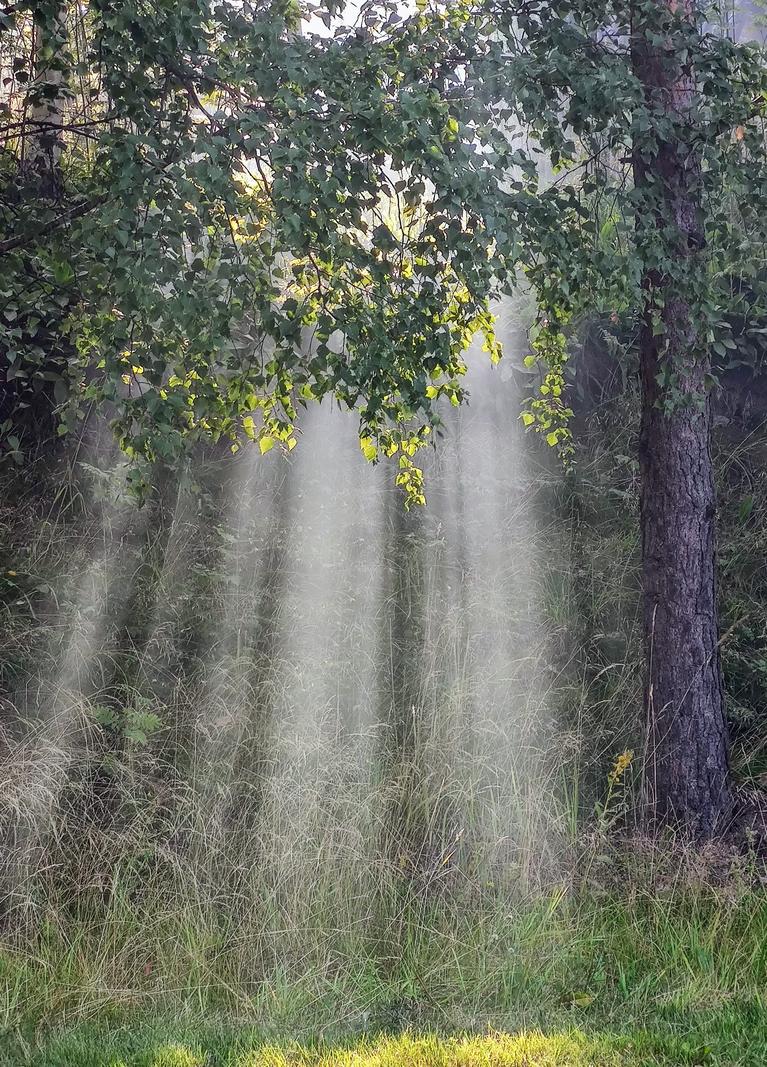
Beautiful shafts of forest light with a clear opportunity to simplify and strengthen the frame.
Yes, you can. You’ve caught a classic woodland moment: mist catching sunlight into clean rays behind drooping leaves and a dark trunk. This sits in the landscape/nature space. The light itself is lovely; the frame is where you can push it further. Right now the heavy canopy and the trunk tight to the right edge compete with the rays, and the bright strip of grass at the bottom pulls the eye. Ask yourself: did you want the trunk to be a strong anchor, or should the picture be purely about the beams of light? Deciding that will guide both framing and processing.
TECHNICAL EXECUTION ★★★★
Exposure is well controlled; the shafts hold detail without obvious clipping, and colour feels natural, not pushed. Sharpness is good for a handheld woodland shot, though some leaves show slight movement blur which is expected at slower speeds. There’s no noticeable noise or heavy processing, which keeps the scene believable. To reach five stars, add a touch more local contrast in the beams and keep small hotspots on the leaves under control so the light remains the clear hero.
COMPOSITION ★★★
The central rays are strong, but the trunk is glued to the right border and reads as an afterthought rather than a deliberate anchor. The dense foliage pressing down from the top and the bright lawn strip at the bottom create competing edges that drain attention from the shafts. A cleaner frame—either committing to the trunk as a strong frame element with more space, or excluding it entirely—would focus the story. Small distractions like the yellow flower at bottom right also catch the eye. A tighter, more intentional crop or a small step in camera would elevate this substantially.
LIGHTING ★★★★
The misty sunbeams are the best part—soft, directional and atmospheric. However, several bright leaf clusters at the top-left and mid-right are as bright as the rays and steal attention. The lower grass sits a bit flat compared with the crisp shafts above. Waiting for slightly thicker mist or the sun a touch lower would make the beams denser and the background darker, adding separation. With subtle dodging and burning you could balance this nicely.
STORY ★★★
The image conveys a quiet morning in the woods, but it’s more a study of light than a moment with a narrative hook. A clear anchor—either the tree as a sentinel, or a small subject caught in the beams—would add purpose. As it stands, the viewer admires the rays but doesn’t linger to find a next beat. What feeling did you want the tree to carry: guarding the light, or simply revealing it?
IMPACT ★★★
It’s pleasant and calming, but similar to many woodland ray images. The competing edges and lack of a decisive anchor keep it from landing hard. A simplified frame and stronger emphasis on the shafts would give it more presence. Push towards an image where the eye hits the beams and stays there.
CONSTRUCTIVE NEXT STEPS
✓ Reframe decisively: step 1–2 metres left or right so the trunk is either fully included as a strong vertical about one‑third in, or excluded entirely. Avoid letting it kiss the edge.
✓ Crop and clean: trim the bottom 5–10% to remove the bright lawn and clone out the small yellow flower; lightly burn the bright canopy patches so the beams remain the brightest element.
✓ Targeted local edits: with a brush apply +10–15 Dehaze/+10 Clarity to the shafts only, and −0.3 to −0.5 stops on surrounding foliage to nudge attention inward.
✓ On location settings: when leaves are moving, keep shutter around 1/250s, f/5.6–8, ISO as needed; a short tele (70–120mm) lets you compress and simplify the scene without including clutter overhead.
AI Version 2.0