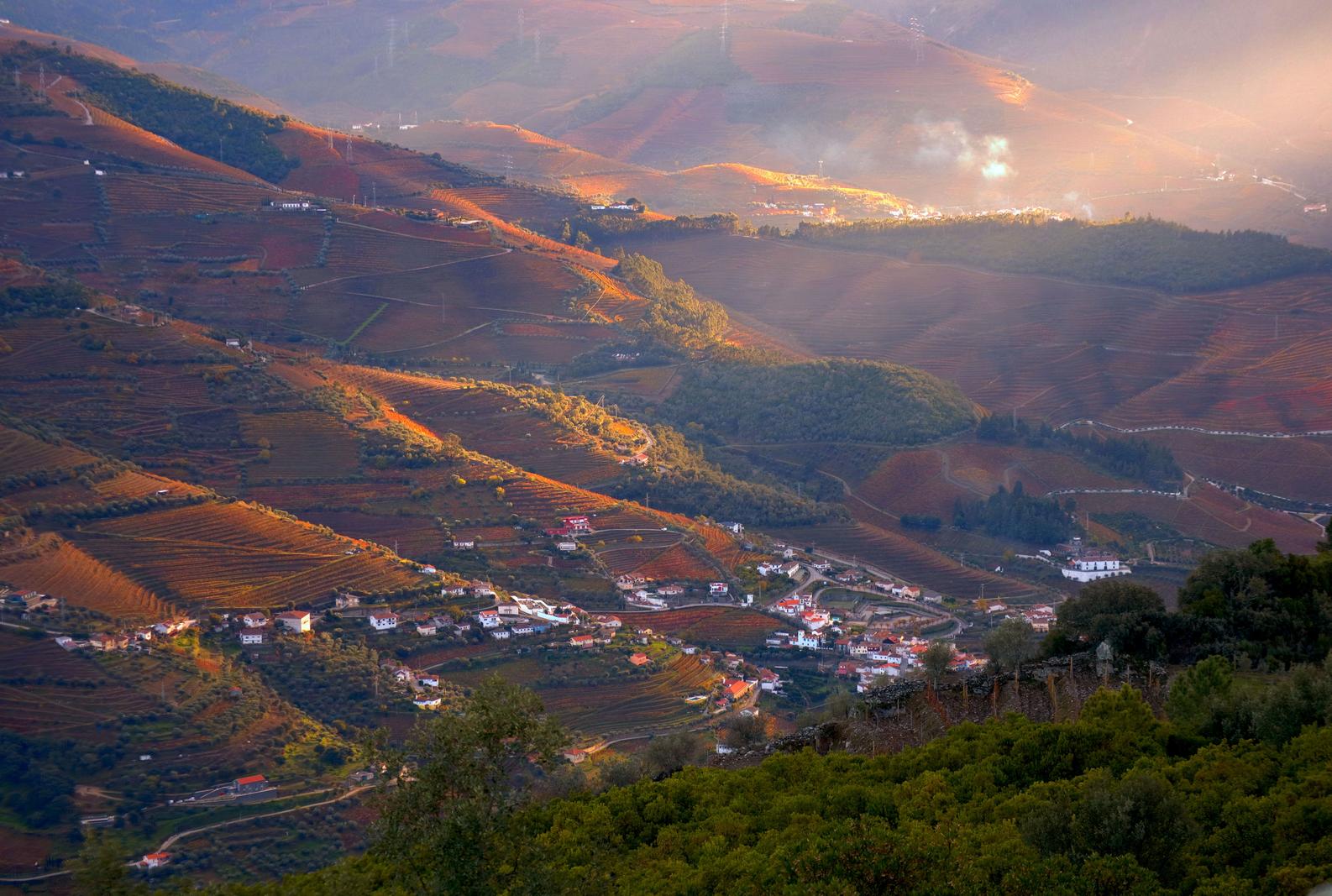
Golden light skims across terraced hills, but the frame feels undecided about what it wants to celebrate.
On focal length: this looks like a moderate telephoto view — roughly 120–200mm on full frame (around 80–130mm on APS‑C). The clues are the compressed layers of hills, the relatively flat sense of depth, and how the village houses appear small yet tightly packed. That choice works well for isolating the patchwork of vineyards and the shaft of warm light with smoke at the top-right; it turns the valley into patterns and tone. If your intent was a sweeping sense of place and depth, a wider lens (24–35mm) with a strong foreground element would help. If your intent was to simplify and make the light and smoke the hero, going longer still (200–300mm) to exclude the duller areas would strengthen the image. As a travel/landscape photograph, it’s caught at a good time of day — the angled light gives shape — but the frame could be more decisive. What did you want the viewer to notice first: the sunlit ridges or the village with smoke?
TECHNICAL EXECUTION ★★★★
The file looks clean and naturally processed: colours are restrained, detail across the terraces holds up, and there’s no obvious HDR or haloing. The distant haze is believable for this kind of scene, though a touch of local contrast in the mid-distance could lift clarity. Sharpness appears good for a telephoto landscape shot from a distance; no worrying motion blur. The dynamic range is handled well — highlights in the lit ridges are bright without blowing out, and shadows still retain structure. Minor issue: the faint power lines and pylons reveal themselves at larger sizes; they’re small but they do add clutter. To reach five stars, I’d want crisper micro-contrast in the mid-ground and either cleaner removal or better management of small artefacts like pylons.
COMPOSITION ★★★
The diagonal ridges guide the eye nicely, and the sunlit bands create rhythm, but the frame lacks a single, deliberate anchor. The brightest element — the smoke and light at the top-right — sits near the edge, pulling the eye out of the picture before it has explored the valley. The heavy green scrub at the bottom adds little and slightly muddies the base of the image; it doesn’t function as a purposeful foreground. Telephoto compression flattens the scene, so without a strong subject the viewer wanders between fields and rooftops. A tighter crop around the lit ridgeline and village would simplify, or a wider approach with a committed foreground would deepen the sense of place. Ask yourself: which story is stronger here — the patterned vineyards or the human presence of the village — and compose to let one lead clearly.
LIGHTING ★★★★
The timing is good. Low, raking sunlight sculpts the terraces and reveals the topography with gentle contrast. The patch of light breaking through on the upper slopes adds atmosphere and a hint of weather. Some parts of the mid-ground fall into flatter light, which softens the drama; it’s pleasing but not transformational. With slightly stronger separation — for instance, waiting for the light to travel further down the valley or catching a clearer beam — this could move into five-star territory. The colour temperature feels natural and not over-warmed, which suits the earthy tones of the vineyards.
STORY ★★★
The image communicates a working landscape — terraces, scattered houses, winding roads — and the smoke suggests life in the valley. It gives a sense of geography and season. However, the narrative is descriptive rather than moment-driven; there’s no focal action or element to hold an emotional thread. A clearer commitment to either the village (human presence) or the abstract patterns of agriculture would sharpen the message. Consider how including a more active detail — a vehicle on the road, a stronger plume of smoke, or a harvest crew — might add that missing moment.
IMPACT ★★★
It’s a pleasant, competent view with attractive light and colour. The telephoto treatment gives order to the hills, but the lack of a decisive anchor keeps it from being memorable. Many images of terraced valleys exist; to stand out, this frame needs either a bolder crop that makes the light the hero, or a wider, more immersive story with foreground and scale. Clean execution helps, but the picture doesn’t yet deliver a strong “stop and stare” moment. Refined framing or a more singular subject would lift the overall punch.
CONSTRUCTIVE NEXT STEPS
- Commit with focal length: if patterns and light are your priority, use 200–300mm and frame tightly around the lit ridge and smoke; if sense of place is the goal, switch to 24–35mm, step to a vantage with a strong foreground terrace or wall, and build depth through layers.
- Crop and clean: trim 5–10% from the bottom to remove the dull green scrub; consider a subtle right-side crop to keep the bright smoke inside the frame; clone the most obvious pylons and lines if this is for a fine‑art/travel presentation.
- Guide the eye in post: gentle dodging along the sunlit ridges and a mild burn in the darker, less interesting slopes will create a clear pathway; add a small local dehaze/contrast boost to the mid-ground to counter haze without overdoing global clarity.
- Use a circular polariser at a similar time of day to cut atmospheric haze and enrich the vineyard tones, but rotate carefully to avoid uneven skies if any are included.
AI Version 2.12