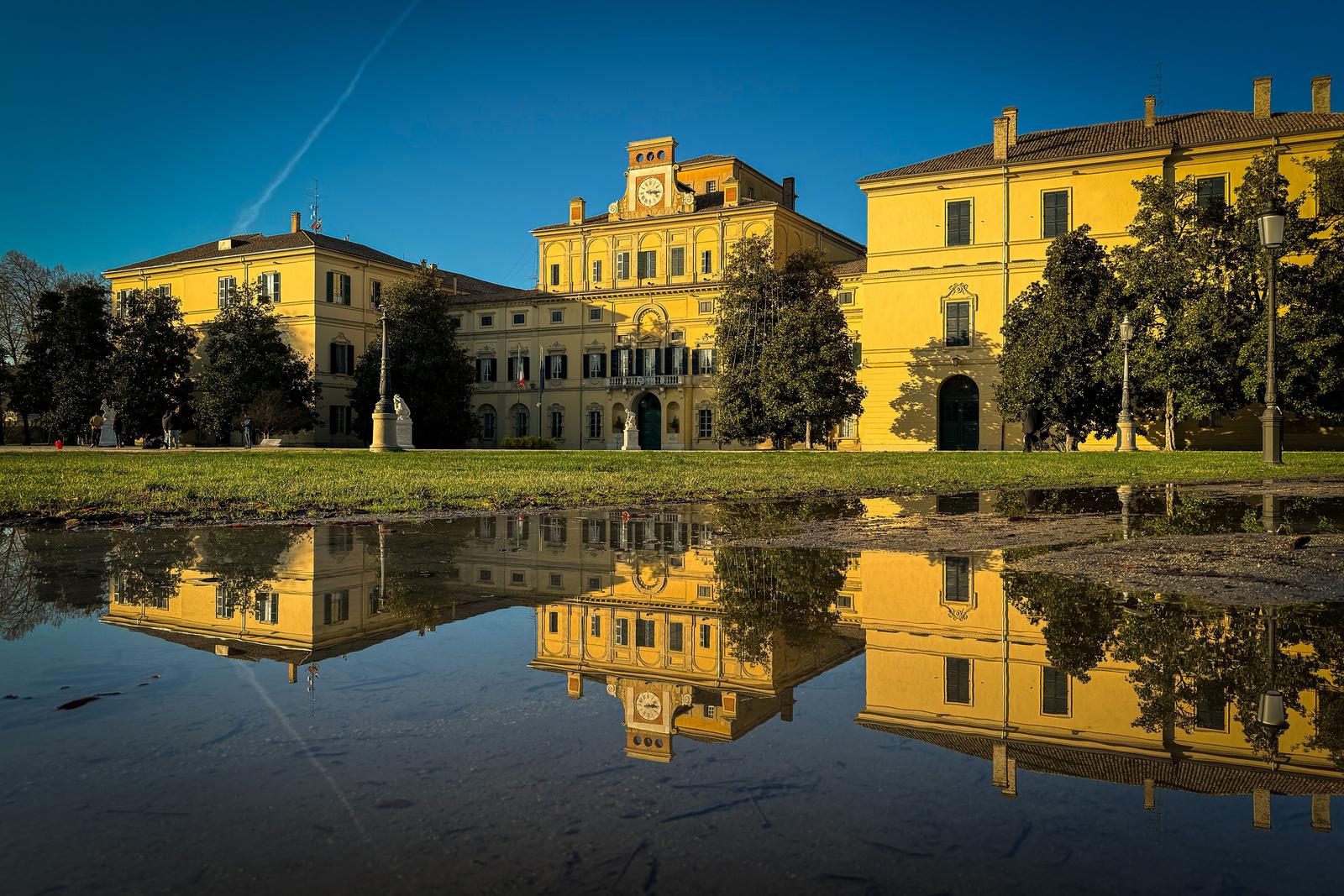
A calm, golden facade doubled by a puddle makes a classic, pleasing reflection study.
Thanks for asking directly, Alessandra. This sits between travel and architectural work, with the palace and its reflection as the clear subject. You’ve chosen a clean, symmetrical view and timed it for warm light, which already does a lot of heavy lifting. To improve, think about committing even more to symmetry and simplifying the frame: a lower camera height to enlarge the reflection, cleaner edges, and tidying small distractions in post would elevate it. One question to consider: what do you want the viewer to notice first—the clock tower, the mirror image, or the sweep of the building—and how can your framing make that priority unmistakable?
TECHNICAL EXECUTION ★★★★
Exposure and colour are well controlled; the building’s yellow is warm without tipping into cartoonish saturation, and detail holds across the facade. The image looks sharp front to back, suggesting a tripod or steady hand and a sensible aperture (around f/8–f/11 would be ideal here). Verticals are mostly true, with only a hint of perspective stress toward the edges—good work. Minor distractions are present: the jet trail in the sky and small debris in the water slightly reduce polish. Clean those and you’re flirting with publication-grade technical quality. For five stars I’d want perfectly corrected verticals, spotless skies/water, and absolutely even micro‑contrast across the frame.
COMPOSITION ★★★★
The centred approach suits the building’s symmetry and the reflection. The puddle provides a strong anchor, but from this height the muddy strip of grass bisecting the frame feels a touch thick and the reflection is slightly underplayed. The right‑edge lamppost and scattered small figures on the left nibble at attention; they’re not fatal, but they dilute the clean geometry you’re building. A lower viewpoint—crouching or placing the camera just above ground—would enlarge the mirror and simplify the bottom third. Consider also tightening the sides to avoid the partial lamppost on the right and to keep the clock tower exactly on centre. With those refinements, the eye would flow straight to the clock and its twin.
LIGHTING ★★★★
The warm, low sun flatters the yellow stucco and gives gentle shadow relief around windows and trees. It’s a good choice for texture and mood without harsh contrast. The sky is a deep, clean blue, which helps the facade pop. The light isn’t yet transformative—shadows are short and the scene remains fairly even, which is safe but not dramatic. Returning a little earlier or later for longer shadows, or at blue hour with the building lights on and a glassy puddle, could add an extra layer of depth. That shift in timing would push the light from “pleasant” to “sculptural.”
STORY ★★★
We understand the place and the recent rain; the few people give scale without a clear moment. As it stands, it’s more a refined record of the palace than a frame with tension or a decisive instant. One strong human element—a person walking across the reflection, a cyclist, or a dog framed cleanly in the grass—could give the picture a heartbeat and a sense of time. Alternatively, excluding people entirely and leaning into pure, pristine symmetry would tell a different, disciplined story. Which direction better matches how you experienced the scene?
IMPACT ★★★
The reflection offers an immediate hook and the colour palette is attractive, so the image lands as pleasant and competent. However, reflection‑of‑a‑building is a well‑trodden idea; small distractions and a slightly high viewpoint keep it from feeling distinctive. With cleaner edges, a bigger mirror, and either a single purposeful human gesture or a stripped‑back, museum‑clean frame, the photo would hit harder. Aim for one bold idea—grand symmetry or a clear moment—and let everything else serve it.
CONSTRUCTIVE NEXT STEPS
- Drop the camera to just above ground level and move closer to the puddle so the reflection fills the bottom third; enable a grid and centre the clock and its reflection precisely.
- Clean the frame in post: clone the jet trail in the sky, remove small water debris, and, if within your ethics, the partial lamppost on the right edge.
- Either wait for a single, well‑placed passer‑by crossing the grass/reflection for scale, or wait until the space is empty and commit to a pure, people‑free symmetrical study.
- Avoid or rotate a circular polariser so it doesn’t kill the reflection; shoot around f/8–f/11, ISO 100, on a tripod if possible, and correct verticals using Transform/Guided Upright for a clean architectural finish.
AI Version 2.12