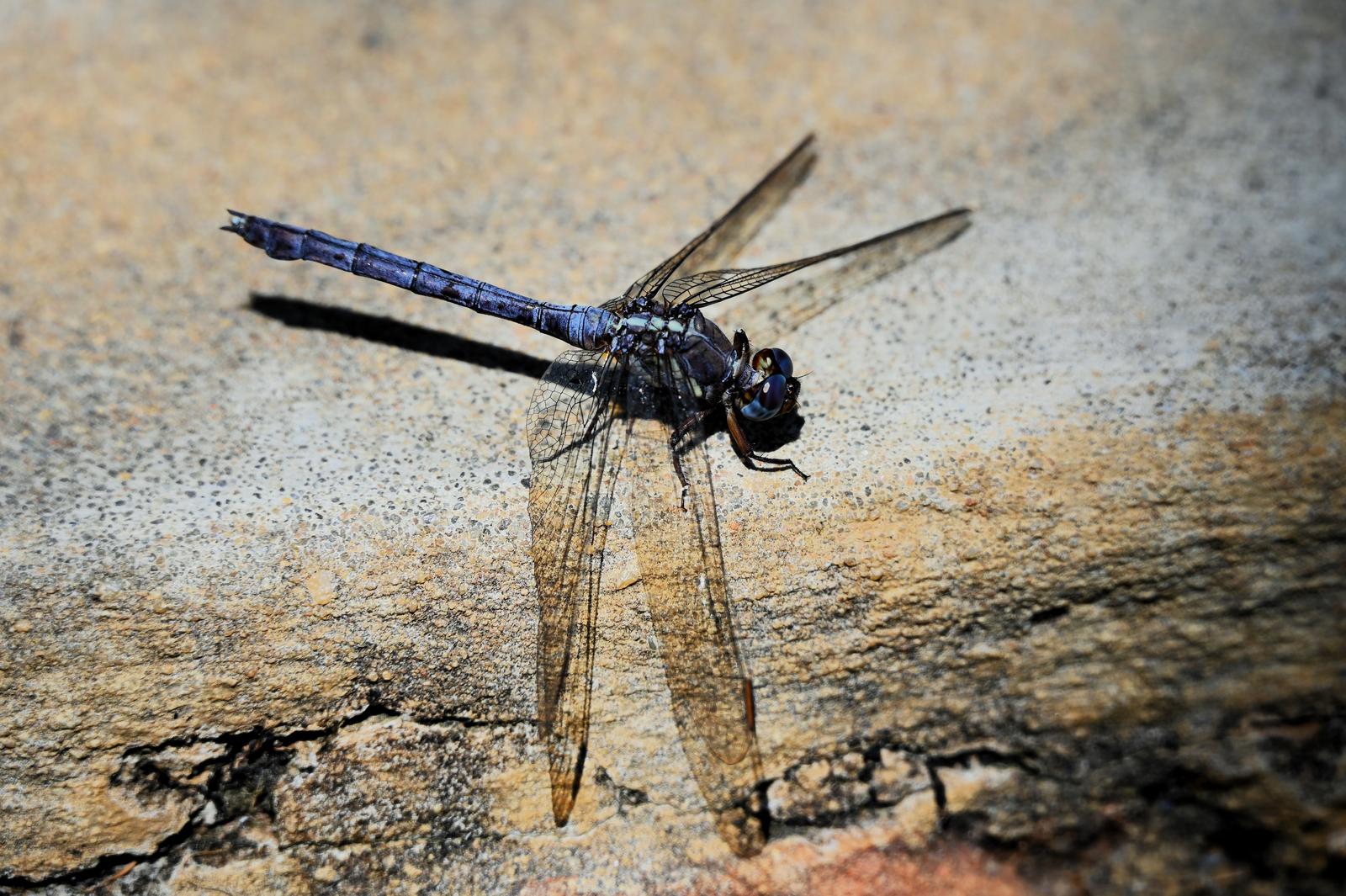
A gritty, sun‑baked study of a dragonfly that leans into harshness.
You’ve definitely pushed the frame toward that bleak, end‑of‑days mood—the desiccated rock, the hard shadow and the dragonfly’s sideways posture all play into it. This sits between wildlife and macro: a close natural‑history detail rather than a pure portrait. The strongest element is the diagonal body cutting across the stone, with those fragile wings echoed by the long, knife‑edged shadow. Where it falls short is control: the light is punishing, and the composition leaves a lot of empty, bright space to the right that dilutes the tension. Did you choose the hard sun because of the “apocalyptic” idea, or was it simply the light available?
TECHNICAL EXECUTION ★★★★
Focus lands well on the thorax and nearer wing, giving crisp venation and decent detail; the eye area looks a touch soft, likely from the razor‑thin depth of field at close range. Exposure is handled without clipping, though contrast is high due to the sun. I don’t see obvious noise or artefacts, and colour feels natural and restrained. For a macro subject, a little more depth across the head and forelegs would help the detail hold up at larger sizes. A smaller aperture (around f/8–f/11 at this magnification) with a commensurately higher ISO or steadier support would push this toward publication‑ready clarity.
COMPOSITION ★★★
The diagonal placement of the body works and the shadow is an effective secondary shape. However, the tail is crowded near the left edge while a broad, bright slab of rock on the right adds little and pulls the eye away from the head. The overhead angle flattens the insect into the texture of the stone, reducing separation and making the image feel more like a record than a deliberate design. Cropping tighter from the right and slightly from the top would concentrate attention on the head–thorax–shadow triangle. How might a lower, more side‑on viewpoint have changed the relationship between the insect and its shadow?
LIGHTING ★★
Midday sun is doing heavy lifting for your “apocalyptic” idea, but it’s also beating up the subject. The hard contrast crushes detail in the head and throws a dense shadow that merges with the wings, making the form harder to read. Specular sheen on the rock competes with the insect. A small diffuser or open shade would retain mood while revealing texture in the eyes and wings. Alternatively, if you want to keep the brutality, angle the light to rim‑light the wings and underexpose slightly so the harshness feels intentional rather than accidental.
STORY ★★★
There’s a faint narrative of fragility and aftermath—the sideways posture and cracked stone suggest a tough environment. Still, it reads more like a found specimen than a moment of behaviour. A gesture—wings raised, head turning, or interaction with the environment—would lift the frame beyond description. If the insect was static, you had time to build a clearer concept through angle, framing and light. What specific emotion did you want a viewer to feel—bleakness, resilience, or loss—and how could the pose and light reinforce that more clearly?
IMPACT ★★★
The gritty texture and stark shadow give the image presence on first glance. However, the heavy light and loose framing blunt the punch, so it doesn’t fully lodge in the memory. With stronger control of edge space and a more intentional use of light—either softened for detail or pushed for silhouette—the concept would land harder. Tightening focus on the eye and emphasising the wing structure would also increase the “wow” factor.
CONSTRUCTIVE NEXT STEPS
- Soften the light with a small diffuser or shoot in open shade; then add a white card just out of frame to lift the eye and head. If keeping the harsh look, underexpose by about 2/3 stop and angle for rim‑light on the wings.
- Increase depth of field: try f/8–f/11, focus on the nearer eye, and if the subject is still, consider a short 3–5 frame focus stack to keep head and thorax crisp.
- Refine the frame: give the tail breathing room on the left and crop roughly 20–25% from the right to place the head near an upper‑right third; decide to include the full shadow or exclude most of it, not halfway.
- Post‑process cleanly: tame bright speckles in the rock around the head with selective healing, add a subtle dodge to the eye for a catchlight, and nudge overall saturation down a touch to keep the earthy palette.
AI Version 2.12