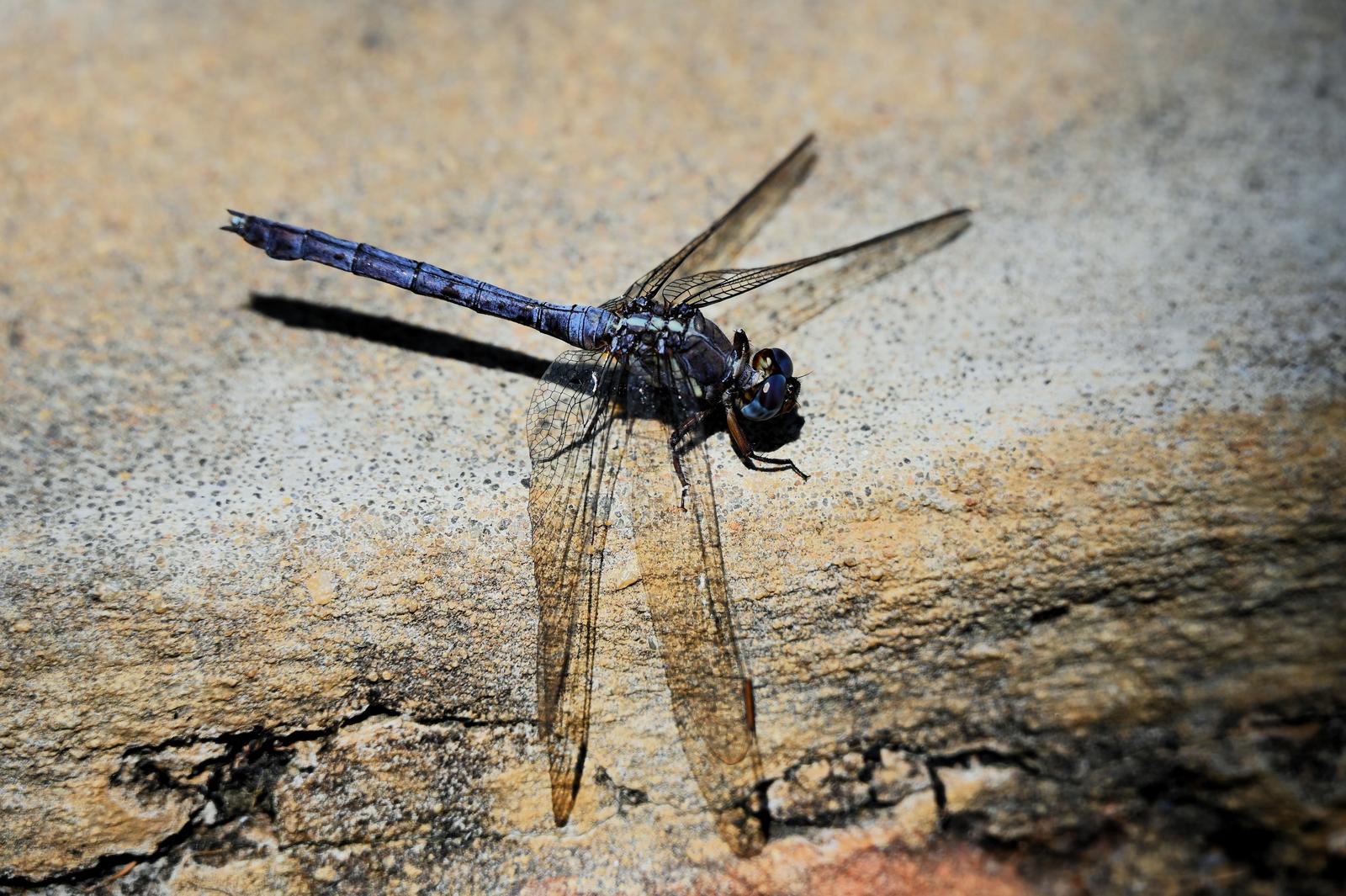
A crisp dragonfly on a barren slab hints at the “last survivor” mood you’re after, but the light and framing don’t fully sell the apocalypse.
Pat, I can see what drew you in: a lone dragonfly with worn-looking wings on a dry, colourless rock — a good starting point for that end‑of‑the‑world feel. As a macro/wildlife close‑up the detail in the wing venation and the strong diagonal pose read well. However, the bright, hard midday light flattens the insect and makes the rock dominate, pushing the mood toward “sunny patio” more than “scorched earth.” If the goal is post‑apocalyptic, I’d lean into bleakness through framing (less empty bright space), controlled contrast on the insect, and colder or desaturated tones. Did you consider dropping lower to make the long wing shadow more of a character, or tightening the crop so the dragonfly feels marooned rather than small against a vast, bright slab?
TECHNICAL EXECUTION ★★★
Focus looks reasonably sharp through the thorax and abdomen, with the wing venation rendered well, but the head/eye doesn’t appear tack‑sharp — the critical point for insect portraits. Depth of field feels a touch too thin; the rear wings fall off quickly and the tail softens toward the tip. Exposure is on the safe side, though the pale rock carries some bright patches that pull the eye. Noise and artefacts are under control and processing seems restrained, which suits the subject. To reach five stars you’d want critical focus nailed on the eye, a slightly deeper DOF (without turning the background crunchy), and highlight control on the rock.
COMPOSITION ★★★
The diagonal placement of the dragonfly is effective and gives the frame energy. That said, there’s a lot of empty, bright rock to the right that doesn’t add to the story; the subject feels pushed left and a bit small. The dark crack along the bottom edge and the tail’s closeness to the left border introduce minor edge tension that doesn’t help. A tighter crop around the insect — or a lower angle that brings the wing shadow sweeping into the right side — would concentrate attention and mood. For a four‑to‑five‑star composition, isolate the subject more cleanly and use the shadow or texture as a deliberate counterweight rather than background filler.
LIGHTING ★★
The midday sun creates a stark, contrasty look that could suit a scorched-world concept, but here it mostly blows the rock and sinks the insect’s detail into dark micro‑shadows. The wing shadows are interesting but underused compositionally, and specular hits on the rock compete with the subject. A small diffuser or stepping into open shade would preserve texture in the insect while keeping the environment austere. Alternatively, a touch of fill (reflector or diffused flash) from camera-right could lift the head and eyes without killing the hard mood. To hit higher marks, aim for light that sculpts the dragonfly and supports the concept rather than fighting it.
STORY ★★
The ingredients for your “post‑apocalyptic” idea are present — a lone creature, desaturated rock, weary wings — but the frame doesn’t push the narrative far enough. There’s no decisive behaviour or strong environmental cue beyond the generic stone surface. The bright, clean tonality undercuts the bleak mood, and the shadow — which could suggest heat and emptiness — doesn’t play a leading role. Consider whether emphasising damage, heat shimmer, or scale (small survivor in a vast harsh space) would carry the theme more clearly. What element do you want the viewer to feel first: heat, isolation, or survival?
IMPACT ★★
It’s a solid natural history close‑up, but it doesn’t stop me in my tracks. The abundance of bright rock and the slightly soft head reduce presence, and the mood doesn’t land with conviction. With stronger light control, a more intentional crop, and a clearer mood treatment, this could step up significantly. Aim for a frame where the insect’s eye and the shadow form a bold graphic statement that supports your theme.
CONSTRUCTIVE NEXT STEPS
- Prioritise eye sharpness and a bit more DOF: try around 1/250–1/500s, f/8–f/11, ISO as needed, and manual focus with focus peaking; if the insect is cooperative, a short 3–5‑frame focus stack will lift the wings without looking artificial.
- Own the mood in-camera: diffuse the sun with a small translucent panel and add a subtle reflector or diffused flash to lift the head/eye; alternatively, shoot in open shade and let a single hard rim of sun define the wing edge.
- Reframe to use the shadow as a character: drop your viewpoint so the wing shadow stretches into the negative space, and crop off the bright right side and the bottom crack — a 4:5 or 3:4 vertical could work well here.
- Post-processing: pull rock highlights down 0.3–0.5 stops, add selective dodge to the eye/face, gently desaturate and cool the background while keeping the insect neutral; a light local contrast (clarity/texture) on the wings will emphasise their worn look.
AI Version 2.12