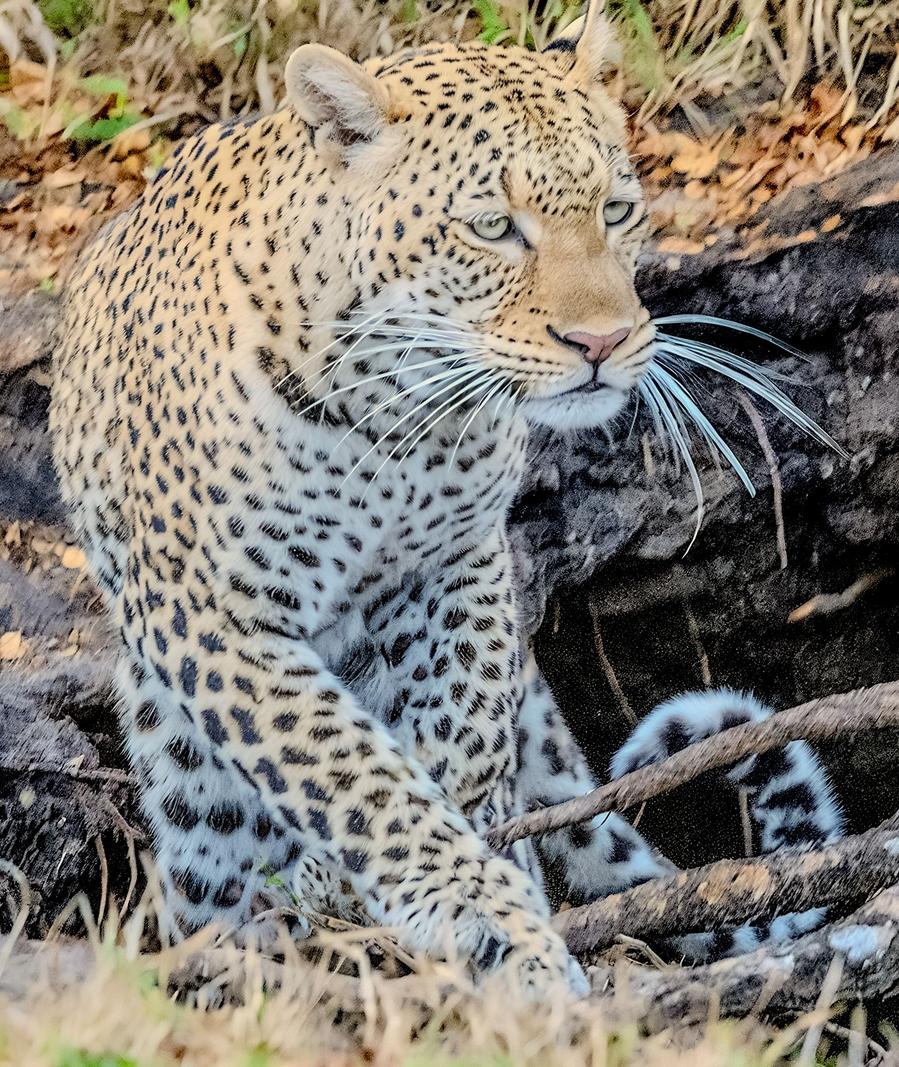
A strong sighting of a magnificent cat, held back by background clutter and heavy processing.
Short answer: yes—stronger separation would lift this wildlife portrait considerably. The leopard’s light coat competes with similarly toned grass and busy sticks on the left, while the dark den behind the right shoulder works well and shows what good separation can do. This reads as wildlife photography, aiming for an intimate moment as the cat steps forward. The raised paw and forward whiskers are lovely details, but the crossing branch over the paws and the crunchy post‑processing reduce clarity. With cleaner background choices in the field and subtler processing, this could sing. Were you fixed in a vehicle, or could you have edged right to use that dark burrow as a full backdrop?
TECHNICAL EXECUTION ★★
The file looks over-sharpened with strong clarity/texture—fur appears crunchy and haloing shows around whiskers and spots. Shadow noise is visible in the den area, suggesting high ISO or lifted shadows. Focus is acceptable on the head, but the eyes don’t feel tack‑sharp at pixel level, which weakens connection. Exposure is broadly fine with no catastrophic clipping. Processing draws attention to itself; dialling back sharpening and using masked, subject‑only sharpening would keep detail without the brittle look. To reach five stars you’d need cleaner, more natural processing and pin‑sharp eyes.
COMPOSITION ★★
The subject dominates the frame, which is good, but competing elements steal attention. The diagonal branch across the paws is a major visual barrier; it blocks the gesture and pulls the eye. Left side grasses and similar-toned earth merge with the cat’s foreleg, reducing separation, while the right side’s dark hollow gives pleasing contrast—shifting position to use more of that would simplify everything. The cat is angled out of frame slightly, with limited breathing space in front; a touch more room in the direction of gaze would feel calmer. A cleaner angle with fewer foreground sticks would move this towards excellent.
LIGHTING ★★★
Soft, even light keeps colours natural and preserves detail in the coat—good for a shaded sighting. However, the flatness means there’s little modelling on the face and no punchy catchlight, so the expression feels a bit subdued. The right-hand dark background provides tonal contrast that helps, but the left side returns to midtones, which flattens separation. Waiting for a slight head turn toward any brighter patch could give a catchlight and lift the eyes. More directional dawn or late light would add texture and shape.
STORY ★★★
The raised front leg and forward-pointing whiskers suggest a cautious emergence, which gives the frame a moment rather than a static pose. The hint of tail rings in the den is a nice touch of context. That said, the obstructing branch interrupts the read of the movement and dulls the sense of flow. A step later—clear paws and head fully out—would deepen the narrative. Behaviour beyond a simple “emerging” gesture (yawn, glance back to cub, scent-mark) would push this higher.
IMPACT ★★
Leopards always command attention, but the busy foreground and crunchy processing sap the wow factor. The viewer’s eye bounces between branches, spots, and patches of similar tone rather than locking on the face. Cleaner separation and a tack‑sharp eye would make this far more memorable. At present it feels like a strong record of a sighting rather than a gallery keeper. Reduce processing artefacts and simplify the frame to raise the impact.
CONSTRUCTIVE NEXT STEPS
✓ In the field, shift right or lower to place more of the dark den behind the head/shoulders; pair with a wider aperture (e.g., f/4 at 300–400mm, 1/1000s, Auto‑ISO) to blur grasses and sticks for separation.
✓ Prioritise eye sharpness: single AF point on the nearest eye, continuous AF, and take short bursts as the paw moves to catch the micro‑moment with a clean gesture.
✓ Post‑processing: mask the leopard and apply moderate sharpening only to the face (+40–60, radius 0.8–1.0), reduce global clarity; burn the background -0.3 to -0.7 EV and lower clarity/texture there to push it back; apply targeted noise reduction to shadow areas of the den.
✓ If ethically acceptable in your workflow, clone/heal the small bright twig tips and stray highlights; or crop slightly from the left/bottom to remove the most distracting stick while keeping space ahead of the face.
AI Version 2.0