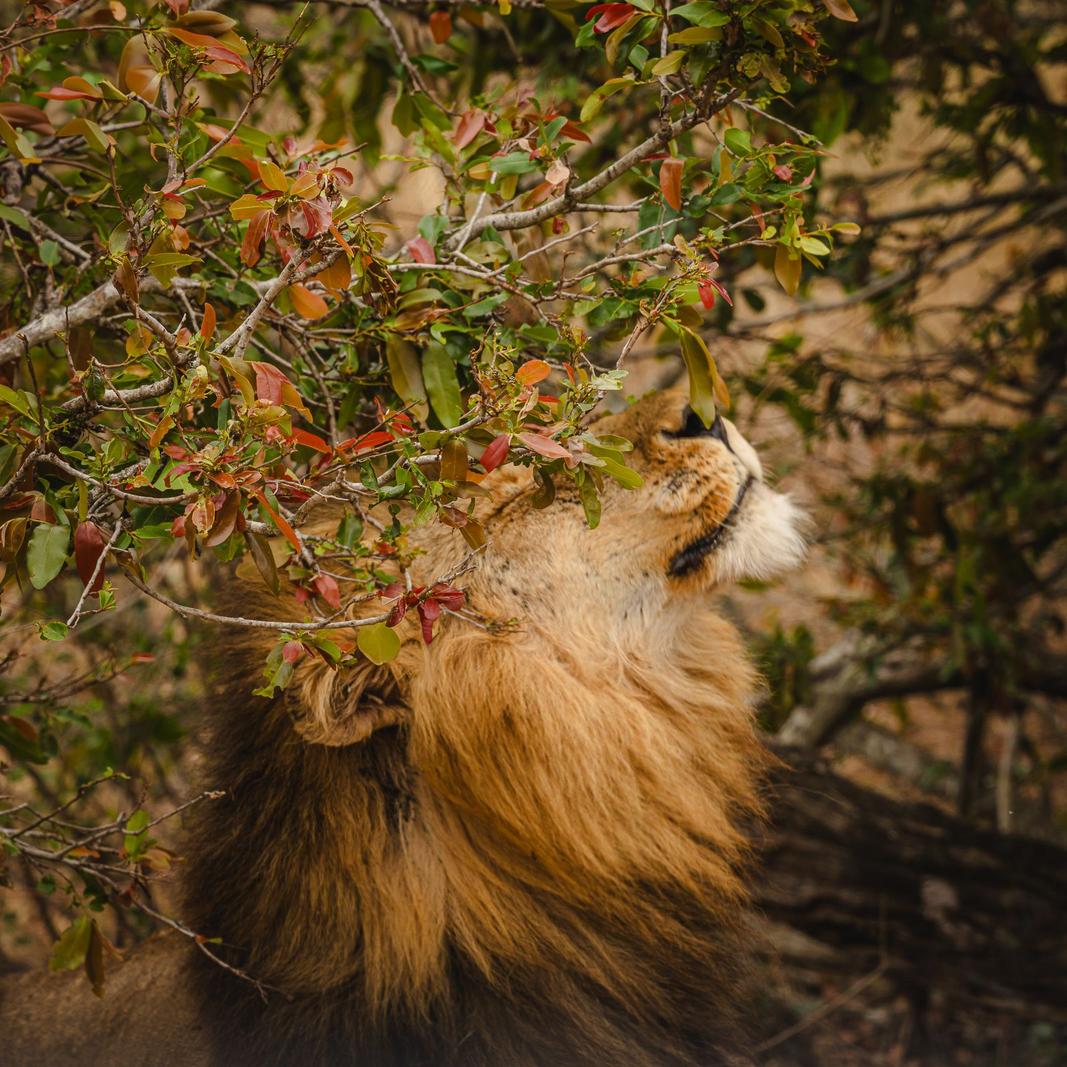
A strong behavioural moment with rich, autumnal tones — the lion breathing in the bush gives this frame its bite.
You’re right that the colours and texture play beautifully here, and you’ve caught a genuine behaviour rather than a static portrait — good call staying on the moment. About the blur at the bottom: that soft smear is almost certainly very close foreground foliage rendered out of focus by a wide aperture and long focal length. To reduce it in camera you have three realistic options in the field: change position so the foreground isn’t between you and the lion, increase depth of field by stopping down (e.g., from f/4 to around f/8–f/11 while keeping shutter speed safe for movement), or step back/use a shorter focal length so the near foliage isn’t so far from your focus plane. Post‑processing won’t “unblur” it; the only fixes after the fact are cropping or careful cloning of small bright patches. Given this is wildlife, I’d prioritise a minimum of around 1/500–1/1000 sec for safety, then raise ISO to allow that smaller aperture. Does a little foreground blur add depth for you here, or do you prefer a cleaner, more graphic frame?
TECHNICAL EXECUTION ★★★★
Focus looks good on the lion’s face and mane despite the busy foliage, and the detail holds nicely in the fur. Exposure is well controlled with no blown highlights in the light-coloured whiskers and solid texture in the mane. Colours are natural and restrained, which suits the subject and season. The noticeable blur at the bottom is optical, not motion or processing, and doesn’t signal a technical error so much as field constraints. To reach five stars I’d like to see a touch more crispness on the eye area and reduced foreground haze through either aperture choice or position.
COMPOSITION ★★★
The best part compositionally is the lion’s upward tilt into the leaves — you’ve framed a clear action and the nose points to the behaviour. However, the lower foreground blur forms a soft band that competes with the main subject and the lion’s mane is a little crowded against the left edge. The branch network is busy; some leaves intersect sharply with the muzzle which slightly dilutes the read of the face. A modest crop from the bottom and left would tighten focus on the gesture while keeping environmental context. How might a small step right or a slightly higher viewpoint have separated the muzzle from the densest cluster of leaves?
LIGHTING ★★★★
The light is soft and warm, giving lovely texture to the mane and keeping contrast manageable through the foliage. There’s no harsh spotty sun, and the muted palette supports the autumn mood. A brighter catchlight on the eye would add life, but with the head turned and partially obscured that’s a tough ask in the field. A subtle local lift on the muzzle and eye ridge would guide attention further. To hit five stars I’d want either a cleaner shaft of light on the face or more separation between subject and surrounding leaves.
STORY ★★★★
This is more than a portrait — the lion pressing into the bush communicates scent‑marking and a quiet, intimate moment. The upward stretch and closed mouth read clearly as behaviour rather than feeding. The seasonal leaves add character and place, strengthening the narrative. It’s engaging, though the face partially hidden by branches slightly mutes the clarity of the action for non‑specialist viewers. A fraction more muzzle and eye visibility would push this into a standout behavioural frame.
IMPACT ★★★★
The scene holds attention thanks to the unusual gesture and the harmony of russet leaves with tawny fur. The mood is calm and wild rather than dramatic, which suits the colours well. The lower blur and busy branch work restrain the punch slightly, keeping it just shy of iconic. With a cleaner lower edge and a bit more facial separation, this would have gallery‑wall presence. As it stands, it’s a strong, memorable image with room to refine.
CONSTRUCTIVE NEXT STEPS
✓ In the field, stop down to around f/8–f/11 and raise ISO as needed to keep 1/500–1/1000 sec; this increases depth of field and reduces that heavy foreground blur without sacrificing sharpness on the lion.
✓ Adjust position: a small sidestep or a slightly higher angle can remove the closest leaves from the immediate foreground; even 30–50 cm can clean the lower frame dramatically.
✓ If repositioning isn’t safe or possible, shoot a looser frame and crop later to exclude the blurred bottom strip; also clone or heal a few bright leaf tips that pull the eye.
✓ In post, add a gentle local dodge on the muzzle/eye ridge and a subtle midtone contrast lift on the mane to lead the eye through the behaviour while keeping colours muted and natural.
AI Version 1.22