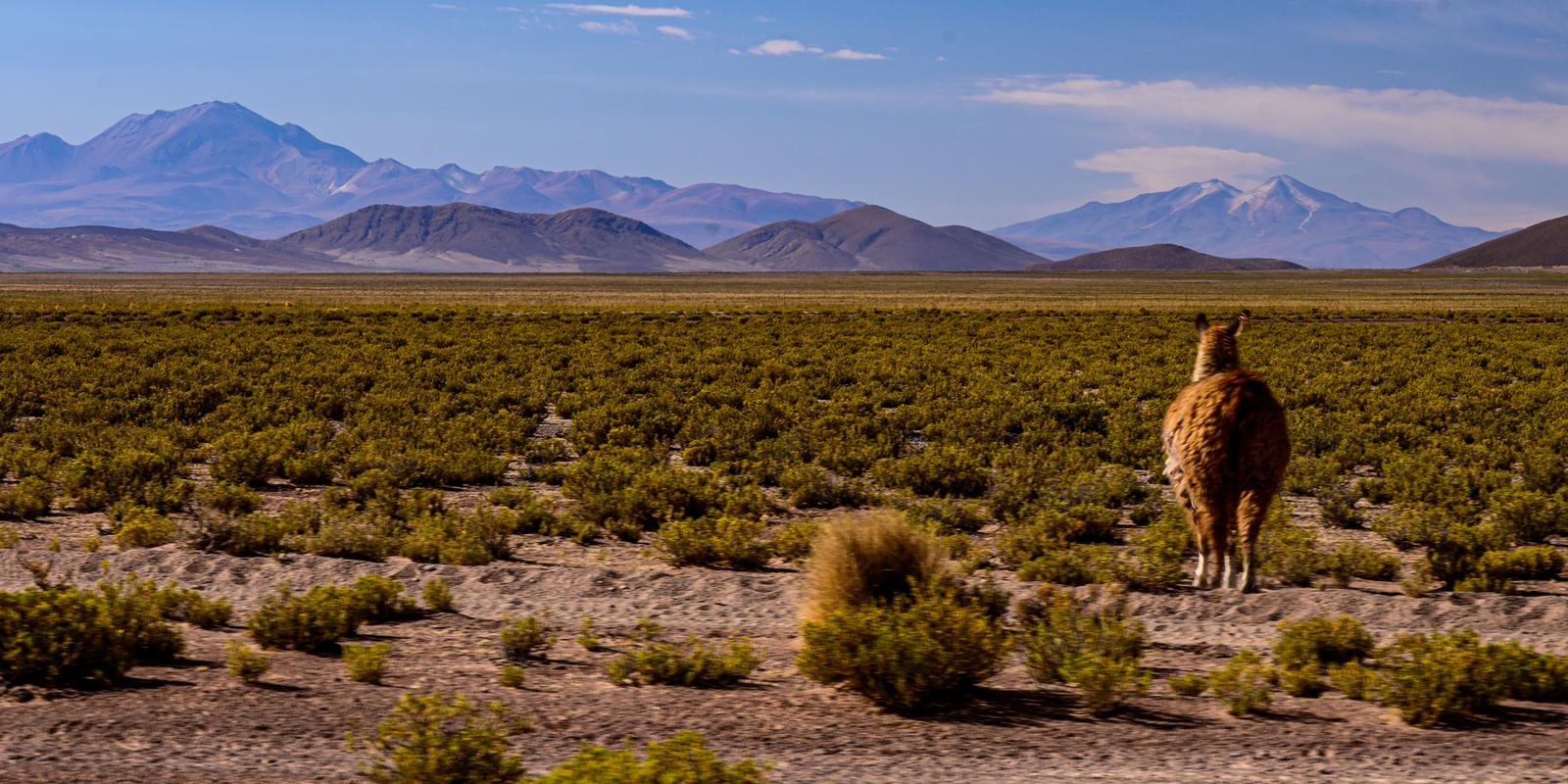
A grand Andean vista with a lone llama for scale, but the moment and sharpness slip away.
You’ve gone for a sense‑of‑place shot — a llama set against the Bolivian altiplano and distant volcanoes — and the idea is solid for travel/wildlife crossover work. The layered mountains read beautifully and the earthy palette feels natural. Shooting from a moving car explains the softness I’m seeing, especially in the foreground scrub and on the llama itself. The animal gives useful scale, but being so close to the right edge and facing away weakens the connection. If you had to shoot from the car, a much faster shutter and a slightly different crop would have helped a lot. When you framed this, was the priority the llama as subject, or the mountains as subject with the llama as accent?
TECHNICAL EXECUTION ★★
Exposure is reasonable and colours are restrained, which suits the scene. However the image shows motion softness consistent with a modest shutter speed from a moving vehicle; the llama lacks crisp detail and the near foreground has a smeared look. Focus appears to sit mid‑distance rather than on the animal, so the key subject doesn’t anchor the frame. There’s light atmospheric haze over the mountains, which is fine but could be tamed with careful post work. To reach five stars you’d need tack‑sharp focus on the llama and a shutter in the 1/1000–1/2000s range (Auto ISO is your friend here), plus a clean file without the slight movement blur.
COMPOSITION ★★
The frame has strong ingredients — layered ranges, vast plain, a solitary animal — but the arrangement isn’t working hard enough. The llama is pushed very close to the right edge and is walking/looking out of the frame, which drains tension rather than building it. The horizon sits near the centre, and the bottom third is mostly empty scrub that doesn’t add much. A tighter crop from the left and bottom would place the llama closer to a third and reduce dead space while keeping the mountains as payoff. In the field, giving more space in front of the animal, or stopping and shooting lower to separate it against the plain, would strengthen the relationship between subject and background.
LIGHTING ★★★
Midday light is serviceable here: it keeps the landscape readable and the colours honest, but it’s a bit flat on the ground and harsh on the llama’s coat. Low‑angle light would carve texture into the shrubs and add shape to the animal, with a chance of a rim on the fur. The distant peaks hold tone nicely, but a polariser (used carefully to avoid banding) could deepen the sky and cut a touch of haze. To push this higher, aim for early or late light with some side direction to build depth and separation.
STORY ★★
The idea of a llama contemplating the vastness is clear, but the animal’s back‑view and soft focus make it a “near moment” rather than a moment. There’s little gesture — ears, head angle, or interaction — to hold attention. If the llama had turned its head, kicked dust, or there were a second animal to create a relationship, the frame would move from descriptive to engaging. As it stands, it’s a record of a place with an animal in it, not a story about that animal in that place.
IMPACT ★★
The scale and setting are pleasing, and anyone who knows the altiplano will recognise the feel. However, the soft subject, edge placement, and flat light keep it from being memorable. We’ve all seen “llama with mountains” — to stand out you need sharper execution and a more decisive moment or stronger light. With those in place, this could land as a striking sense‑of‑place image rather than an in‑transit snapshot.
CONSTRUCTIVE NEXT STEPS
✓ From a moving car, prioritise speed: set shutter 1/1000–1/2000s, Auto ISO up to 1600, continuous AF‑C and burst mode; shoot out of an open window, brace elbows on the door (not the glass) and keep the lens hood on to reduce flare.
✓ Re‑crop this file: trim ~20–25% from the left and ~15% from the bottom to bring the llama off the edge and cut dead foreground while keeping the mountain layers strong.
✓ Return in golden hour if possible; side light will add texture to the scrub and a rim to the llama. A mild dehaze or selective contrast on the mountains, and a gentle polariser in‑camera, will clean up the distant tones.
✓ Wait for a gesture: ears forward, a glance across the frame, or a step that kicks dust. If the environment is the hero, go slightly longer to compress the peaks behind the llama; if the llama is the hero, step closer (safely) and lower to give it presence against the plain.
AI Version 2.0