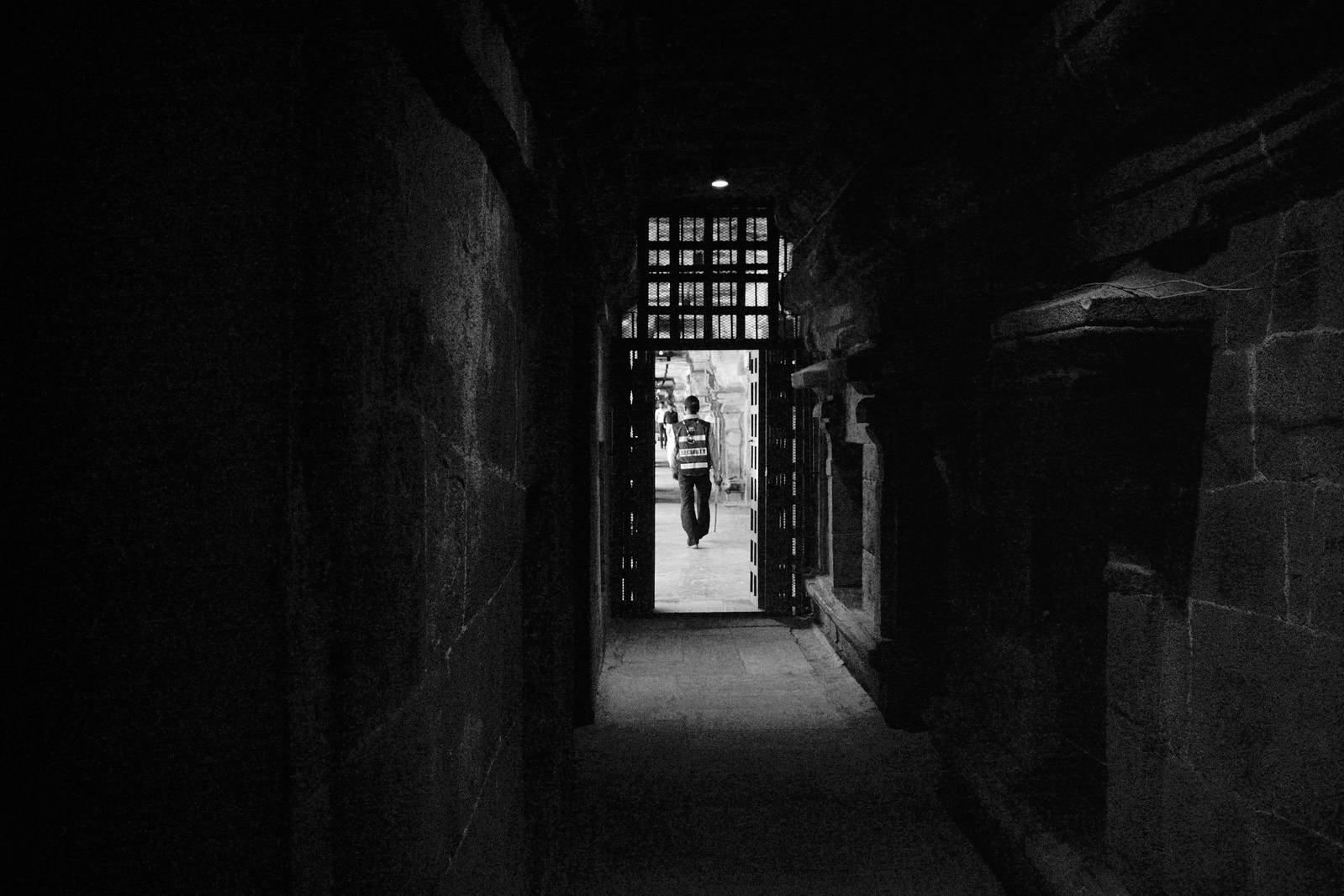
A moody corridor frames a lone figure, offering a strong sense of scale and time.
Your aim comes through: the heavy stone tunnel swallowing most of the frame and the small person walking away do suggest a single life set against long history. This reads as a candid street/travel frame that leans on architecture for structure. The central doorway is a good stage; the grid above and the bright courtyard beyond feel like “community,” while the person’s small silhouette signals the “individual.” Where it weakens is in the very deep shadows and a moment that’s more descriptive than gripping. Would letting the viewer read a bit more texture in the walls—and catching a clearer stride or gesture—better serve your idea?
TECHNICAL EXECUTION ★★★
Exposure is broadly controlled: the courtyard is bright but still retains some detail, and the doorway silhouette is readable. However, the corridor’s blacks are pushed so far that large areas go dead, losing stone texture that could enrich the sense of age. There’s visible high‑ISO grain in the shadows, which suits the mood but also adds muddiness. The small ceiling light above the door becomes a distracting hotspot. A touch more dynamic range in the darks and tidying that bright dot would lift the file substantially.
COMPOSITION ★★★★
The tunnel forms a strong natural frame guiding the eye straight to the doorway—solid choice. Placing the door centrally gives a ceremonial feel that fits the theme. The figure is nicely contained within the bright portal, but the left side of the corridor is an expanse of near‑black that feels heavier than the right; a step to your right or a modest crop would balance the weight. Consider whether you wanted symmetry—if so, shift so the right-hand stone features mirror the left, or commit to asymmetry and crop tighter from the left. How would the image change if the person were slightly closer or placed on a third within the doorway?
LIGHTING ★★★★
The contrast between the dark passage and bright exterior creates mood and directs attention effectively. The figure reads well as a silhouette, and the glow beyond the door suggests life outside the tunnel. That said, the shadows verge on crushed, which flattens the interior surfaces that could otherwise add tactile history. The tiny lamp above the door is a high-contrast distraction that pulls the eye upward without payoff. Slight shadow recovery and selective burning would keep the drama while improving readability.
STORY ★★★
The concept—one person dwarfed by place—is clear and sincere. The subject walking away supports anonymity, but the moment itself is quiet rather than decisive; there’s limited gesture or interaction to deepen the narrative. A more pronounced stride, a pause at the threshold, or a second figure in the courtyard could add tension and scale. What specific behaviour or juxtaposition would express “community history” beyond setting—ritual, maintenance, visitors, or signage? At present it feels like a well-seen scene rather than a fully formed moment.
IMPACT ★★★
The framing and contrast make this immediately readable and pleasant to linger on. It isn’t derivative or gimmicky, but it stops short of being unforgettable because the blacks are heavy and the human moment is restrained. With cleaner tonal control and a slightly stronger gesture, this could land with more authority. The image has a good foundation; it just needs that extra beat of story or polish to stick.
CONSTRUCTIVE NEXT STEPS
✓ In post, lift shadow detail on the corridor walls by 10–20 points (curves or shadows slider) to reveal stone texture; then burn the tiny ceiling light and any bright hotspots so the doorway remains the brightest area.
✓ Rebalance the frame: either crop 5–8% from the left to reduce the dead black mass, or on location step a half‑pace right to centre the tunnel and achieve truer symmetry.
✓ Wait for a cleaner gesture: time the subject’s stride mid‑step or when their body is centred between the door uprights; shoot a short burst at around 1/250s, f/4–f/5.6, ISO as needed to freeze the step without blur.
✓ Consider returning when ambient light is softer outside (earlier or later), preserving exterior detail and easing the dynamic range so the interior can hold more texture without losing silhouette strength.
AI Version 1.22