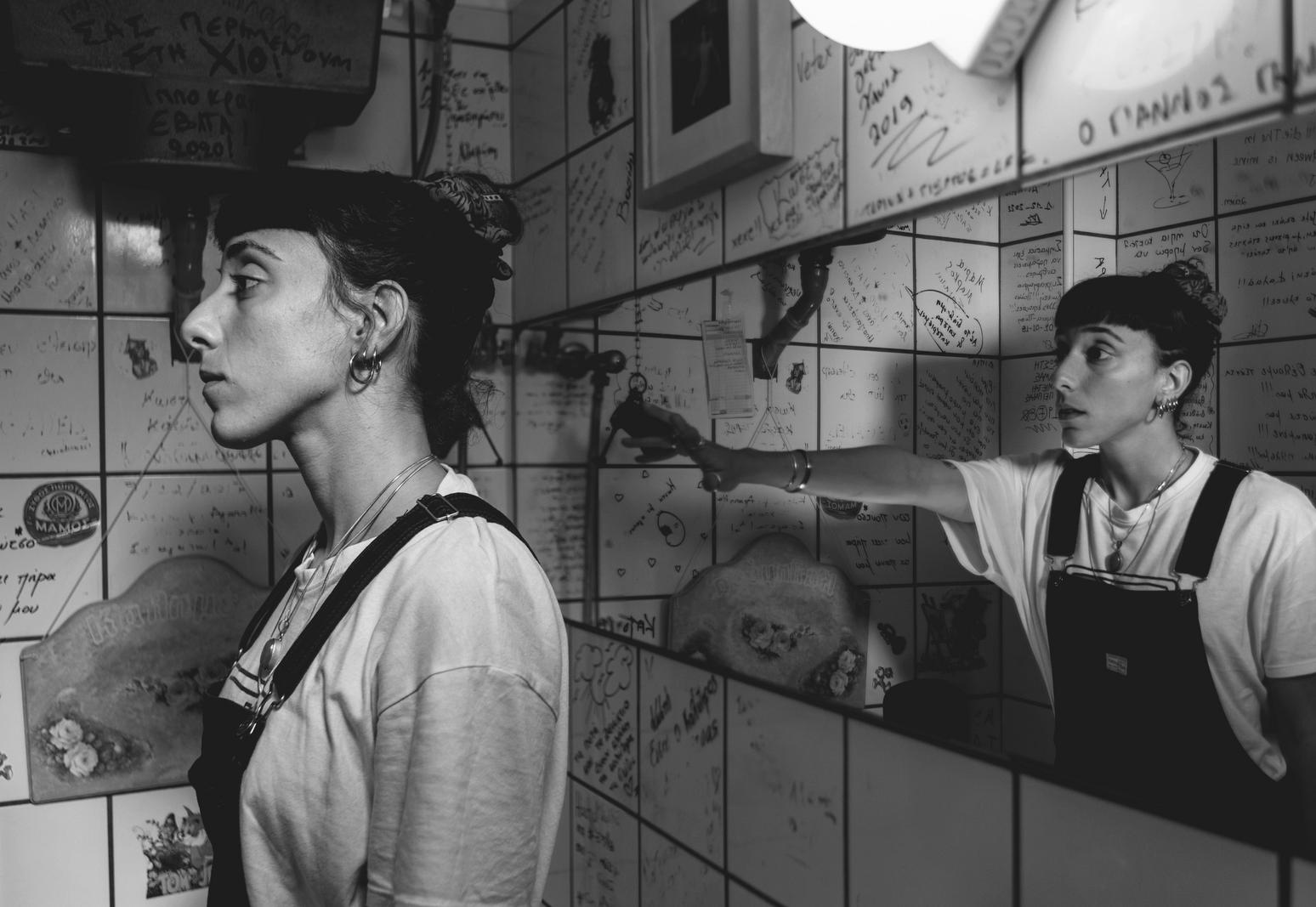
A strong, concept-led portrait where the mirror becomes your sparring partner.
“Abandonment” is a conceptual photograph dedicated to this difficult internal conflict.
Your idea comes through clearly: the calm profile on the left versus the animated reflection on the right creates a believable internal dialogue. This sits comfortably as a fine‑art portrait. The tiled room covered in handwriting adds mental noise and history, while the hand reaching in the reflection gives the scene a decisive moment. Black and white is a smart choice; it simplifies a very busy space and holds the mood together. One question for you: what made you commit to the bright fixture at the top-right—was it meant as a harsh “interrogation lamp”, or did it simply come with the location? Your answer will shape whether you keep it next time or control it more aggressively.
TECHNICAL EXECUTION ★★★★
Focus is crisp on the subject’s profile and the reflection; texture in the tiles is retained without muddiness. Tonal range is strong for a high‑contrast environment, and the conversion to monochrome feels clean rather than over‑processed. The main technical weakness is the bright lamp in the upper right, which clips and drags the eye away from the faces; it reads as a hotspot rather than a purposeful light source. Grain/noise is unobtrusive, and motion is frozen despite the gesture in the mirror. With a touch more control of that highlight and perhaps a fraction more separation between subject and background via aperture choice, this would be publication‑ready. To reach five stars, manage the lamp exposure in‑camera (lower ISO, faster shutter, or slight step to exclude it) and refine local contrast around the face and hand to guide attention.
COMPOSITION ★★★★
The left‑profile facing into the frame anchors the viewer, while the reflection provides action—an effective two‑character conversation in one person. The mirror line creates a natural divide and the pointing arm drives our gaze across the frame. However, the lamp in the top-right corner becomes an unintended focal point, and the top of the head bun sits very close to the edge, adding slight crowding. The environment’s writing supports your concept but verges on overpowering; the eye occasionally gets lost in the graffiti instead of the faces and hand. A small change of position to drop the lamp or give more headroom would tidy the frame without losing energy. Five stars would require eliminating the bright merger and giving the subject a little breathing space while keeping that strong gesture.
LIGHTING ★★★★
The overhead/bathroom lighting carves the subject’s profile with pleasing shadow shape and keeps the reflection readable—good use of available light. The hard source suits the theme of confrontation and adds grit to the tiles. The trade‑off is the blown fixture and a slight flattening on parts of the shirt, which competes with the face due to its brightness. Consider using the lamp more as a motivator than a subject: let it light the scene but not appear in the frame, or flag it to reduce direct glare. Some subtle dodging on the profile and the reflection’s eye line would emphasise the human element over the environment. To hit five stars, keep the mood but control the brightest area so the face remains the brightest, most intentional point.
STORY ★★★★
The narrative is clear: a self confronting self. The stillness of the left figure against the assertive pointing in the mirror is the moment that sells the idea. The messy walls feel like internal chatter, which supports your theme rather than distracts when attention is correctly guided. What emotion did you want in the reflection—accusation, fear, resolve? If that expression were even more definite, the concept would deepen further. A tiny beat of interaction—eyes meeting themselves or the pointing hand touching the mirror—could elevate the tension. It’s engaging and thoughtful, just shy of profound.
IMPACT ★★★★
This image stands out and is memorable among conceptual self‑portraits because the gesture is specific and the setting has character. The monochrome treatment avoids gimmickry and keeps the mood cohesive. The single glaring hotspot is the main element softening the punch; it steals attention at the crucial moment. Resolve that and increase micro‑contrast around the face and hand, and you’d have a frame that holds viewers longer. The work is strong, original, and close to exhibition quality with modest refinements.
CONSTRUCTIVE NEXT STEPS
✓ Control or exclude the lamp: step left and slightly down to keep the fixture out, or flag it with a hand/coat to reduce glare; in post, burn the hotspot by 0.7–1.0 stops and add a gentle highlight roll‑off.
✓ Guide the eye: dodge the profile’s cheekbone and the pointing hand by ~10–15% and burn the bright shirt area to keep the face as the brightest element; add a subtle vignette weighted to the mirror side.
✓ Give breathing room: reframe to add 2–3 cm of headroom above the bun and avoid edge tension; alternatively, crop slightly from the top-right to remove the lamp entirely while preserving the gesture.
✓ Consider depth control: if possible, open the aperture by one stop to soften the graffiti just a touch, keeping legibility but reducing competition with the face and hand.
AI Version 2.1