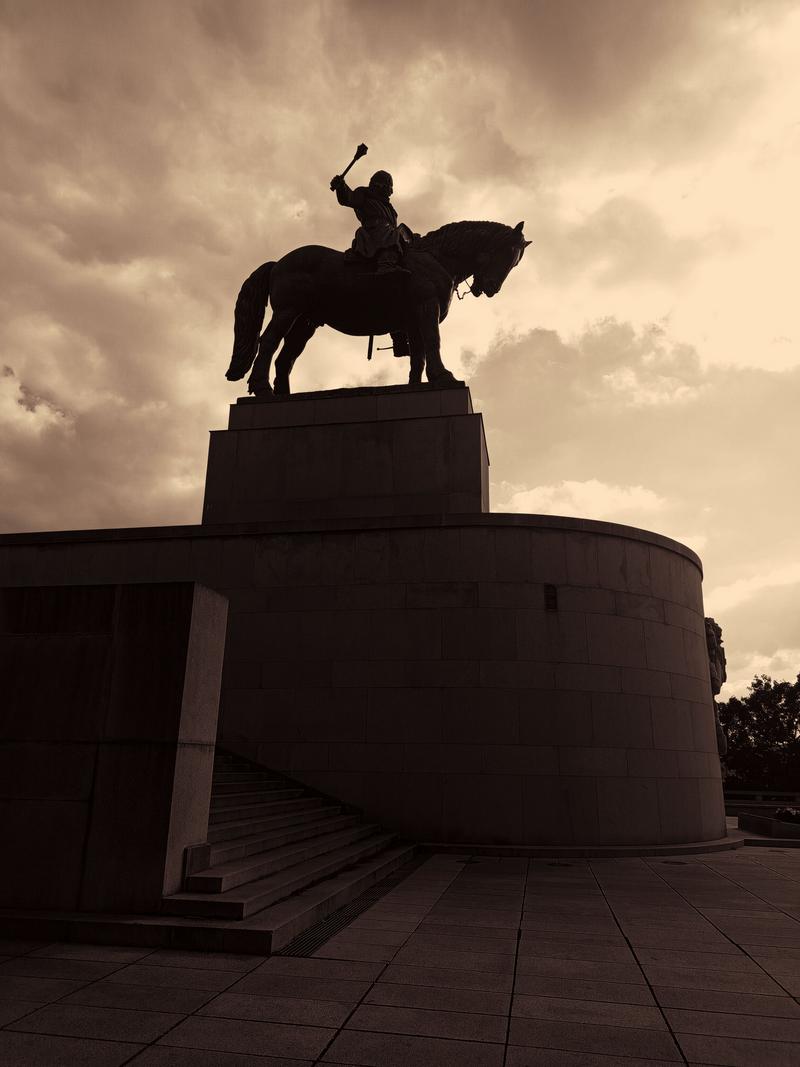
A bold, moody silhouette that rightly celebrates the monument’s power, but the frame can be refined to land the full punch.
You’ve gone straight for grandeur, and the silhouette and low viewpoint do give the equestrian statue presence. This sits between architectural and fine‑art travel work: form, scale and atmosphere matter more than literal detail. The sepia toning supports the historic feel and the stormy sky adds weight. I see your intent clearly, though the composition and tonal control below the statue hold the image back from its full “majestic” statement. What made you choose sepia over a clean black‑and‑white—was it to suggest age, or to tame the contrast? And did you consider including a person for scale to push the sense of monumentality further?
TECHNICAL EXECUTION ★★★★
The exposure for a silhouette is handled well: the horse and rider read crisply against the brighter sky and edge detail looks sharp. Tonal range in the sky is strong, with good texture in the clouds. The lower half is very deep—most of the plinth, steps and foreground are near-black, which costs you usable texture and a little elegance. Sepia is tasteful and not overcooked, though a touch of shadow lift on the wall could reveal material without weakening the silhouette. I don’t see obvious artefacts or noise; processing is restrained. To reach five stars, keep the statue pure black but recover subtle detail in the cylindrical wall and steps so the base feels intentionally rendered rather than crushed.
COMPOSITION ★★★
The subject is clear and well isolated against the sky, and the round plinth gives a pleasing curve that echoes the clouds. However, the large dark block on the lower left truncates the stairs and interrupts the natural ascent toward the statue. There’s also a lot of empty paving at the bottom that adds space without adding story; it dilutes the vertical drama. A step or two to the right and slightly lower would let the staircase sweep into the frame as a leading line and reduce the left-hand obstruction. A tighter crop from the bottom would concentrate attention on the monument and sky. Five stars would require a cleaner lead (unblocked steps or a stronger curve) and less dead foreground.
LIGHTING ★★★★
Backlighting suits the subject, carving a bold outline and giving the rider’s raised arm a decisive gesture. The sky has texture and mood, and the darker tones work with your intent. What’s missing is a sliver of rim light on the statue or a slightly brighter halo that would separate complex shapes like the horse’s head from the sky even more. Timing this for a break in the clouds, or shifting position to catch a brighter patch behind the head, would help. The sepia cast is consistent and avoids garish colour. For five stars, aim for that tiny kiss of edge light or a more luminous cloud behind the subject to sculpt form without sacrificing the silhouette.
STORY ★★
The photograph communicates “monumental” and little else; it’s an impressive object study rather than a moment. The raised weapon provides some built‑in drama, but without context or human scale the narrative remains thin. The heavy shadows on the plinth also hide inscriptions or textural clues that could speak about place and history. Consider waiting for a visitor on the steps or a flag snapping in wind to add a small, time‑specific element. What feeling did you want from viewers beyond awe—defiance, guardianship, memory? Five stars would need a human or environmental beat that anchors this beyond “a powerful statue under a brooding sky.”
IMPACT ★★★
The silhouette and sky give the image immediate presence and it would look strong at a smaller size or as a spread opener. The mood is consistent and the subject has gravitas. But the blocked left edge, empty pavement and lack of a secondary element reduce memorability. A more deliberate viewpoint and a cleaner base would convert mood into a lasting statement. Five stars would require a more precise frame and a small, distinctive detail that makes this rendition stand apart from countless monument silhouettes.
CONSTRUCTIVE NEXT STEPS
✓ Reframe from two metres to the right and a little lower so the staircase forms a clear diagonal lead into the plinth; avoid the dark left-hand block and trim 15–25% from the bottom to remove empty paving.
✓ Time the shot for a brighter gap in the clouds directly behind the horse’s head or rider’s arm to create a thin rim/halo; spot-meter the sky to keep the silhouette clean.
✓ In post, keep the statue at near‑black but lift the wall and steps by about 0.5–1 stop with a graduated or local adjustment; add gentle midtone contrast to the clouds and clone the small plaque/mark on the wall that pulls the eye.
✓ Consider a second frame including a passer‑by on the steps for scale and story—shoot at 1/250s or faster to freeze them cleanly while retaining your silhouette exposure.
AI Version 2.0