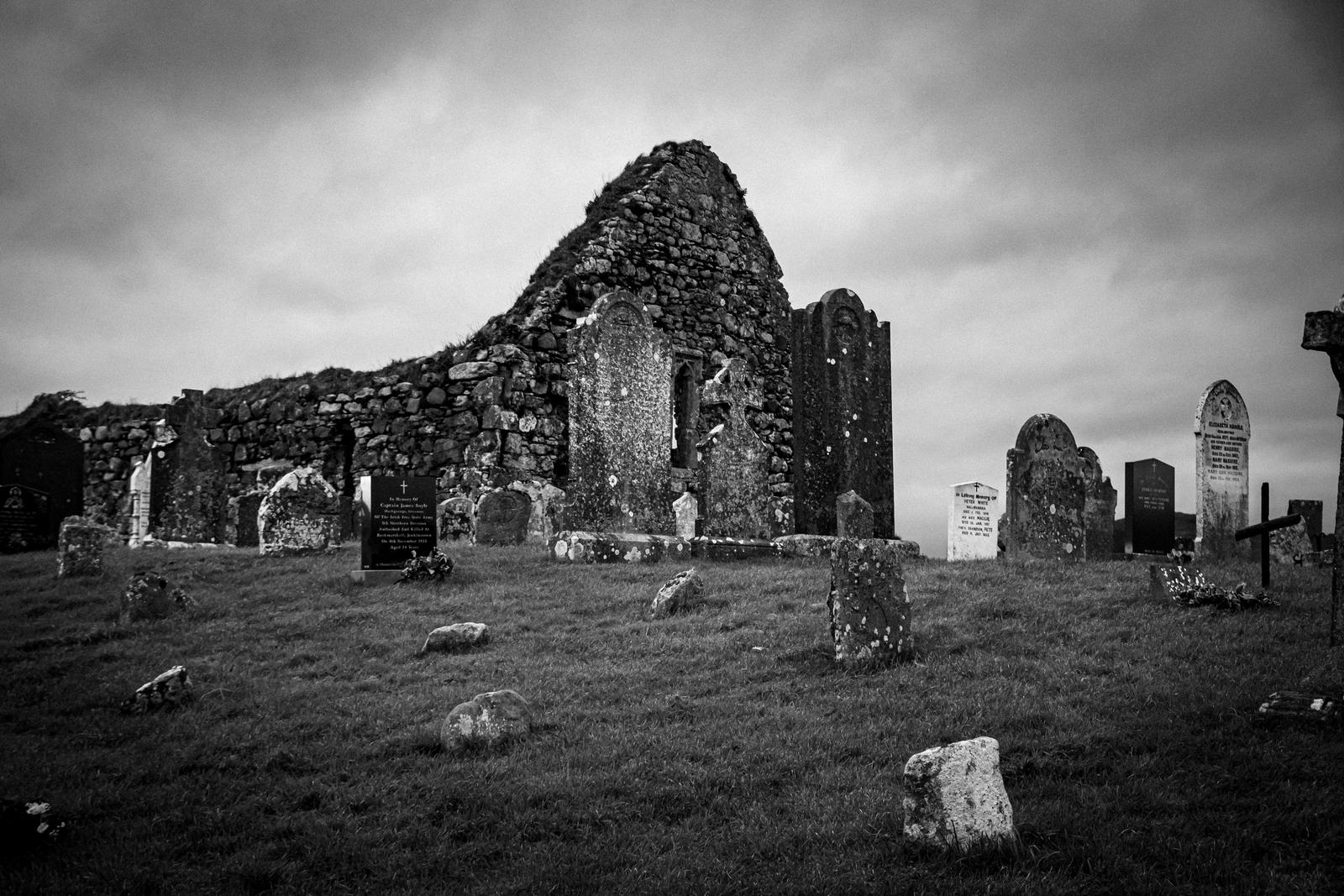
A strong, moody setting that deserves bolder light and a cleaner, more deliberate frame.
Thanks for asking directly, Ann. For club judging, images in this travel/landscape vein tend to score when they show clear intent: one dominant subject, confident control of tone, and light that shapes the scene. Your ruin and gravestones give you a great stage; the leaning wall and the lichen‑spotted stones have character. Right now the frame feels descriptive rather than decisive, mainly because the light is flat and the main subject competes with nearby headstones. Below is how to push it into the “select” pile.
TECHNICAL EXECUTION ★★★
Exposure is broadly safe; you’ve held detail in the stones and grass without blowing the sky. Sharpness looks acceptable across the mid‑ground, suggesting a mid‑aperture and steady hand or tripod. The file, however, reads a little grey—midtones are compressed and the sky lacks bite, which flattens the scene. In a monochrome treatment the separation between grass, stone and sky comes from tonal control; here those elements sit too close together. A touch of local contrast (clarity) and selective dodging and burning would help the ruin stand out. To reach five stars, aim for crisper micro‑contrast on the masonry and a sculpted tonal map that guides the eye.
COMPOSITION ★★★
The ruin is the natural hero yet it merges with two tall headstones to its right, diluting its presence. Several partial stones near the frame edges (especially the cropped cross on the far right and the dark modern slab left of centre) pull attention. The gently sloping foreground stones do add depth, but none of them assert themselves as an intentional foreground anchor. Consider how a step or two to the right, and a slightly lower viewpoint, would separate the ruin’s peak from the headstones and give it clean sky around its silhouette. A tighter crop from the right to remove the half‑cross, or moving in to feature one “hero” stone in the foreground leading to the ruin, would simplify the read. What, precisely, do you want me to look at first—the ruin or a particular grave—and how can you arrange the frame so that answer is never in doubt?
LIGHTING ★★
The overcast gives even exposure but little shape; the scene lacks directional light to model the stones. Texture is present, yet the absence of highlights and shadows leaves the mood heavy rather than dramatic. For this subject, low raking light at the edges of the day would carve form into the rock and grass and create separation. Alternatively, a stormier sky with a brighter patch breaking through could spotlight the ruin against darker clouds. In post, you can echo this by subtly burning the sky’s top third and dodging the ruin’s front face to mimic a shaft of light. Returning in slanting light or brooding weather would push this category to the top tier.
STORY ★★
The subject matter carries built‑in mood—ruin, age, memory—but the frame doesn’t yet choose a clear narrative thread. Is it about the endurance of the church remains, or the scattered, broken stones in the foreground? Without a defining gesture (a single fallen tablet foregrounded, fresh flowers, a bird on the pinnacle, a visitor in quiet reflection) the image reads as “a cemetery scene” rather than a specific moment. Think about layering one intentional element that adds time or tension. What detail in this place made you pause, and how can you arrange or wait so that detail becomes the story?
IMPACT ★★
The setting is promising, but the combination of flat light, competing subjects and a featureless sky reduces punch. Club judges will have seen many monochrome graveyard photographs; to stand out yours needs either exceptional light, a decisive foreground/subject, or a surprising moment. Right now it’s competent rather than memorable. With stronger separation of the ruin, more deliberate edges, and bolder tonal contrast, this could move up a league. Aim for a frame that reads instantly from across the room.
CONSTRUCTIVE NEXT STEPS
- Return in side light (golden hour or just after rain). Use f/8–f/11 on a tripod and place the ruin cleanly against the sky; step 2–3 metres right and go lower to separate it from the tall headstones.
- Choose a “hero” foreground: one broken stone or cross placed bottom third leading to the ruin; exclude partial stones at the edges. Commit to that subject and let everything else support it.
- Monochrome processing: darken blues to deepen the sky (or use an orange/red filter in camera), add midtone contrast, dodge the ruin’s face, and burn frame edges/top sky. Keep it subtle—aim for shape, not a heavy vignette.
- Clean the frame: crop or clone the cropped cross on the far right and tame the bright white headstone on the mid‑right so the eye isn’t pulled away from the ruin.
AI Version 2.12