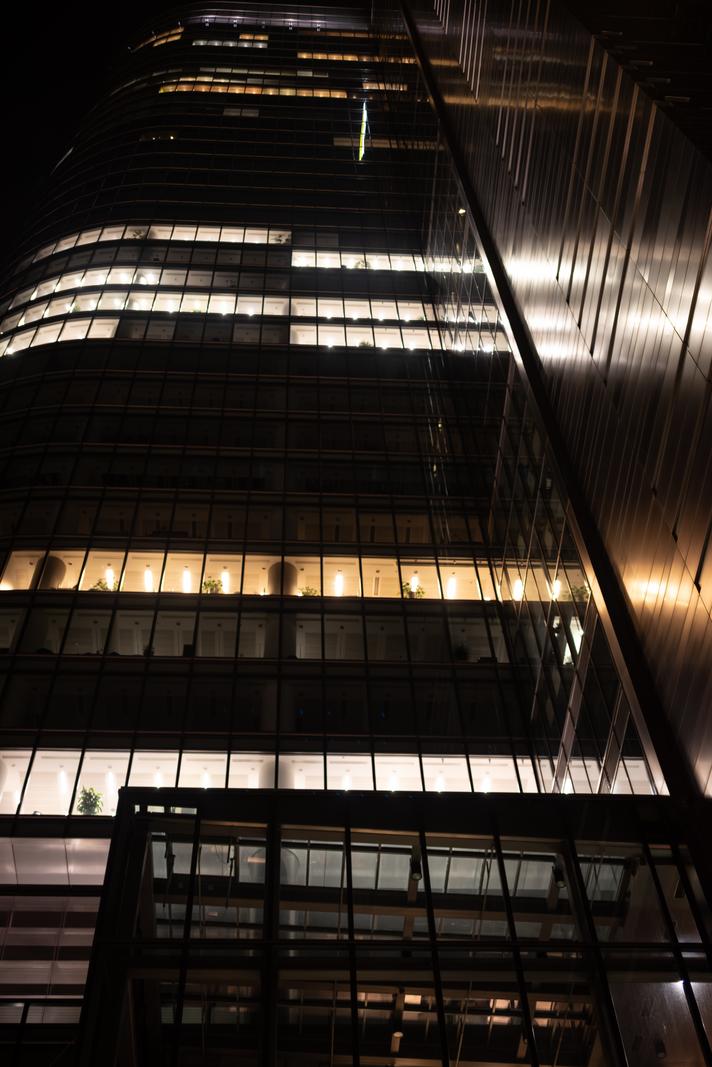
Striking night geometry, but the perspective and framing hold it back.
You’ve clearly aimed to showcase the façade’s grids and the glow from the occupied floors — a classic architectural study at night. The repeating windows and the warm bands of lit offices are the strongest elements here, and they do read well. This sits squarely in architectural photography, where precision in perspective and framing is part of the story. Right now the building is heavily keystoned and the frame is split by the bright metal plane on the right and a cropped glass atrium at the bottom, which dilutes the clarity of your idea. What were you most drawn to — the abstract pattern of the windows, or a broader view of the tower itself? Deciding that up front will guide both your angle and how much of the structure you include.
TECHNICAL EXECUTION ★★
Exposure is generally under control — the lit floors are bright without obvious blooming, and noise is not intrusive for a night scene. However, the image suffers from strong keystone distortion; the verticals converge dramatically, making the building appear to lean away. In architectural work this is a technical flaw unless used very deliberately for an abstract. The right metal cladding contains hot streaks and specular highlights that feel clipped, and deep shadows in the lower half lose detail. White balance is mixed (cool in the glass, warm in the interior bands), which can work, but here it feels unbalanced across the frame. To reach five stars you’d need corrected verticals, cleaner highlight control, and consistent tonal detail across the façade.
COMPOSITION ★★
The frame feels undecided between an abstract pattern and a descriptive view. The bright metal wall on the right creates a heavy vertical slab that competes with the window grid rather than supporting it. The bottom edge clips the glass atrium awkwardly, adding a busy stack of lines right where the eye lands first. Up top, small bright details near the edge pull attention and make the crop feel abrupt. A more deliberate approach — either a centred, squared-off façade or a tight crop focusing solely on the illuminated bands — would give the image a clear anchor. Consider how the strongest light band could be placed on a third to lead the eye through the frame.
LIGHTING ★★★
The interior office lighting creates a pleasing rhythm of warm strips against the cooler exterior glass. This contrast hints at life inside the building and gives the scene some depth. That said, the light is very contrasty; the unlit floors are close to black, which flattens architectural detail and reduces texture. The specular reflections along the right wall are harsh and draw the eye away from the main subject. Shooting at blue hour would lift the ambient level, open the shadows, and give cleaner separation from the night sky. With more balanced light and fewer hotspots, the structure would feel more sculpted.
STORY ★★
There’s a seed of a story here — late hours in a corporate tower, signalled by those glowing bands and the little plants visible behind glass. But the frame doesn’t develop that idea further. Without people, clearer context, or a more intentional abstraction, the photo becomes a record of lights rather than a moment. The mixed elements (right wall, cropped atrium) distract from any narrative about work after dark. What could you include — a lone worker at a desk, a cleaner in silhouette, or a more disciplined pattern — to give viewers something to hold onto? Push either the human trace or the pure graphic concept.
IMPACT ★★
The scene has potential: tall glass, rhythmic illumination, and a mood that many city-dwellers recognise. As presented, it’s easy to pass by because the image lacks a decisive visual idea. The leaning verticals and crowded borders sap confidence and dilute the “wow” of the architecture. With stronger perspective control and a cleaner, more intentional crop, this could become a bold graphic study or an atmospheric city-night vignette. At present it’s competent but forgettable; tightening the concept would lift memorability significantly.
CONSTRUCTIVE NEXT STEPS
✓ Correct perspective: shoot squared to the façade with a tripod and keep the camera level; use a tilt‑shift lens if available, or apply Vertical/Transform in post to keep parallel lines true, then crop cleanly.
✓ Time it for blue hour and bracket 3–5 exposures (static scene) to protect bright window detail while lifting shadow floors; blend gently to avoid an HDR look.
✓ Commit to a concept: either go tight on the illuminated bands and repeating windows (exclude the right metal wall and lower atrium), or step back for a symmetrical, head‑on view that shows the building’s full face with tidy borders.
AI Version 2.1