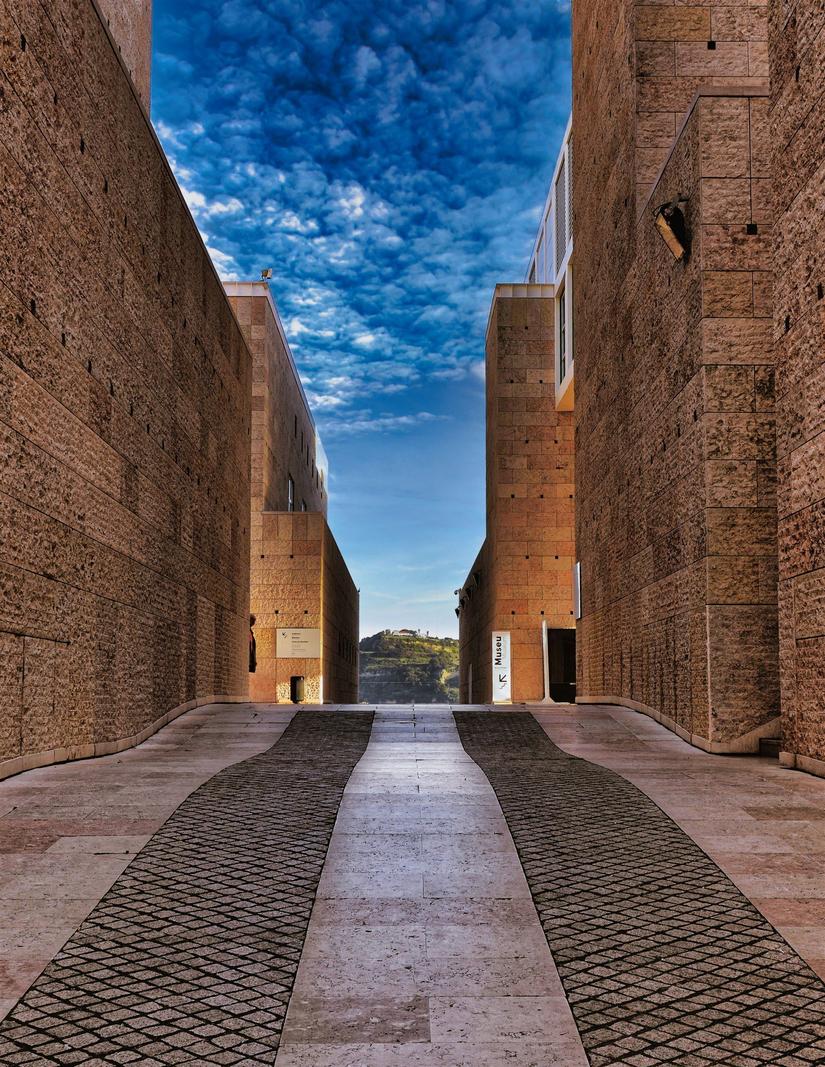
Strong geometry and a clear vanishing point, but the frame needs an anchor and cleaner control.
You’re asking the right question, David. This reads as architectural/travel work: two tall stone walls forming a corridor that funnels the eye to a bright opening, a distant hill, and a textured blue sky. The strongest qualities are the symmetry and the patterned paving that naturally lead us forward. To compose it better, decide whether your picture is about the architecture itself or the view beyond; right now it sits between the two and lacks a focal anchor. Small shifts in position and timing—plus a more disciplined centre—would make the lines feel intentional and give the scene a reason to hold the viewer. Would a single figure or cyclist entering that bright slot have given scale and purpose to those powerful lines?
TECHNICAL EXECUTION ★★★
Focus and exposure are sound, with readable texture in the stone and paving. However, the sky and wall detail look a little over‑processed—local contrast and saturation feel pushed, giving a crunchy, HDR‑ish look and slight halos along the top edges. Vertical control is decent, though there’s a hint of keystoning as the walls lean inwards. Colour is mostly natural on the stone but the blue in the sky is heavy. Pulling back clarity/dehaze and blue saturation would restore a more honest, grounded rendering.
COMPOSITION ★★★
The scene promises a bold, symmetrical statement, yet the camera placement isn’t perfectly centred—the dark paving bands don’t align exactly with the frame and the right wall reads a touch heavier. The opening is dead‑centre but lacks a subject, so the powerful lines lead us to a visual cul‑de‑sac. The sign elements on both sides are near the edges and nibble at the symmetry rather than supporting it. A lower viewpoint would have amplified the paving pattern and strengthened the funnel effect. Alternatively, step forward and trim some sky so the slit of light becomes the dominant frame-within-a-frame.
LIGHTING ★★★
Open shade inside the corridor gives even detail, while the distant opening is brighter and naturally draws the eye. It’s functional light, but not particularly expressive; the walls feel a bit flat and the sky competes for attention. Side light later or earlier in the day could have carved texture into the stone. Be mindful of the dynamic jump at the exit—great for a silhouette if you include a person, but currently it just becomes a hotspot. Taming the sky would also keep the emphasis on the architecture rather than the clouds.
STORY ★★
At present the photograph is a clean record of a passageway. There’s little sense of purpose or activity—no human scale, no moment at the threshold, and the hill beyond doesn’t add much meaning. The place feels empty rather than calm. A single passer‑by, a cyclist, or even a shadow falling across the floor would have provided a moment and a reason to travel through the frame. What did you want us to discover at the end of those lines—the building’s rhythm, or the life that moves through it?
IMPACT ★★★
The strong perspective and patterned paving make an immediate impression, and the corridor’s height is imposing. Impact drops once the viewer reaches the opening and finds nothing to reward the journey. The slightly heavy processing further distances the image from a natural, tactile feel. With a precise centre, a human element for scale, and subtler tones, this could be a striking, memorable architectural study. Right now it’s attractive but not sticky.
CONSTRUCTIVE NEXT STEPS
✓ Commit to perfect symmetry: use a tripod and grid lines, place the exact centre of the paving seam in the middle of the frame, and ensure both walls have equal visual weight; nudge your position a few centimetres until edges match.
✓ Add a focal anchor at the opening: wait for a lone figure to walk into the bright slot and expose for the corridor (around -0.3 to -0.7 EV, 1/250s, f/8–f/11, ISO 100) to silhouette them cleanly and give scale.
✓ Control the frame: either lower the camera to emphasise the textured bands and reduce the empty sky, or step forward to let the opening dominate; decide which story you want and crop accordingly.
✓ Post‑process with restraint: reduce blue saturation by ~10–20, back off clarity/dehaze on the walls, and heal small distractions (security camera top right) to keep attention on the geometry.
AI Version 2.0