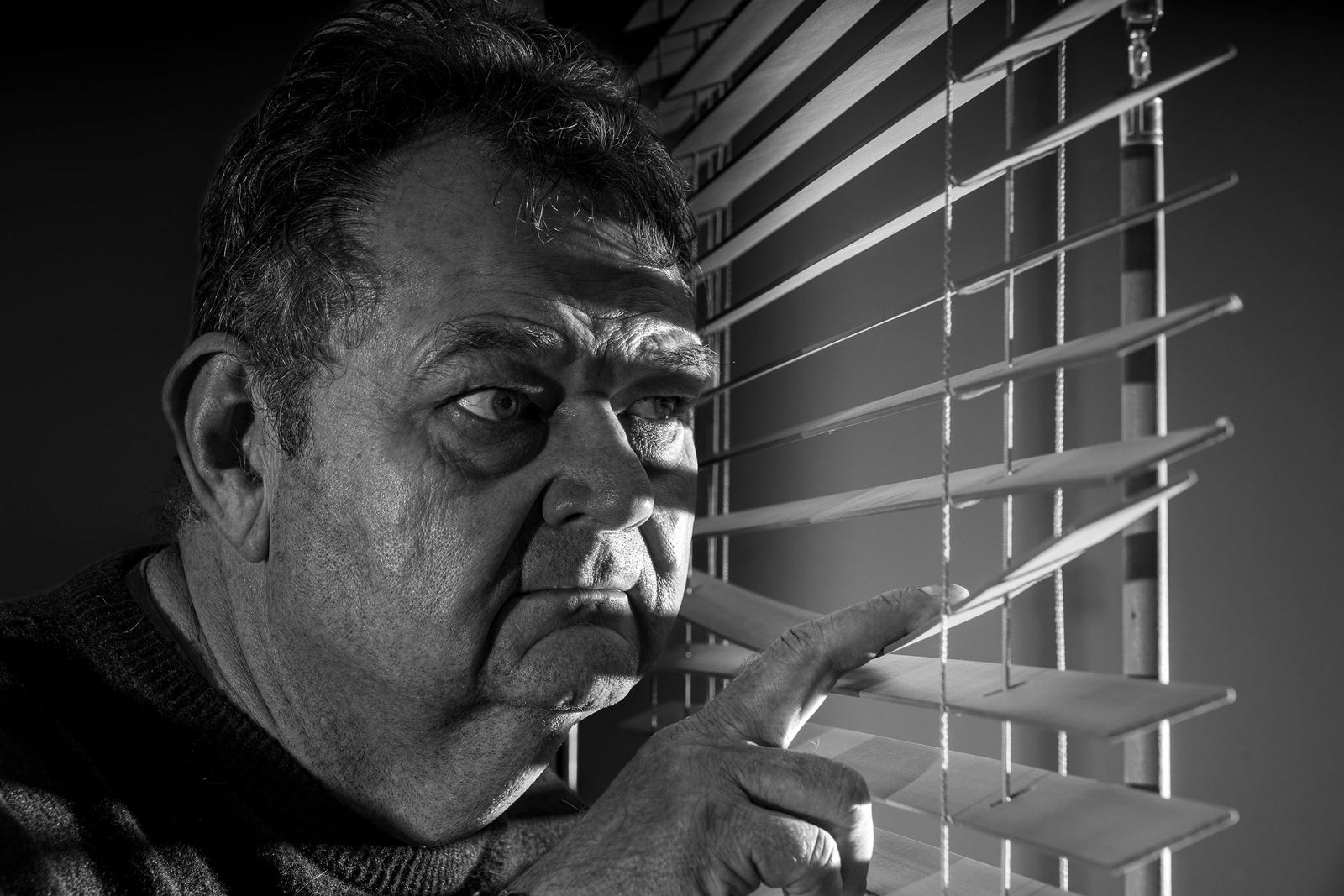
Strong noir mood with crisp slatted light and a tense gesture, but a few choices blunt the drama.
Yes, you’re very close. This is a portrait staged with noir styling: hard light through blinds, a suspicious expression, and deep shadows. The scowl and the finger prising open the slat give it tension, which is the strongest part. What holds it back from full-on noir is where the brightest tones sit (on the blinds rather than the face) and some set choices that read more “modern neighbour” than “shadowy detective.” If your aim is classic noir, consider how wardrobe, space for the gaze, and light placement support that read. What would happen if you left more room to the right so his look has somewhere to go—perhaps even a hint of what he’s watching?
TECHNICAL EXECUTION ★★★★
The black‑and‑white conversion is clean with a healthy tonal range, and the face appears sharp enough for print. Noise is well controlled and the texture in the skin feels natural rather than over‑processed. Highlights on several slats are verging on clipping, which pulls the eye off the subject; a mild burn there would help. Depth of field is appropriate, isolating the man from the background without making the blinds mushy. No obvious artefacts or halos. To hit five stars, keep the brightest tones on the eye/cheek area and tame the brightest slats so contrast serves the character, not the set.
COMPOSITION ★★★★
Placing the man to the left works, and the finger breaking the plane of the blinds adds a nice diagonal gesture. The blinds and the pull cord create strong lines, but the vertical cord cutting down near his eye competes for attention. The frame feels tight at the top and bottom of his head/hand; a touch more breathing room would reduce the cramped feeling. Most importantly, his gaze runs into the right edge—more negative space to the right would build suspense. Consider shifting your position slightly so a slat gap frames the eye while the pull cord falls further right or left. For five stars, give his look room and use the blinds as a deliberate frame rather than a busy barrier.
LIGHTING ★★★★
The hard, angled light through the blinds is a solid nod to noir and sculpts the face with grit. However, the brightest stripes land on the blinds more than the features, so the face plays second fiddle to the set. Raising the key and moving it 20–30 degrees forward would lift the eye sockets and place a band of light across the eye/cheekbone. A faint fill from camera‑left (or a white card) could rescue shadow detail without losing menace. A tiny catchlight would add life. Five stars would come from having the eye sit in a clean, deliberate band of light with the slat highlights slightly subdued.
STORY ★★★★
The expression and the small gesture of the finger parting the slat give a clear sense of tension—someone’s watching or being watched. Right now the wardrobe (a simple knit) reads contemporary and domestic; that’s fine if the story is “suspicious neighbour,” but it undermines a 1940s detective vibe. Which direction do you want—period pastiche or modern paranoia? A fedora/coat, cigarette, or a hint of rain on the glass would push classic noir; alternatively, reveal a sliver of what he sees to ground a present‑day scenario. The story is there; it just needs one more clue to be unmistakable.
IMPACT ★★★★
It’s a striking frame with immediate mood and a memorable face, and the slatted light is always punchy. The blinds‑and‑peeking trope is familiar, so originality rests on precise light, styling, and a small twist. Right now the brightest tones and the tight crop limit its staying power. Give the gaze space, redirect the brightest light to the eye, and add one narrative detail to separate it from similar images. That would lift it into the kind of shot that lingers rather than just reads as a well‑executed homage.
CONSTRUCTIVE NEXT STEPS
✓ Re‑light so a clean band of light crosses the eye/cheek: raise the key and move it 20–30° toward camera; add a minimal white‑card fill on camera‑left to open shadows without killing contrast.
✓ Reframe with more negative space on the right and shift so the pull cord doesn’t bisect the frame; let the eye sit in a slat gap and keep his finger fully clear of the bottom edge.
✓ Post: burn the brightest slats by 0.5–1 stop and dodge the near eye/iris by ~0.3–0.5 stops; add a light film‑grain layer for texture.
✓ Decide your era and dress the set accordingly—hat/coat for classic noir, or include a subtle exterior clue (streetlight, silhouette) through the gap for modern tension.
AI Version 1.22