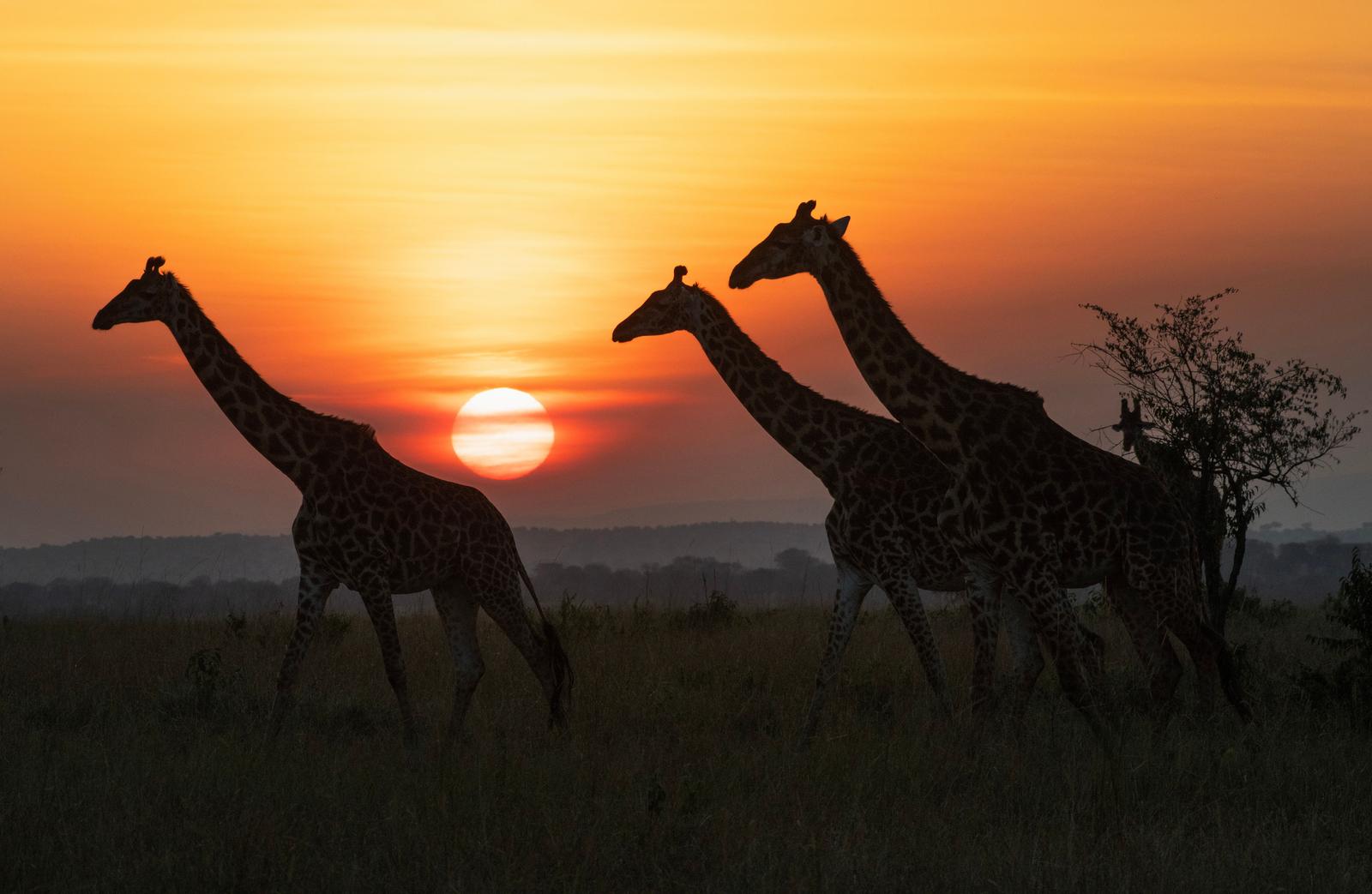
A classic savannah silhouette with lovely shapes and colour, held back by crowding on the right.
You were indeed in the right place, Susan. On exposure: for a silhouette like this your choice is broadly right—the sun still has a defined disc and the giraffes read as clean dark shapes, which is the goal. If you wanted deeper colour and a slightly smaller, less dominant sun, dialling in about −2/3 to −1 EV (or metering off the bright sky just beside the sun and locking exposure) would have tightened it further. This sits in wildlife territory with a landscape feel; the line of giraffes against the low sun is the strongest element. How deliberate was your metering—did you expose manually off the sky or use compensation in aperture priority?
TECHNICAL EXECUTION ★★★★
Edges on the giraffes are crisp with no obvious motion blur, suggesting a suitably fast shutter. The exposure preserves a readable sun and a gentle gradient in the sky while allowing the animals to fall into true silhouette; that’s sound control. Blacks are fully crushed in the foreground, which is fine here, though a touch more headroom would avoid losing the lower legs in darkness. Colours look natural—warm but not overcooked—and there’s no visible artefacting or haloing around the sun. To hit five stars I’d like to see slightly cleaner shadow detail around the feet and a touch more nuance in the darkest tones, achieved in-camera with a small underexposure and then a careful lift of the extreme blacks in post.
COMPOSITION ★★★
The left giraffe has elegant breathing room and leads the eye toward the sun, which is well placed just off-centre. The three animals on the right, however, overlap heavily and merge into one mass; the rear animal’s head disappears into the others and the small tree on the far right introduces extra clutter, including a half-hidden giraffe behind it. These mergers weaken the otherwise strong silhouettes. A lateral step to your left or simply waiting for more separation would have resolved this tension and created four distinct profiles. A tighter crop from the right to exclude the tree would also strengthen the frame.
LIGHTING ★★★★
The timing is excellent—low sun, warm haze, and a clean horizon give you atmosphere without harsh contrast. Backlight defines the long necks nicely and the sun’s position adds a focal anchor without bleeding detail. There’s enough graduated colour in the sky to carry the scene, and you’ve avoided flare and HDR-looking edits, which keeps it believable. A slightly earlier moment—when the sun was a touch higher—might have produced a slimmer disc and a little rim light along the giraffes. That extra separation light would have lifted them off the dark grass for a five-star result.
STORY ★★★
We get a clear sense of place and time—giraffes moving across the plain at dawn or dusk. The walking posture of the left animal offers a hint of movement, but the overlapping group on the right hides gestures that could deepen the moment. Waiting for a stride with more leg separation or a glance between two individuals would create a stronger narrative connection. The partial giraffe peeking by the tree reads as a stray extra rather than a deliberate character. What story did you want us to feel here—migration, calm, or urgency—and how might you have framed to underline that?
IMPACT ★★★
This is a pleasing, publishable image with broad appeal, but it sits close to the well-worn “sunset wildlife silhouette” trope. The subject matter and colour carry it, yet the overlaps and right-edge distractions keep it from being unforgettable. Remove those issues and it jumps a level. A more unusual alignment—sun nestled between two clear necks or a single, dominant profile—would give it a stronger signature. As it stands, it’s good work with room to become distinctive.
CONSTRUCTIVE NEXT STEPS
- For silhouettes, meter off bright sky a few degrees from the sun, lock exposure (or set manual) around −2/3 to −1 EV; then recompose—this keeps the sun controlled and colours rich.
- Prioritise subject separation: take a few steps left and wait for gaps between necks and legs; aim for clean profiles with no overlaps or tree mergers.
- Refine the frame in post: crop from the right to remove the tree and the half‑hidden giraffe; a subtle linear gradient lifting the very darkest grass by 5–10 points can recover foot shape without killing the silhouette.
- Use continuous high burst around 1/500–1/1000s to catch decisive leg positions and micro‑gestures that add life to the herd.
AI Version 2.12