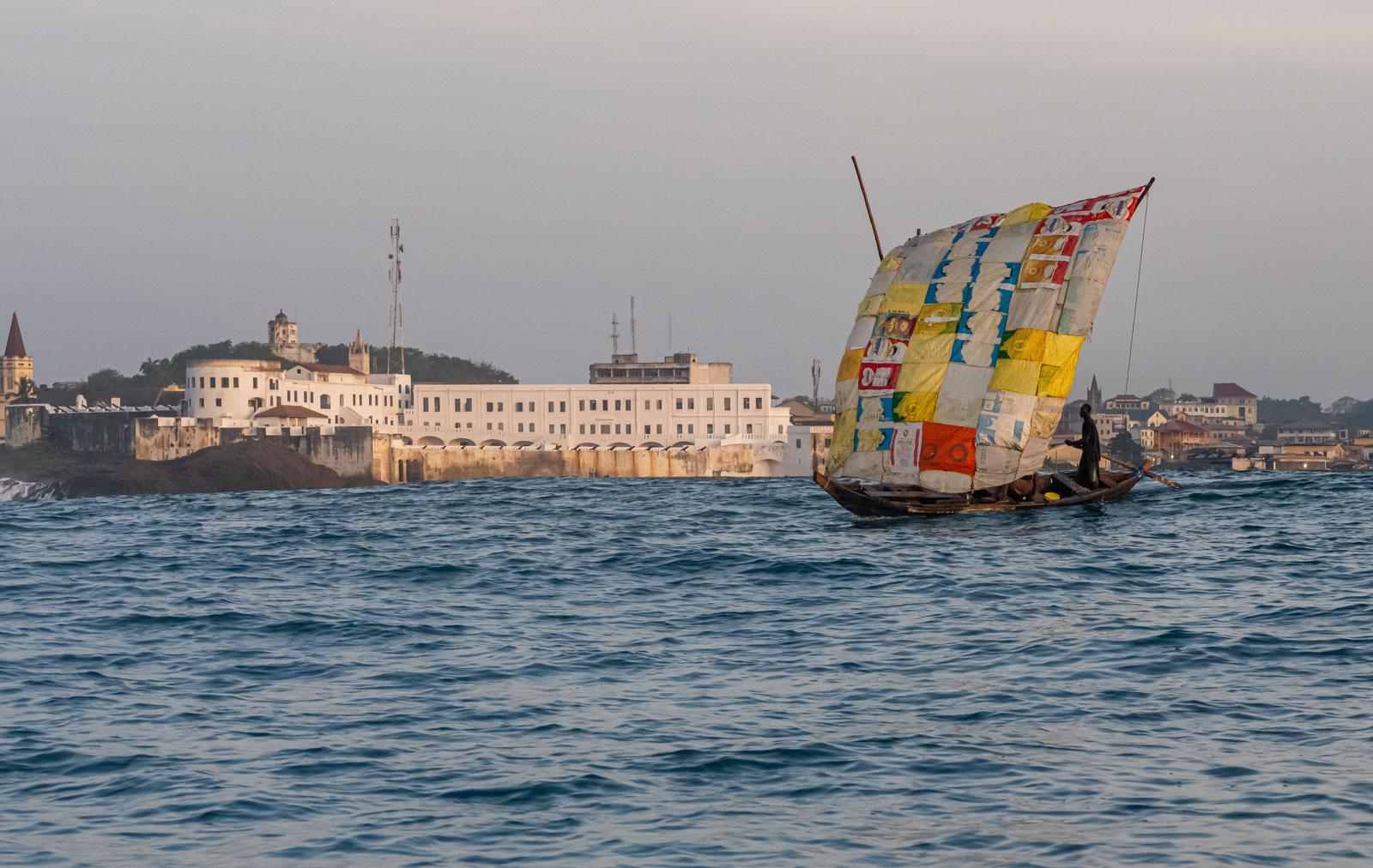
A lyrical slice of coast life with a wonderful tension between a handmade sail and an imposing shoreline fortress.
Thanks Emery. I’m treating this as travel/documentary: a small sailing canoe with a patchwork sail passing a coastal stronghold at calm dusk. The strongest qualities here are the dignified view of the fisherman and the thoughtful juxtaposition of present-day labour against a heavy slice of history. The choice to shoot from the waterline rather than the shore puts us in the scene and gives the sea real presence. I’ll break down what’s working and where tightening will lift it further.
TECHNICAL EXECUTION ★★★★
The file looks clean and restrained; colours are natural and not pushed. The sail and standing figure are nicely sharp for a moving boat, suggesting a sufficiently quick shutter. The white fort holds detail without obvious clipping, which is easy to lose at this hour, so well judged exposure. The distant shoreline is a touch soft and hazy, likely atmospheric, but it reads as depth rather than a flaw. I see no heavy processing or artefacts, though the midtones could take a little micro‑contrast to add bite to the sail’s texture. To reach five stars, aim for crisper definition across the boat and slightly more clarity in the fort, either via a fraction faster shutter or selective local contrast in post.
COMPOSITION ★★★★
The frame balances two anchors: the boat on the right and the fort on the left, with the sea leading us between them. The horizon is straight and the negative space of water gives the boat breathing room. The sail sits cleanly against the sky, which keeps it readable; good timing there. Where it slips is spacing: the boat feels a little close to the right edge and could use more lead room in the direction of travel to enhance momentum. The tall telecom mast behind the fort and a few busy rooftop shapes nibble at the elegance of the background. Would stepping or panning a fraction earlier to keep the boat further left—and/or trimming a little water from the bottom—have improved balance for you?
LIGHTING ★★★★
The soft late-day light is kind to the scene, keeping colours gentle and the sea a pleasing blue without glare. Side light skims the patchwork sail, revealing seams and texture—one of the image’s pleasures. The fort’s white walls are evenly lit, avoiding harsh hotspots that often plague bright façades. It isn’t dramatic light, but it feels honest and suits the subject. A slightly lower sun or thinner haze would add extra shape and warmth to the sail and more tonal separation in the fort. Consider whether waiting for the sun to dip a few more minutes could have deepened the mood without losing detail.
STORY ★★★★
The narrative is strong: a handmade, patched sail and lone sailor set against a monumental coastal stronghold—past and present in one frame. The human figure standing in the canoe gives agency and scale; this is not just a pretty seascape. The water’s texture hints at motion and purpose rather than a static postcard. What’s missing for a five-star story is a decisive micro‑moment—a visible gesture (handling a rope, bracing against a wave) or a stronger wave splash to punctuate the action. Did you wait for a specific gesture, or was boat traffic dictating a quick grab? A second layer of human activity on the shore could also add depth if available.
IMPACT ★★★★
The colourful, quilted sail is memorable and instantly draws the eye; it’s the kind of detail viewers remember. Combined with the historical backdrop, the image feels grounded in place rather than generic. The calm light and measured palette keep it tasteful and print‑worthy. It stops short of iconic only because the composition feels slightly constrained on the right and the moment isn’t quite at a peak. With a touch more space for the boat to “travel” into and a clearer human gesture, this could be a portfolio leader.
CONSTRUCTIVE NEXT STEPS
- Give the boat more lead room by framing a little wider or timing a beat earlier; aim to keep at least a third of the frame open in front of the bow to strengthen the sense of movement.
- Shoot from even closer to the waterline (if safe) and trim some foreground sea in post; this will enlarge the boat slightly and tighten the dialogue with the fort.
- In post, apply selective dehaze/clarity on the sail and the fort’s midtones, and consider cloning out the telecom mast behind the fort—it’s a small but persistent distraction in a travel image.
- When possible, wait for a micro‑gesture—hands on a rope, a turn of the head, or a small wave breaking against the hull—to add a clear moment without staging.
AI Version 2.12