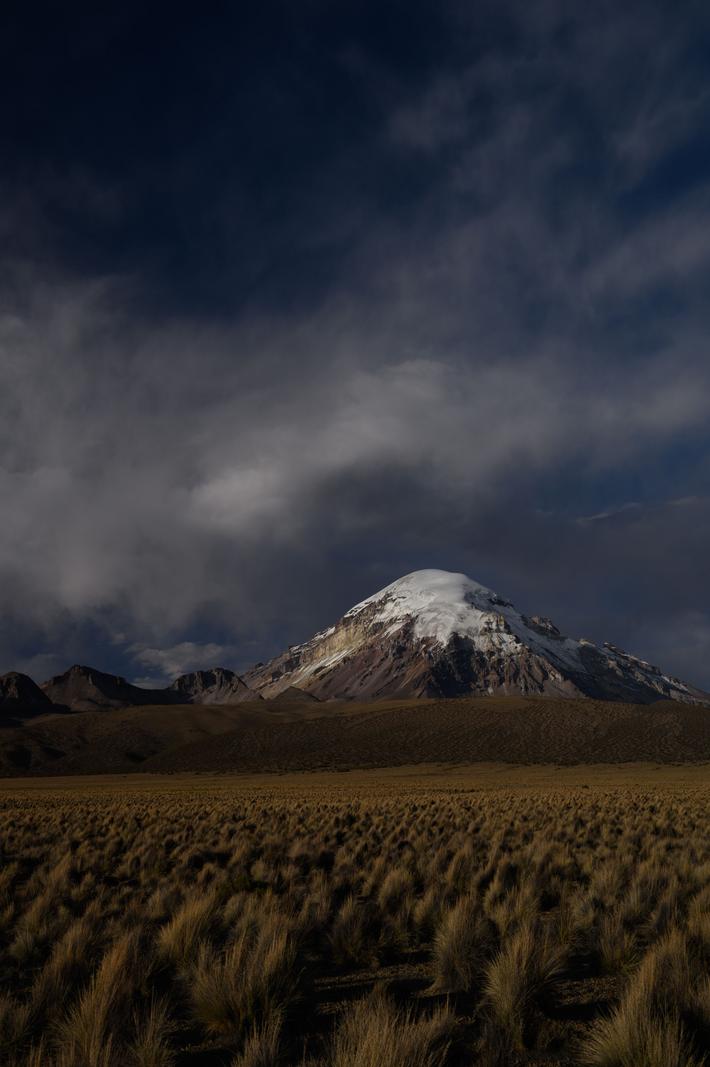
A strong, moody mountain scene that would benefit from tighter intent and a clearer visual anchor.
People aren’t required here—landscapes can sing without them. To strengthen this frame, think about three levers you control without adding a person: composition (where you place the horizon and what you use as a foreground anchor), timing of light, and how much of the sky you allow to dominate. Right now the snow‑capped peak is compelling, and the brooding cloud ceiling adds mood, but the huge expanse of dark sky and the unlit foreground grasses dilute the focus. Consider whether you want the story to be “the mountain under a storm” or “the grassland leading to the peak”—your framing should commit to one. What would change if you lowered your viewpoint and built the frame around a single clump of grass or rock, then used a panoramic crop to reduce the sky? This is classic landscape work with a travel feel, and some deliberate choices will lift it from a good view to a photograph with presence.
TECHNICAL EXECUTION ★★★★
The file looks clean and sharp; the snow on the summit holds highlight detail nicely and colours are natural and restrained. Exposure, however, leans dark overall, leaving the foreground grasses a little crushed where texture would help depth. There’s no obvious noise or artefacts, and the tonal handling in the clouds is smooth. The image would gain with a small lift in midtones and careful shadow recovery on the grassland to open detail without flattening contrast. A touch of local dodge on the lit ridge could guide the eye to the peak more decisively. To reach five stars, refine the tonal separation between foreground, mountain, and sky while keeping the natural look.
COMPOSITION ★★★
The mountain sits near centre with a very low horizon and an enormous amount of sky, which makes the frame feel top‑heavy and slightly detached from the land. The grassland offers texture but no clear foreground subject to pull the viewer in; it reads as a dark carpet rather than a lead‑in. A panoramic crop removing the top quarter to third of the sky would concentrate attention on the peak and ridge line. Alternatively, moving a metre or two to place a single prominent tuft of grass or a rock in the lower third would create a foreground‑midground‑background flow. Was your intention for the sky to be the main character? If so, the peak might sit lower and smaller; if the peak is the hero, give it more frame and a lead‑in.
LIGHTING ★★★★
The brooding weather is a strong asset—the soft directional light chisels the snow and hints at incoming storm. The foreground, though, falls into deep shade, which flattens the first third of the frame and weakens depth. Waiting for cross‑light to skim the grasses, or a brief sunbreak to paint the ridge, would add separation and texture. Early or late light would also warm the tones of the land against the cool sky for a pleasing contrast. With a little more side‑light on the lower half, this would move towards top‑tier light quality.
STORY ★★★
There’s a clear sense of solitude and raw place—a high, icy summit rising from a dry plain. However, the scene reads as a general view rather than a specific moment; the clouds are interesting but not at a decisive shape, and the land offers no singular detail to “hold” the story. Stronger weather (a clearing storm edge, a shaft of light, drifting mist) or a deliberate scale element (a moon, a distant bird, a highlighted boulder) would give the frame a moment. What did the wind or cloud movement look like five minutes later, and could a longer exposure have shown that change?
IMPACT ★★★
It’s a handsome mountain shot with tasteful colour and mood, but the excess sky and unlit foreground keep it from being memorable. Trim the frame and time the light and you’ll gain punch without gimmicks. The ingredients are promising; what’s missing is a strong anchor or a more decisive slice of weather. Achieving that would push it into the striking category.
CONSTRUCTIVE NEXT STEPS
✓ Try a 16:9 or 2:1 panoramic crop that removes the top quarter‑third of sky; keep the summit on an upper‑third intersection to make the mountain the clear subject.
✓ On location, get lower and closer to a single clump of grass or a rock and use 24–35mm to make it a foreground hero leading the eye to the peak.
✓ Return for cross‑light (sunrise/sunset or a sunbreak after rain) so the grasses catch light; use a polariser to cut haze and deepen cloud definition; consider bracketing one stop either side if the contrast is extreme.
✓ With a tripod and 6–10 stop ND, test a 15–60s exposure to streak the clouds while keeping the mountain crisp, adding movement and a sense of passing weather.
AI Version 2.0