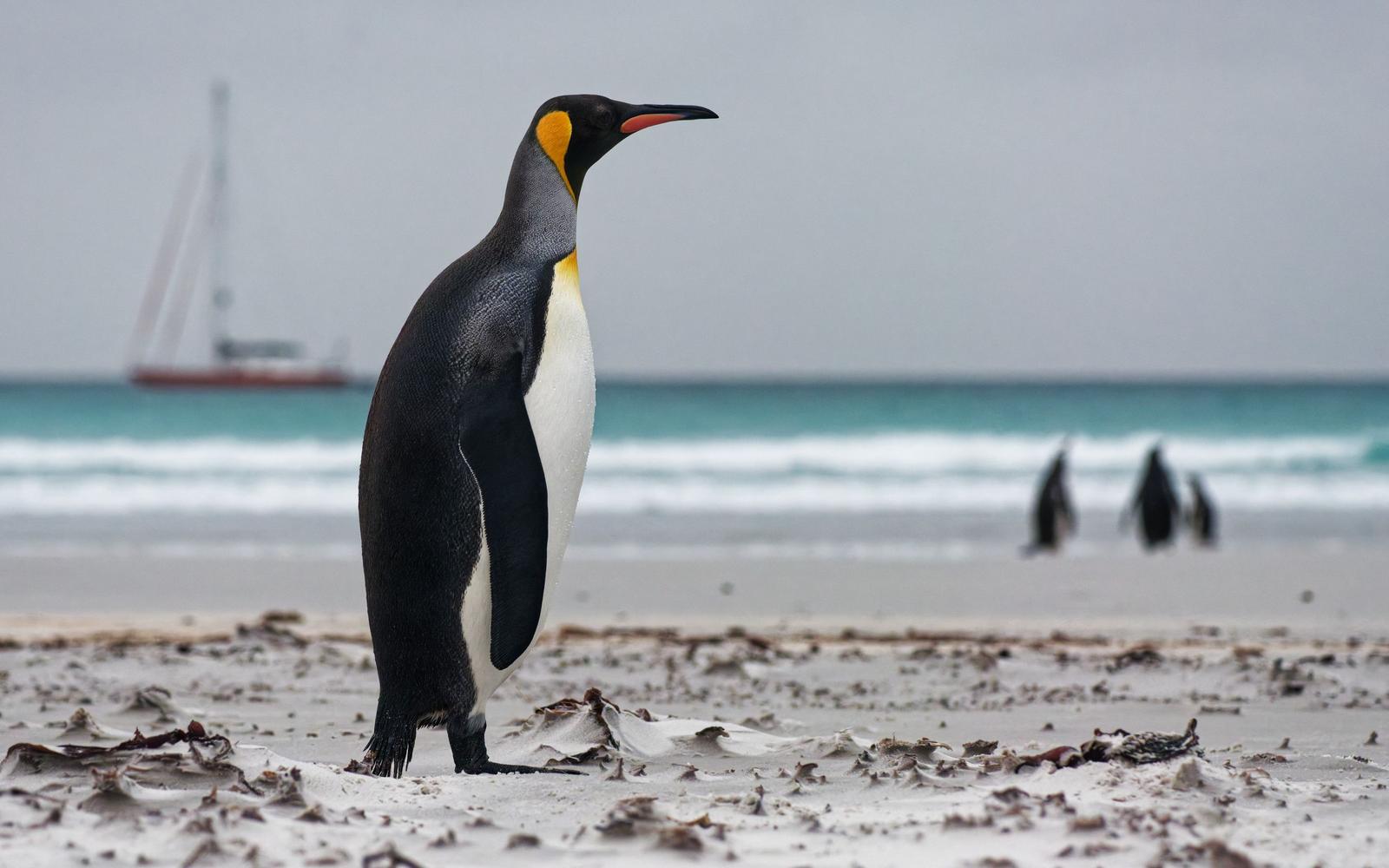
A clean, dignified wildlife portrait with a welcome sense of place.
Your choice of shallow depth of field works well here, Hervé—it isolates the penguin while keeping the boat and distant birds as soft context. This reads as wildlife with a travel flavour: a proud profile in the foreground, a hint of expedition life in the back. The restrained colour and overcast mood suit the species and the place. Do you want this to feel like a solitary portrait or a wider story of colony and journey? That answer will guide how prominent the boat and background penguins should be in future frames.
TECHNICAL EXECUTION ★★★★
Feather detail looks crisp and the exposure holds both the white belly and dark back nicely—no clipped whites and plenty of texture. The shallow DOF is clean, with a gentle fall‑off that separates the subject without looking overly processed. Colour is natural; the yellow/orange throat patch feels true and not pushed. I can’t see noise or artefacts that would worry a print. To push this to five stars, aim for a tiny catchlight and absolutely pin‑sharp focus on the eye; a subtle local dodge there in post would help.
COMPOSITION ★★★★
The penguin’s profile is elegant, with space in front of the beak so it has “room to breathe.” The defocused trio on the right forms a secondary anchor, and the boat on the left adds a third point—nice triangular balance. The horizon runs through the neck/chest, which slightly flattens the figure; a lower viewpoint would place the bird cleanly against sky. The red boat, even blurred, tugs the eye—either commit to it as a feature or minimise its influence by shifting your position. A touch more negative space at the feet would also emphasise stature.
LIGHTING ★★★
Soft overcast light keeps detail and colour honest—ideal for feathers—but it’s also quite flat. Without directional light, the body loses some sculpting and there’s little sparkle in the eye. Early or late side light would carve shape into the flank and add a pleasing rim along the back. Even within overcast, adjusting your angle to catch a brighter patch or pale sand as a reflector could lift the face. Would waiting for a brief break in the cloud have given you a subtle highlight on the beak?
STORY ★★★
The frame communicates place: a lone king on a Falklands beach, colony and expedition hinted at behind. It’s a dignified portrait, but the moment is static—no step, call, or interaction. A lifted foot, a shake of feathers, or a glance toward the distant group would deepen the narrative. If the boat is part of the story, bringing it a touch closer in frame or aligning it with the penguin’s gaze could strengthen that connection. As it stands, the story is clear but restrained.
IMPACT ★★★
It’s a pleasing, polished image of a charismatic species—easy to enjoy and well executed. The subtle travel context helps, but it doesn’t yet deliver a standout moment. Greater gesture, stronger light, or a more intentional relationship between the foreground bird and background elements would lift memorability. What unique angle—behavioural or compositional—could make this feel unmistakably yours?
CONSTRUCTIVE NEXT STEPS
- Get lower—penguin eye height if safe—to separate the head cleanly from the horizon and add presence; aim for the eye on the upper third.
- Commit to the background: step a metre or two so the red boat either sits well away from the penguin’s silhouette or is excluded; alternatively, align the distant penguins to form a clear counter‑subject.
- Wait for gesture: a lifted foot, open beak, or head tilt. Use around 1/1000s, f/4–f/5.6, and continuous AF to catch that micro‑moment.
- Post‑processing: gently dodge the eye and the yellow throat patch, reduce saturation of the red boat via HSL so it doesn’t steal attention, and heal a few bright kelp scraps near the feet.
AI Version 2.12