Moody rain, great potential—right now the frame is fighting itself rather than singing.
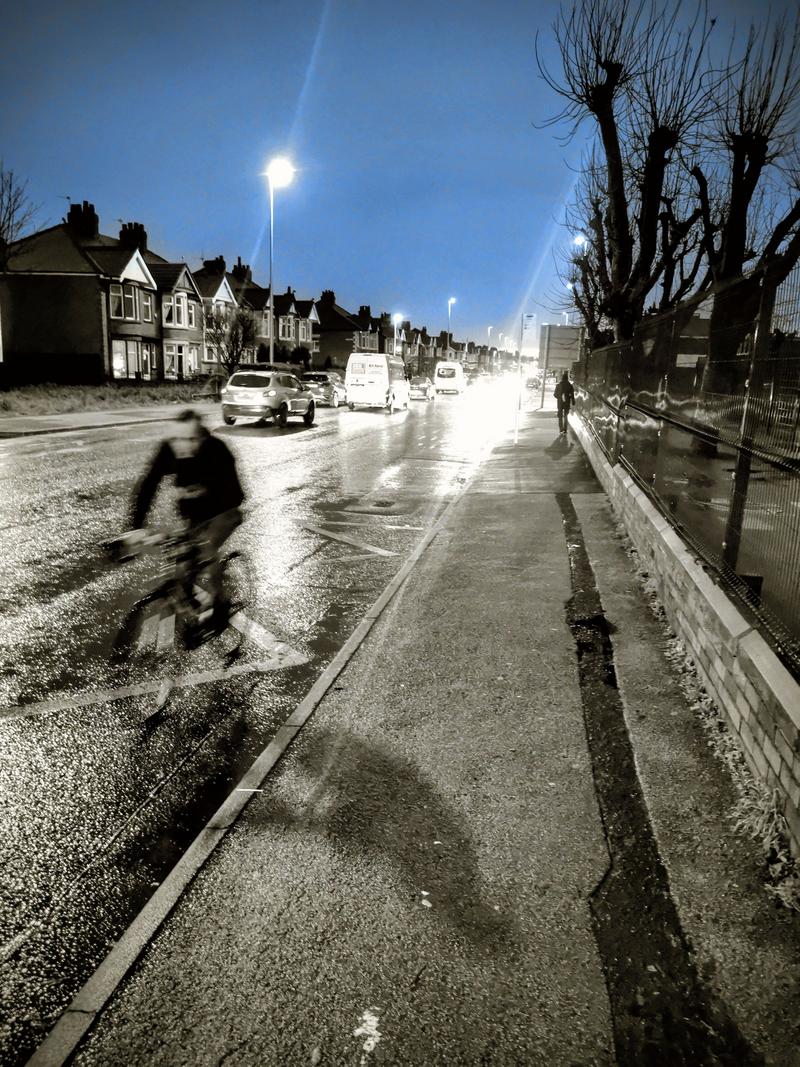
Thanks for asking directly, Andrew. This sits in street photography: an urban evening with wet roads, a blurred cyclist and a lone walker. The strongest ingredients are the slick reflections and the sense of movement, but the image is weakened by two things: the heavy selective colour treatment (blue sky, monochrome street) and an unclear subject. Decide first what the picture is about—is it the cyclist’s rush through the rain, or the small figure on the pavement against the traffic glare? Your answer dictates camera settings, framing and processing.
TECHNICAL EXECUTION ★★
The selective colour grading pulls the shot away from realism and caps the technical quality; it reads as a gimmick rather than a choice that serves the story. Headlights are heavily blown, which is acceptable at night, but here they dominate and clip large areas of detail. The cyclist is entirely motion‑blurred without a sharp anchor elsewhere, so the viewer has nothing to lock onto. Grain and focus on the static parts are fine, suggesting the camera could have handled a higher ISO to allow a faster shutter. To reach five stars, lose the selective colour, anchor one subject with either a sharp capture or a clean pan, and control the brightest highlights in post.
COMPOSITION ★★
The pavement on the right occupies nearly half the frame yet contains only a tiny figure; meanwhile the brightest area is the headlight burst mid‑right, so the eye is dragged there rather than to the cyclist. The blurred rider sits low-left with little space to move into, which flattens the sensation of speed. The dark fence and trees form a heavy mass on the right edge, adding weight without adding meaning. Consider what would change if you stepped a metre left (if safe) and lowered your viewpoint to place the cyclist against the lighter road rather than the kerb, giving them space to travel into. A tighter crop from the right would also cut the visual dead space and the brightest distraction.
LIGHTING ★★★
The wet road catching the streetlights is the best asset—those silver highlights give mood and texture. However, the central headlight burst is so intense that it overwhelms the subtler reflections and swallows detail on the pavement. The blue-toned sky feels disconnected from the mostly monochrome street, which makes the light look inconsistent. Waiting for a moment when a cyclist passes under a lamppost (or when fewer cars approach head‑on) would give a controllable pool of light without the flare. Bringing the shot to a true black‑and‑white would unify the tones and let you dodge/burn the reflective path with intent.
STORY ★★
There’s a good everyday narrative here—commuters, rain, speed versus stillness—but the moment isn’t quite formed. The cyclist is a smudge rather than a readable figure, and the pedestrian is too small and distant to carry emotion. Because neither character is clear, the traffic glare becomes the protagonist by default, which isn’t very interesting. Ask yourself: whose story is this, and what gesture or position would make them unmistakably the lead? A sharper rider, or a walker stepping into a pool of light, would lift this from “scene” to “moment.”
IMPACT ★★
The atmosphere of a wet evening is appealing, but the image doesn’t stick because the subject is ambiguous and the processing draws attention to itself. The brightest area steals attention without reward, and the blue‑sky/monochrome street treatment dates the picture. With a clear focal point and honest toning, this could be punchy and memorable. What single element do you want a viewer to remember—the rider’s urgency, the glare on wet tarmac, or the solitary walker? Choose, then build everything else to support it.
CONSTRUCTIVE NEXT STEPS
- Commit to a subject and set shutter accordingly: for a sharp cyclist aim around 1/250–1/500s (raise ISO to 1600–3200 if needed); for motion with clarity, pan at ~1/20–1/40s and follow the rider so they’re sharp against streaked background.
- Reframe to reduce distractions: if safe, move left towards the kerb and lower your viewpoint; leave space ahead of the cyclist; or crop roughly 15–20% from the right to lose the empty pavement and brightest headlight burst.
- Process cleanly: ditch selective colour and go full black‑and‑white; pull highlights down, lift midtones on the wet road, and use gentle dodge/burn to create a luminous path leading to your subject.
- Wait for timing: shoot when a subject enters a lamplight pool with fewer oncoming cars, or when the walker reaches the bus stop sign—one clear gesture in good light beats constant traffic glare.
AI Version 2.12