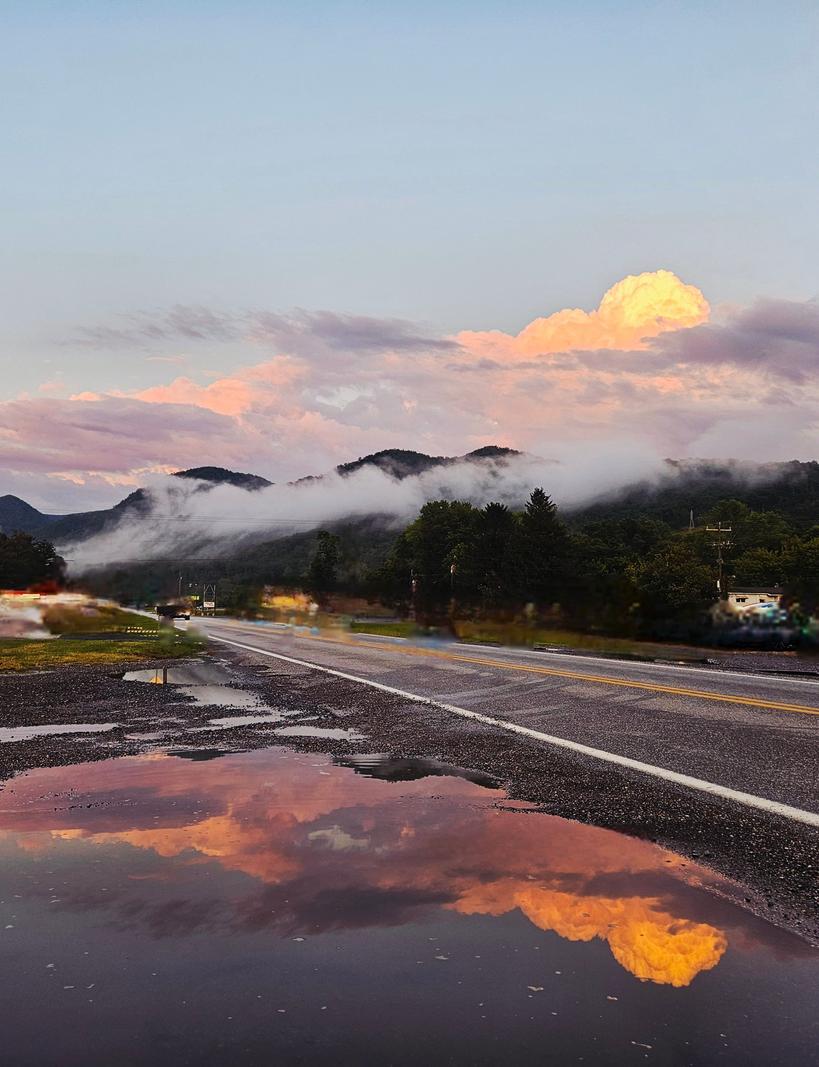
A calm, after‑rain roadside with pastel clouds doubled in a puddle — a solid idea with room to refine.
You’ve achieved the “double” — the warm cloud and its reflection are the strongest elements here. This sits in the landscape/travel space, and your timing after rain with low mist along the hills adds mood. What holds it back is the messy mid‑ground near the road and a strange smear across the verge that looks like computational artefacts, which breaks the illusion. The reflection would sing louder if the frame committed more decisively to it. What made you choose this standing height rather than getting very low to let the puddle fill the foreground and clean up the clutter?
TECHNICAL EXECUTION ★★
Exposure is controlled well; the sky retains colour and the reflection has good tonal range without clipped highlights. White balance feels natural and the mist reads cleanly. However, there’s noticeable digital smearing/artefacting along the centre of the frame by the roadside and grass, likely from heavy in‑camera processing (phone HDR/NR or a slight stitch/IBIS hiccup). That mushy strip undermines detail and realism, and the mid‑ground looks soft compared to the crisp puddle edge. To reach five stars you’d need a clean file: shoot RAW, stabilise (tripod or firm brace), keep ISO low, and avoid aggressive computational modes that blend frames.
COMPOSITION ★★★
The diagonal road is a usable lead‑in and the puddle provides a foreground anchor. The bright, peach cloud sits upper right and echoes nicely in the lower right reflection, giving a pleasing echo. But the frame is busy: power lines, signage and gravel fragments compete for attention, and the horizon sits a bit indecisively, neither a strong thirds placement nor a deliberate symmetry. A much lower viewpoint would enlarge the puddle, simplify the foreground, and allow you to choose between a near‑symmetrical “sky/reflection” scene or a road‑led narrative — right now it’s half of each. Consider a tighter crop from the right and a touch off the empty upper sky to concentrate on the cloud, mist and reflection.
LIGHTING ★★★★
The timing is good: soft, warm light on the clouds, cool greens in the trees, and a lovely band of fog across the hills. The reflection catches that warmth, which is the photograph’s charm. There’s no harsh contrast and the scene breathes. The only drawback is the large, pale blue upper sky that contributes little; trimming it would make the remaining light feel richer. To reach five stars you’d want slightly more separation or edge light on the hills, but overall the light is handled well.
STORY ★★★
The picture hints at a quiet “after the storm” moment: rain has passed, puddles linger, mist clings to the mountains. That’s a mood, and the road suggests travel or return. Still, it remains descriptive rather than memorable because there’s no extra beat — a single car with headlights, a cyclist, or a stronger commitment to the mirror‑world could give the scene a heartbeat. Ask yourself: is this about the road, or about the sky reflected at your feet? Choosing one clearly would strengthen the story.
IMPACT ★★
The warm cloud and reflection have presence, but the mid‑frame artefacts and scattered roadside details blunt the initial “wow”. As it stands, it sits among many pleasant sunset‑plus‑puddle images. Clean execution and a bolder compositional choice would lift it beyond “nice view” into something that sticks. Eliminate distractions and commit to either symmetry or a lead‑in narrative for a stronger, more memorable result.
CONSTRUCTIVE NEXT STEPS
✓ Get very low — knee or ground level — and let a single clean puddle dominate the foreground. Compose either a near‑symmetrical sky/reflection or use the puddle edge as a clear leading curve; don’t split the difference.
✓ Move a few steps to exclude the power lines/signage on the right and aim for a simpler edge‑to‑edge frame; a slight crop off the top and right will also help.
✓ Technical clean‑up: shoot RAW at ISO 100, around f/8 on a tripod (or brace the camera), and disable phone “smart HDR/long exposure” modes to avoid the mid‑frame smearing. Use a 2‑second timer to prevent shake.
✓ Post‑processing: heal out small bright gravel specks and wires, add subtle local contrast to the fog/hills, and pull orange saturation back a touch so the colour feels natural and not syrupy.
AI Version 2.0