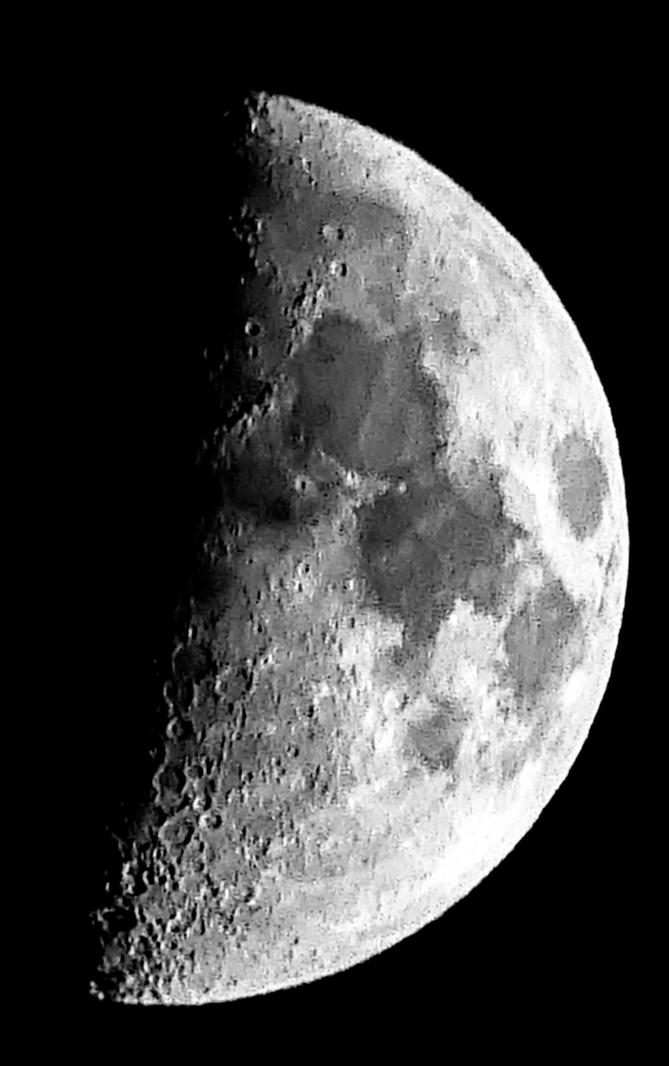
Strong lunar relief, but resolution and contrast control are holding it back.
Joseph, this is a clean, minimalist study of the Moon with pleasing raking light along the terminator. Although you’ve titled it “Waxing Crescent,” the illumination looks closer to first quarter, which actually helps reveal those craters and ridges so well. As an astrophotography‑style image, the intention reads as a detailed, high‑contrast portrait of the lunar surface rather than a wider scene. The dark, featureless sky keeps the focus firmly on texture and form, and the terminator running vertically gives the frame a nice sense of height. What were you aiming for here — a pure technical study of detail, or a moodier piece that places the Moon within a larger story?
TECHNICAL EXECUTION ★★
Detail is present, but it’s soft and appears to have been pushed with heavy sharpening; halos are visible along the bright rim and around some crater edges. The file also shows coarse noise/grain and compression artefacts, particularly in the mid‑tones near the terminator, suggesting high ISO, digital zoom, or significant cropping. Contrast feels aggressive: shadows on the left edge are crushed to black, bleeding subtle terrain detail. Focus may be a touch off or limited by atmospheric shimmer, as micro‑detail never quite snaps. With cleaner acquisition (lower ISO, faster shutter, steadier support) and gentler processing, this could jump a full category.
COMPOSITION ★★★
The Moon is set slightly right of centre with generous negative space on the left, which works with the phase and lets the subject “look into” darkness. However, it’s crowded near the right edge and bottom—there’s little breathing room around the limb, which adds tension but not purpose. A touch more space all around (or a deliberate, tighter crop that commits to the edge) would feel more intentional. The vertical orientation suits the tall arc of the terminator, yet the frame could be more decisive: is it a clinical study (perfectly centred, symmetrical) or a graphic design (bold negative space)? Deciding that explicitly would strengthen the read.
LIGHTING ★★★★
The sun’s low angle across the surface sculpts relief beautifully; craters along the terminator pop with depth and texture. Bright regions on the sunlit side hold tone reasonably well without obvious clipping. Where it stumbles is in the treatment of shadow—local contrast seems pushed, losing the half‑tones that give volume just left of centre. A subtler tonal curve could preserve that modelling and let the light do more of the work. Overall, the chosen phase and angle are good decisions for surface detail.
STORY ★★
This functions as a straightforward celestial portrait: impressive, but thin on narrative. There’s no context (horizon, foreground silhouette, or comparative scale) to suggest time, place, or experience beyond “I photographed the Moon tonight.” That’s fine for a study, yet it limits emotional pull. If your goal is atmosphere, consider elements that hint at the human vantage point or a passing moment. What mood or idea did you want viewers to take away beyond detail?
IMPACT ★★★
The subject is inherently striking, and the terminator gives graphic strength, so the image does land at first glance. However, softness, halos, and the cramped crop reduce the “wow” that crisp lunar shots deliver. It sits among many similar moon studies without a distinguishing twist, either technical or conceptual. Cleaner detail and a bolder compositional choice (or added context) would lift memorability significantly.
CONSTRUCTIVE NEXT STEPS
✓ Capture cleaner data: use a sturdy tripod, manual focus on the limb, lower ISO (100–400), and a fast shutter (around 1/250–1/500s). If shooting through a telescope, avoid digital zoom and refocus between short bursts to beat seeing.
✓ Improve acuity without halos: in post, reduce global clarity; apply deconvolution or Unsharp Mask on a masked layer targeting mid‑tone detail only. Manage blacks with a gentle S‑curve to keep shadow half‑tones alive near the terminator.
✓ Consider stacking: record 50–200 short exposures and stack in AutoStakkert!/RegiStax to average out noise and atmospheric shimmer, then apply restrained sharpening.
✓ Make the composition decisive: either give the Moon more breathing room on the right and bottom, or commit to a bold graphic crop with generous negative space. Alternatively, include a foreground silhouette (tree line, rooftop) to add scale and a sense of place.
AI Version 2.1