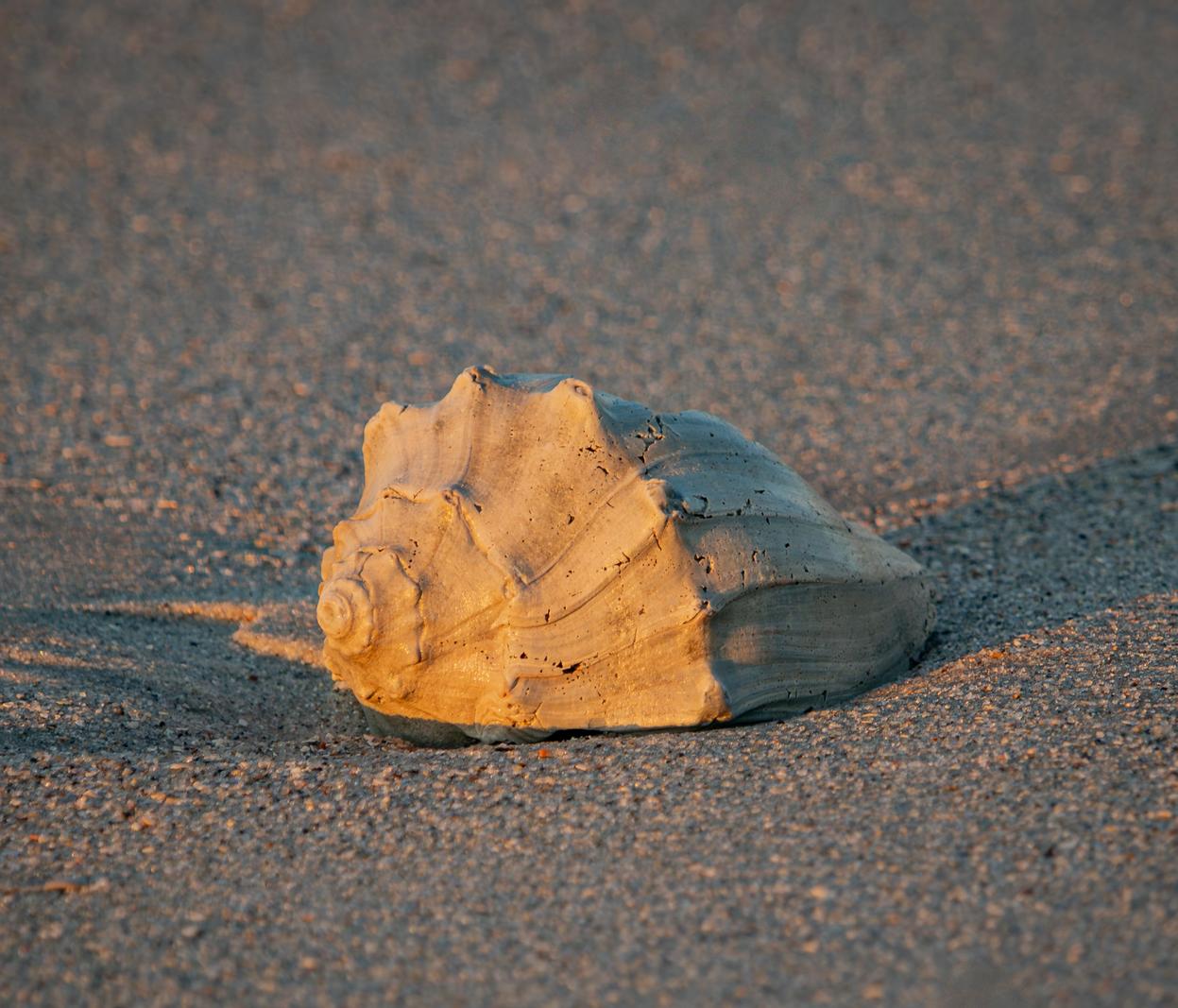
Warm evening light and texture are strong, but the frame needs a clearer intent — either go tighter or tell more of the beach story.
Thanks, Gordon. This reads as a simple still‑life/nature study: a single shell on sand in low, warm light. You’ve handled the tones cleanly and the side light nicely models the ridges, so the raw capture is sound. The image falls short because it sits between two ideas — a close study of form and texture, and a small story about a shell on a shoreline — without fully committing to either. Ask yourself: do you want the viewer to feel the solitude of the beach or to marvel at the shell’s sculptural detail? Your answer should drive framing, viewpoint and timing.
TECHNICAL EXECUTION ★★★★
Focus on the shell looks crisp and the sand retains fine detail, suggesting a solid shutter speed and clean processing. Exposure is balanced; highlights on the top plane aren’t clipped and shadows hold texture. Colour is warm but believable for late light, though the overall cast could be cooled a touch to avoid a uniformly yellow feel. There’s no visible noise or artefacts, and sharpness appears natural rather than over‑edged. To reach five stars I’d like to see a subtle local contrast treatment that adds bite to the shell’s ridges without affecting the sand, plus a tiny clean‑up of the darker pits and specks if they distract.
COMPOSITION ★★★
The shell sits roughly left‑of‑centre with a long shadow pointing right; it’s simple and uncluttered, which helps. However, there’s a lot of empty space above and to the right that doesn’t add much, and the shadow exits the frame abruptly, feeling unresolved. The viewpoint is slightly high, flattening the subject against the sand; a lower angle would increase presence and shape. Consider either a tighter crop that puts the shell on the lower‑left third and keeps the entire shadow within the frame, or go wider to include contextual elements like a tide line. What would a vertical orientation do here, letting the shadow lead up through the frame?
LIGHTING ★★★★
The low, raking light is the image’s strength, giving the shell form and revealing texture in the sand. The warm side light produces pleasing dimension without harsh hotspots. The shadow adds direction but, because it’s cut off, its potential as a leading element is muted. A slightly lower angle would lengthen and define that shadow more dramatically. For a five‑star result, time it so the light grazes even more tangentially or reflect a hint of fill from the left to lift the shell’s darker flank by half a stop.
STORY ★★
Right now it is simply a shell on sand; pleasant, but thin on narrative. There’s no sense of tide, wind, or recent human presence to give context or tension. Including a receding wave, foam, or a single footprint would transform it from an object study into a small scene with time and place. Alternatively, an extreme close study would make the “story” purely about form and texture, which is a valid choice. Which direction feels truer to what you noticed in the moment?
IMPACT ★★
It’s calm and agreeable but easy to pass by, largely because the frame doesn’t make a decisive statement. The warm light helps, yet the abundance of similar sand and the cropped shadow dilute the punch. A committed composition (tight sculptural study or wider environmental moment) would lift memorability. Distinctive timing — e.g., a wave just touching the shell — could also add that spark. Refining these choices would raise this comfortably into “stop and look” territory.
CONSTRUCTIVE NEXT STEPS
✓ Commit to a direction: either crop tight (remove ~40% of the top and ~20% of the right) to place the shell on the lower‑left third with the entire shadow included, or shoot wider to incorporate shoreline elements that give context.
✓ Change viewpoint: get lower to the sand and use a longer focal length (85–200mm) around f/4–f/5.6 to compress and soften the background while keeping the shell sharp; this will emphasise shape and isolate it from the grainy texture.
✓ Add a moment: wait for an incoming wave to lick the shell; try 1/6–1/10s on a tripod for gentle streaks while keeping the shell sharp, or 1/250s to freeze droplets — both create a clear “why now.”
✓ Post‑process subtly: cool the white balance by 200–300K, add a gentle dodge on the shell’s ridges and a burn on the surrounding sand to steer the eye; heal a few high‑contrast specks that pull attention.
AI Version 2.1