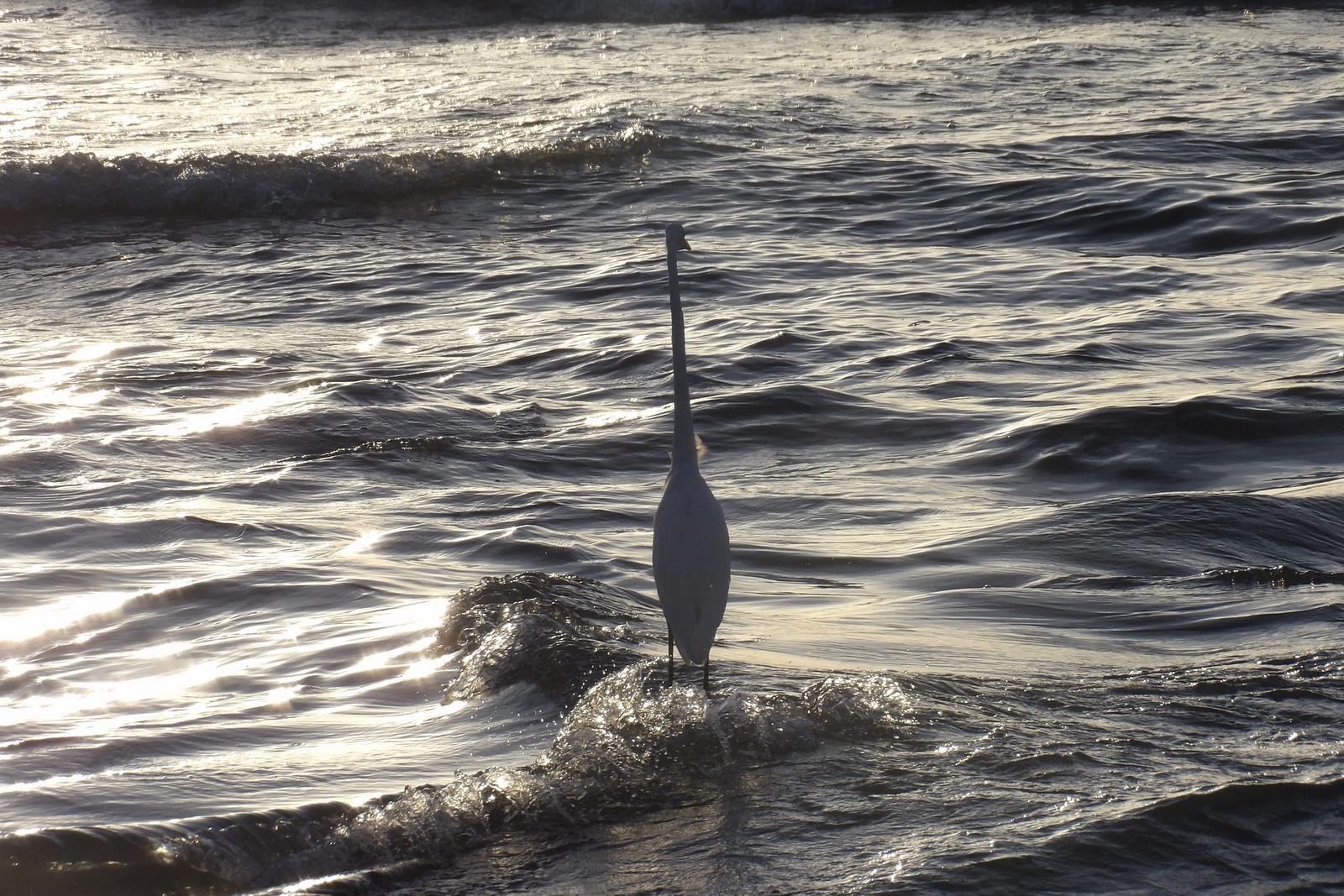
A calm, silvery scene with a lone wader, but the static rear view and busy water keep the picture from truly landing.
Thanks, Sandra. I hear your dilemma: move for a better angle and risk flushing the bird, or stay put and accept the view you’ve got. With wildlife this is common, and the usual answer is fieldcraft and focal length—get into position (or down low) well before you’re inside its comfort zone, then let it relax and wait for the moment. Here you have a wildlife silhouette of a wader standing in backlit water; the shimmering surface is pleasant and the small wave around the legs adds a hint of movement. What holds it back is the subject showing you its back with no eye, gesture or profile, so the character of the bird is missing. If your priority was the sea’s motion, a slower shutter could have made the water sing; if the priority was the bird, you needed a side profile or a step to give it life. Which of those mattered most to you at the time — the water’s texture or the bird’s personality?
TECHNICAL EXECUTION ★★★
The exposure keeps most of the bright reflections under control and the silhouette is clean, with no heavy-handed editing. Focus looks acceptable; the outline of the bird and the ripples are reasonably crisp. The dynamic range is tough here and the bird is rendered as a near-solid shape, so there’s no feather detail or catchlight to grab us. Highlights in the water are a little hot in places but not destructive. To reach ★★★★★ you’d want critical sharpness on the head/eye (if visible), cleaner separation from the background, and either deliberate rim‑light detail or a true, controlled silhouette with smooth tones and no clipped sparkle.
COMPOSITION ★★
The subject sits dead‑centre and faces away, which creates a passive, documentary feel. There’s a lot of similar‑looking water above the bird that doesn’t add information, while the most interesting part—the small breaking wave at its feet—is near the bottom edge, feeling crowded. Because the head is tiny and merges with dark water, the viewer’s eye wanders without a strong anchor. A lower angle or a side profile would separate the shape of the neck and bill against a lighter patch of water. A tighter, off‑centre crop placing the bird lower-left or lower-right would add direction and give space in front of its gaze or movement.
LIGHTING ★★
The backlight creates attractive sparkle but doesn’t sculpt the bird; there’s little rim light along the neck and no eye highlight. The light on the water dominates, so the subject is visually overwhelmed by contrast and specular reflections. This kind of lighting can be powerful for silhouettes if the outline is unmistakable, but here the long neck blends into darker ripples. Working 30–60 degrees off the sun or waiting for a cloud edge would give cleaner separation and gentler highlights. For five stars, I’d want purposeful rim lighting, a readable outline, and controlled reflections that support—rather than overpower—the subject.
STORY ★★
We have a bird standing in moving water—calm, but thin on narrative. The tiny wave around the legs hints at a moment, yet there’s no gesture: no stride, no head turn, no feeding behaviour. Because we can’t see the eye or profile, the animal’s character is hidden. Waiting for a single step as the wave reached it, or for a quick head tilt, would have lifted the frame immediately. To reach the top tier, aim for a micro‑moment of behaviour (a foot lifted, a strike, or a shake sending droplets into the light).
IMPACT ★★
The scene is pleasant and peaceful, but it’s easy to pass by because the subject lacks presence and the frame lacks a decisive moment. The repetitive texture of the water and centred placement reduce drama. With a stronger silhouette, a cleaner rim highlight, or a distinct behaviour, this could become memorable. Consider whether you want a graphic study (bold shape against bright water) or an intimate wildlife moment—right now it sits between both ideas. Push it decisively in one direction next time.
CONSTRUCTIVE NEXT STEPS
- Fieldcraft first: get into position before you’re close—low, still, and slightly off the sun—then let the bird settle. Use a longer focal length (300–600mm) so you can wait for a side profile without prompting it to fly.
- Chase a moment: waders often step as a wave reaches them. Pre‑focus and use continuous high burst at around 1/1000s to freeze a lifted foot and splash; alternatively, if the bird is rock‑still, try 1/15–1/30s on a supported camera to blur the water while keeping the bird sharp.
- Refine the frame: either shoot from a lower viewpoint to separate the neck against brighter water, or crop now to place the bird on a lower third and remove excess top water that adds little.
- Post‑processing: tame the brightest water highlights (-0.3 to -0.7 EV highlights), add a gentle local dodge along any rim light on the neck, and a subtle midtone contrast boost around the bird to increase separation without heavy effects.
AI Version 2.12