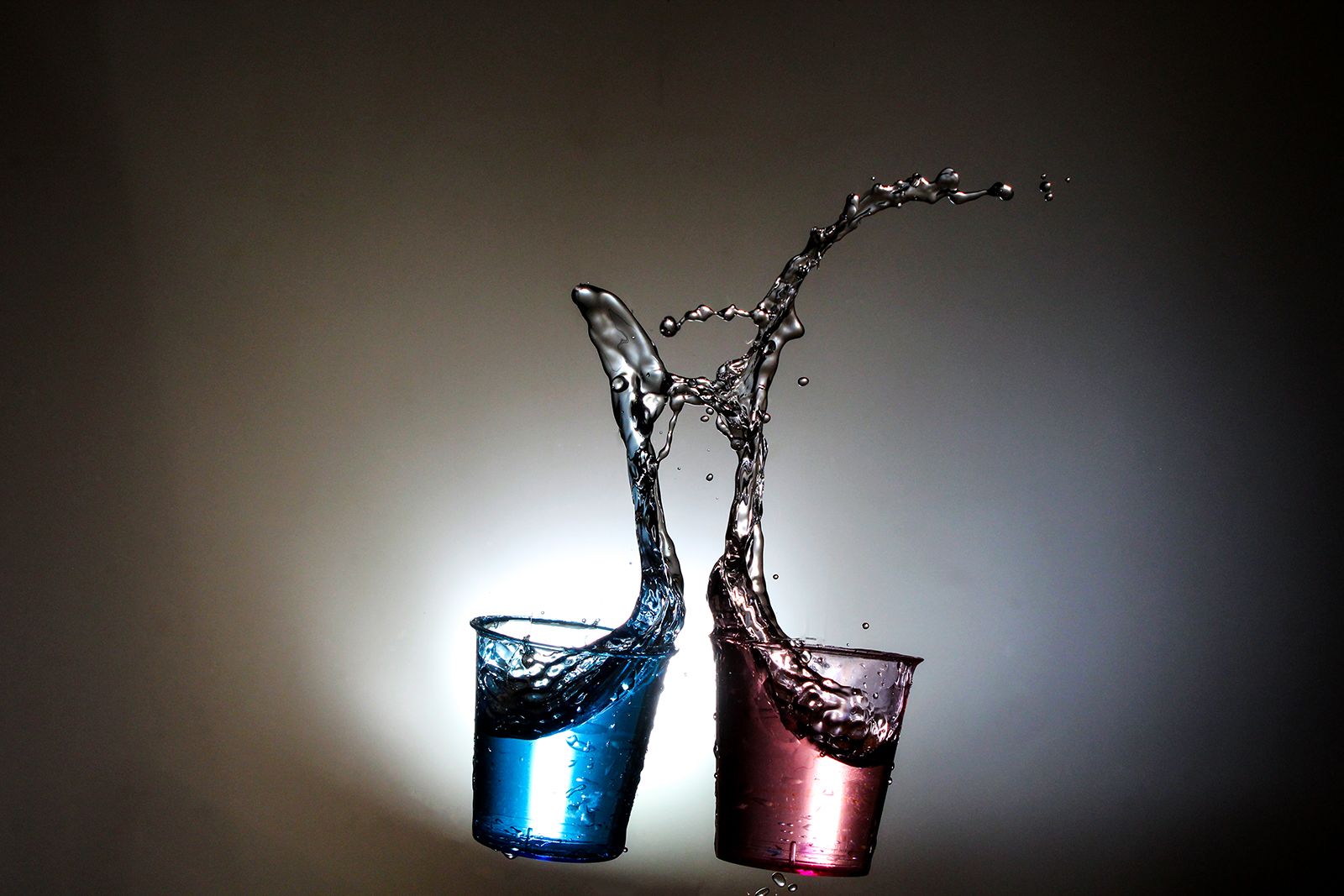
Crisp, energetic and clean — you’ve nailed the split‑second splash.
You’ve achieved your aim: the water is frozen cleanly and the droplets read beautifully. The two translucent cups (blue left, pink right) tilt towards each other and the splash arcs between them in a satisfying “cheers” moment — a studio still‑life with a product feel. The central glow behind the cups helps the water read as silver rather than grey, and the scene is free of heavy processing. As you refine this kind of shot, ask yourself: what exact splash silhouette are you chasing — a crossing X, a crown, or a single elegant arc — and how consistently can you engineer that shape?
TECHNICAL EXECUTION ★★★★
The motion is convincingly frozen; droplets at the top right are crisp, suggesting you used a short flash duration. The exposure is well held: the cups retain colour and the highlights in the water are bright without turning chalky. I can see a few hot speculars and a hint of softness on the front rim of the pink cup, likely from depth‑of‑field or minor residual blur, which is why I’m not at five stars. If you didn’t already, running the flashes at lower power (1/32–1/64) will shorten the burst and make every micro‑droplet tack sharp. How are you pre‑focusing — manual focus on the cup edge before the splash — and are you locking it to avoid hunting?
COMPOSITION ★★★★
The visual gesture is strong: two cups near the bottom, splash bridging the gap and pulling the eye upward into clean negative space. The opposing colours balance each other well and give the frame a clear left/right structure. The cups, however, feel slightly cramped against the lower edge; an extra centimetre of breathing room would remove that tension and make the arc feel more deliberate. Consider a vertical crop or capture to emphasise height — the drama is mostly upward. What would happen if the cups were separated a touch more so the arc cleared their rims and read as a single, unmistakable curve?
LIGHTING ★★★★
The backlit gradient is a solid choice: it gives transparency to the water and a clean stage for the droplets. The central hotspot is doing most of the work, but it flattens the front faces of the cups a little, leaving them slightly murky by comparison. A subtle front fill or narrow strip lights from each side would add edge definition to the splash and restore shape to the cups without killing the backlit sparkle. Flagging the background light to control the bright core would also keep attention on the water rather than the glow. Would a tiny kicker from camera right create a highlight ridge along the arc, making the splash read even clearer?
STORY ★★★
There is a clear, simple moment here — two vessels clink and the liquid leaps — which gives the image life beyond a static product shot. It’s fun and readable, but the narrative stops at “caught the splash.” If you want the frame to carry more meaning, you could introduce a secondary cue: hands to suggest a toast, a single ice cube hitting the surface, or two liquids of different colours actually mixing mid‑air. Right now it’s a technical success first, a story second. What feeling did you want the viewer to take away — celebration, collision, or precision?
IMPACT ★★★★
The clean set, bold colour contrast and frozen chaos create an immediate hit; it’s the kind of picture that grabs attention on a page. It feels polished and intentional, not gimmicky. To push it to unforgettable, the splash shape needs to be even more distinctive or poetic — the kind of silhouette you remember after you look away. Refining the lighting accents and composition as noted would also concentrate the punch.
CONSTRUCTIVE NEXT STEPS
✓ Shorten flash duration and lock focus: run speedlights at 1/32–1/64 power, manual focus on a pre‑placed marker where the splash peaks, and shoot at f/8–f/11 for cup sharpness without risking motion blur.
✓ Reframe for breathing room: give a little more space beneath the cups or try a vertical orientation; keep the arc fully contained and remove edge‑hugging droplets with spot healing to reduce distractions.
✓ Add controlled accents: keep the backlight but introduce narrow side strips or reflective cards to skim the water and lift cup detail by about 1/3 stop; flag the background light to tame the central hotspot.
AI Version 2.0