Beautiful sky and calm water, but the frame needs a clear anchor.
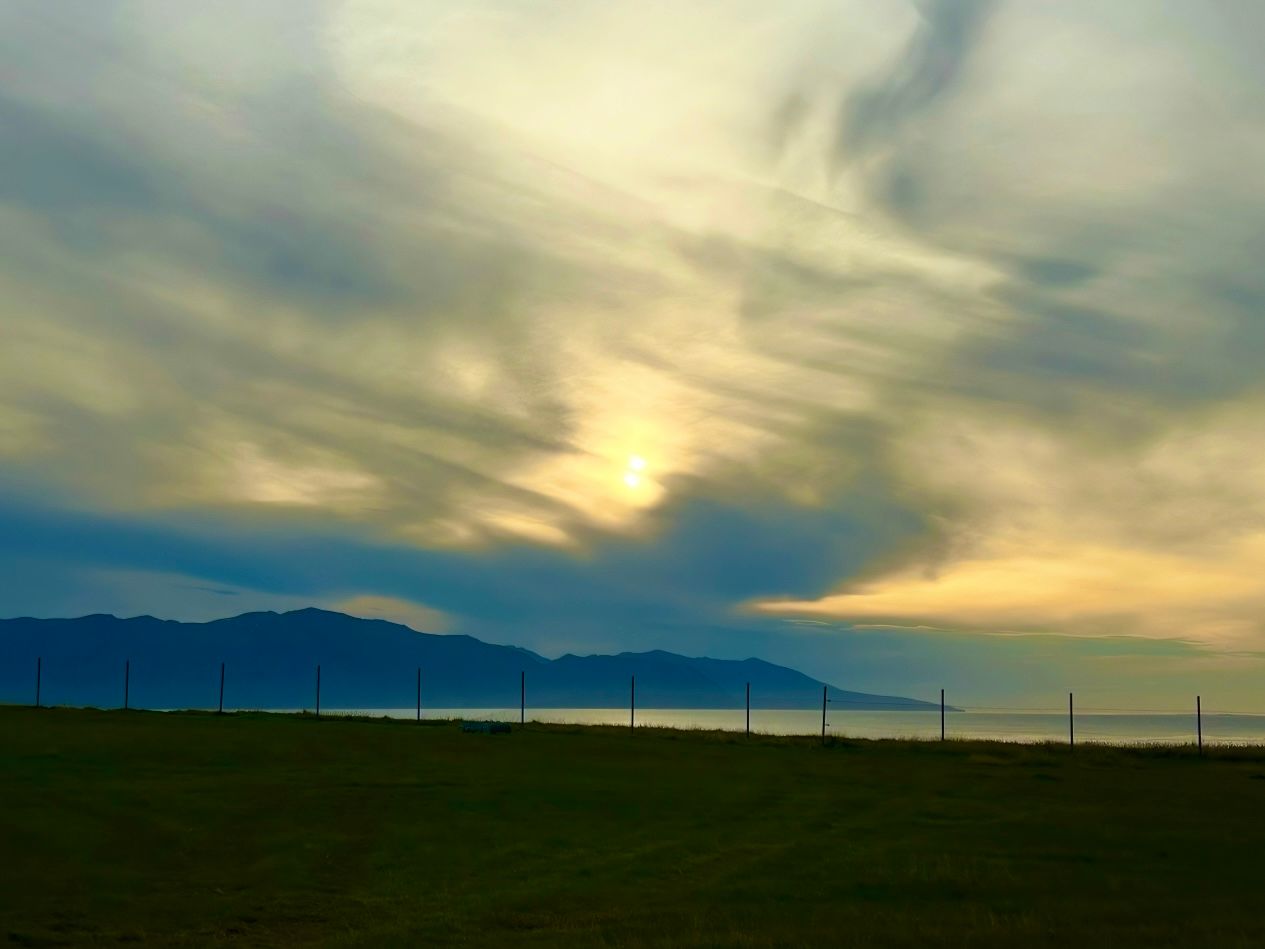
Thanks for raising framing directly — that’s the right question for this image. This sits in landscape territory: a serene shoreline, layered mountains, and a dramatic, cloud-diffused sun. Right now the slim fence line slices across the scene without quite earning its place; it neither guides the eye nor frames the view. If your intention was to use the fence as a device, it needs to become either a strong foreground lead-in or disappear entirely. What role did you want the fence to play — barrier, rhythm, or guide? Answering that will shape the decisions below.
TECHNICAL EXECUTION ★★★
Exposure is broadly well handled: the bright sun behind cloud retains shape and the sky colour feels natural. The foreground grass, however, is very dark and reads as a near‑black mass with little texture, which costs detail and balance. I don’t see obvious artefacts or heavy processing, which is good. A soft grad or bracketed exposures would have helped hold more land detail without flattening the sky. To reach five stars, aim for cleaner tonal separation in the lower third and a touch more micro-contrast in the mountains.
COMPOSITION ★★★
The sun sits near a third and the mountains create a pleasing horizon, but the frame is sky‑heavy and lacks a compelling foreground element. The line of fence posts is evenly spaced and dead straight; instead of leading the viewer, it acts like a barrier across the middle of the scene. The empty, very dark grass occupies a lot of space without adding meaning. Consider either stepping close and low to make the fence a bold diagonal that points to the headland, or moving to exclude it and using the shoreline as a cleaner base. What would happen if you cropped 20% off the bottom to let the waterline become the anchor?
LIGHTING ★★★
The diffused sun through cloud gives a gentle glow and soft gradients — tasteful and natural. It’s pleasant but not transformative, and the light doesn’t shape the land much; the mountains sit in uniform blue-grey. A touch earlier/later or a change in weather (clear gap at the horizon, side light on the ridge) would add definition. A long exposure in this light could also add motion to the water and clouds, providing energy without harsher contrast. To hit top marks, wait for light that carves the ridgeline or introduces a decisive colour shift.
STORY ★★
At present it’s a quiet view rather than a moment. The fence hints at “kept out” or distance, but the composition doesn’t commit to that idea strongly enough to communicate it. A human figure, a bird line over the water, or a boat would create scale and a reason to linger. Alternatively, making the fence dominant could express separation as a clear theme. Ask yourself: what emotion or idea did you want the fence and sun to convey together?
IMPACT ★★
The scene is soothing, yet it blends into the many sky‑led shoreline photos we all see. The heavy, empty foreground and undecided role of the fence reduce presence. With a stronger foreground purpose and more purposeful light or timing, this could step up. For five stars, the frame needs either a striking leading element or a singular moment (weather, subject, or gesture in the landscape) that gives it bite.
CONSTRUCTIVE NEXT STEPS
✓ Decide the fence’s job: either feature it as a bold diagonal lead-in by moving closer and shooting from a lower angle, or exclude it entirely by shifting position or cropping; right now it’s a passive barrier.
✓ Crop 15–25% off the bottom and clone out the small rectangular object near the centre fence line; then lift the land with a masked Curves/Exposure adjustment so the grass has texture rather than a black block.
✓ For balance in this kind of sky/land dynamic range, use a soft 2–3 stop graduated ND or bracket two exposures on a tripod and blend with a gentle luminosity mask.
✓ Return in side light or blue hour, or try a 10–30 second long exposure with an ND filter to introduce water/cloud movement and create a cleaner, more intentional mood.
AI Version 2.0