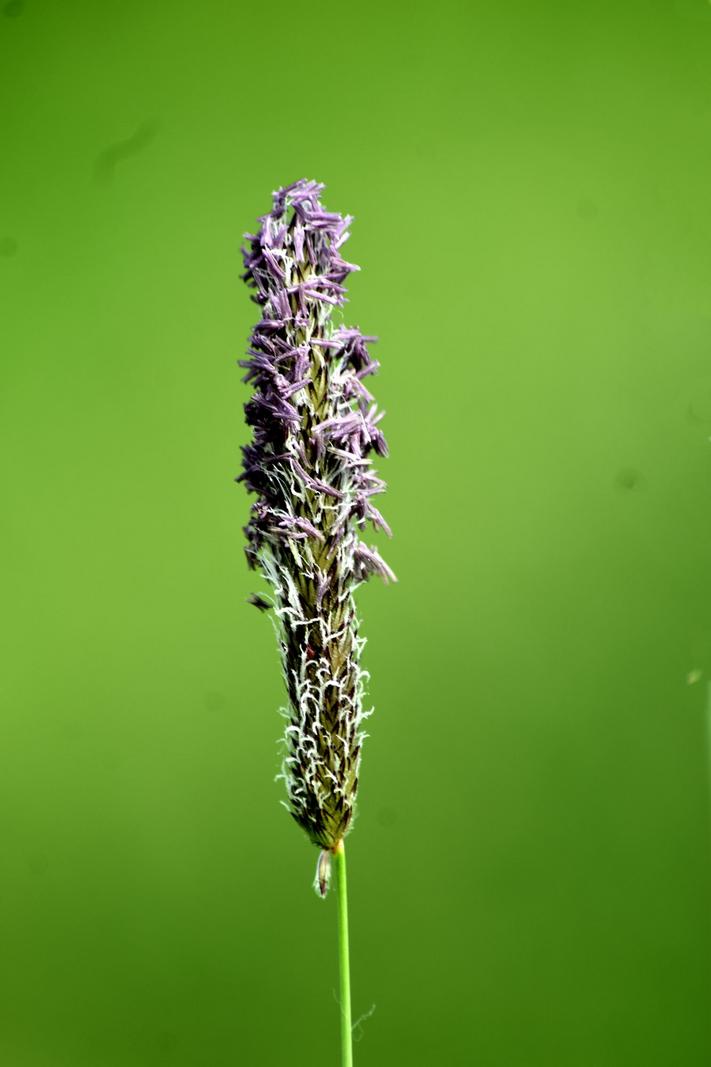
A delicate subject with lovely colour contrast, but the critical sharpness isn’t quite there.
Short answer: yes, this could be sharper. What I’m seeing is a slightly soft seed head—especially toward the purple tips—suggesting a mix of slight misfocus and a hint of movement (wind or a too‑slow shutter). The smooth green background works well and the colours feel natural, placing this firmly in macro/nature territory. Where did you intend the focus to land—the purple anthers at the top or the white filaments in the middle? Knowing that helps decide depth of field and focusing strategy.
TECHNICAL EXECUTION ★★
Focus doesn’t land cleanly on a decisive plane; the top third is particularly soft while the mid‑section is only moderately crisp. This softness looks more like micro‑motion or a narrow depth of field than lens sharpness limits. Exposure and colour are fine, and noise is minimal. I also notice a few faint spots in the background that could be dust or small bokeh blemishes—easy to retouch. To reach five stars here you’d need tack‑sharp detail on your chosen focal area, faster shutter or stabilized setup, and a cleaned background.
COMPOSITION ★★★
Centering the seed head is a safe, clean choice and the uniform green backdrop keeps attention on the subject. The vertical crop suits the tall form, though the head feels a touch cramped at the top and heavy at the bottom. A slight shift left or a little more negative space above would let it breathe and strengthen balance. Consider whether placing the most textured area (those purple tips) on an upper third would add tension. What would a lower shooting angle do to separate the stalk more clearly from the background?
LIGHTING ★★★
The light is even and gentle, which avoids harsh specular highlights on the florets. However, it’s also a bit flat, giving limited texture to the tiny structures. A slight side‑light or diffused flash could add micro‑contrast and definition without looking artificial. Early or late light would also bring softer modelling. Five stars would require more deliberate shaping of light to reveal structure.
STORY ★★
As a botanical study it’s clear, but it doesn’t yet offer a moment beyond “here is a grass head.” There’s potential in the emerging white filaments and purple anthers—pollen release is a micro‑moment you could lean into. An insect visitor, a gust captured mid‑movement (with purpose), or a cluster of similar heads at different stages could deepen the narrative. Ask yourself: what behaviour or phase of life are you trying to show?
IMPACT ★★★
The green–purple contrast is pleasing and the minimal background gives the image a calm presence. Softness reduces the “wow” factor, as viewers expect razor detail in macro work. With improved sharpness and a slightly more intentional frame, this could stand out more. Stronger light direction or a clearer focal plane would lift it further.
CONSTRUCTIVE NEXT STEPS
✓ Stabilise and freeze: use a tripod, shoot on a wind‑sheltered day, and set 1/400–1/800s with auto‑ISO; use a remote or 2‑sec timer to eliminate micro‑shake.
✓ Nail focus and depth: switch to manual focus with live‑view magnification (or focus peaking) and place focus on the most interesting detail (e.g., the purple anthers). Start around f/8 to balance depth and diffraction; if the subject is still, consider 5–10‑frame focus stacking.
✓ Shape the light: add a small white card/reflector for side fill, or a diffused on‑camera flash at low power (1/64–1/128) to add crisp micro‑contrast without harshness.
✓ Post‑process cleanly: remove the faint background spots with spot‑healing; apply modest local contrast and sharpening (e.g., radius 0.7–1.0, mask the background), and leave a little extra headroom at the top with a slight crop adjustment.
AI Version 2.0