Quiet, calming beauty with solid craft, but missing a stronger anchor and moment.
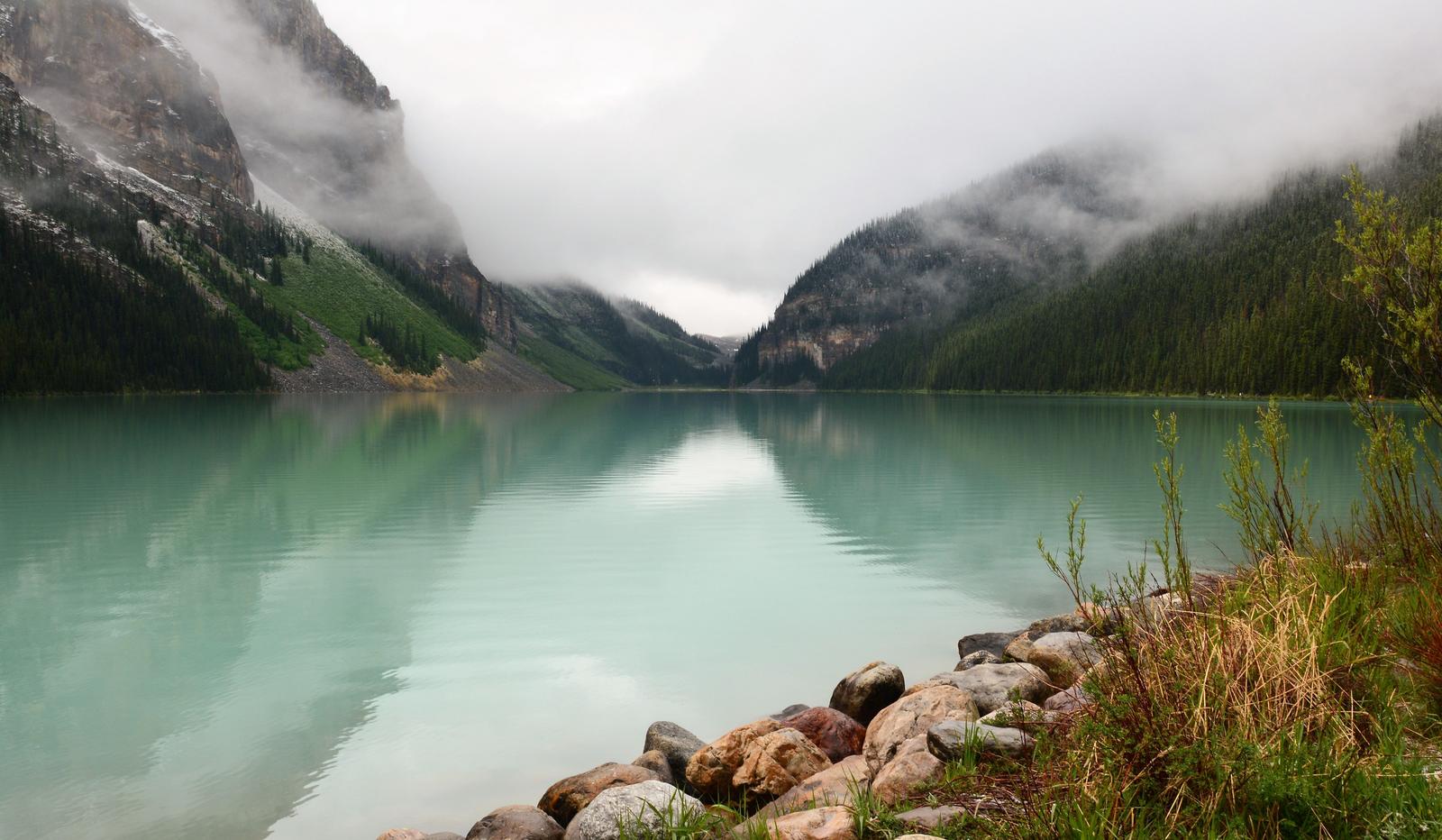
This is a landscape, and a quietly handled one: the milky turquoise lake and mist-draped mountains are the key players here. The calm water gives you a clean reflection, while the stones and grasses on the right bank try to act as foreground interest. You’ve made tasteful, restrained processing choices, which fits the mood. Were you aiming for perfect symmetry as the main statement, or did you want the mist to be the subject? That decision should drive both framing and any small post tweaks.
TECHNICAL EXECUTION ★★★★
Exposure is well judged: the pale sky isn’t blown, and the glacial water holds gentle tonality without banding. Detail looks crisp in the foreground rocks and the forested slopes; any softness in the distance reads as atmospheric rather than a focus miss. Colour is natural—no cartoonish saturation—which suits the scene’s subdued character. There’s a slight overall flatness that could use a touch more mid‑tone contrast. A hint of selective dehaze on the mid‑distance trees would add separation without killing the fog. For a five‑star technical file I’d want micro‑contrast and edge‑to‑edge sharpness refined to print level and the small edge distractions cleaned in post.
COMPOSITION ★★★
The scene is framed around a central vanishing point, which invites a symmetrical read, yet the foreground only exists on the right side. The stones and scrub on that edge feel cramped and pull the eye away from the centre rather than leading us into it. The horizon sits near the middle; that’s fine if you commit to symmetry, but then the foreground should be balanced across the bottom edge. The blank grey sky occupies more space than it earns; trimming the top would concentrate attention on the valley and reflection. How would a lower, slightly leftward position—letting the shoreline sweep across the frame—change the depth and balance? Right now the composition is pleasant but a little static.
LIGHTING ★★★
Soft overcast light and drifting cloud create a calm, wet‑morning mood. The fog rolling off the mountains adds atmosphere and hides messy detail, which helps. However, the uniform grey also flattens the scene; there’s minimal shadow structure on the slopes and little sparkle on the water. A small break of side light would have carved shape into the forests and cliffs. Given the conditions, you’ve exposed cleanly, but the light isn’t doing heavy lifting for drama.
STORY ★★★
The image communicates quietness—still water, low cloud, a pause between showers. That mood is clear, yet there’s no decisive element to anchor a moment: no canoe, bird, or human presence for scale or tension. The mist introduces a hint of travel narrative, but it remains more a beautiful view than a specific story. Could you have waited for a small event—a ripple, a brief light patch, or a passing kayaker—to give the frame a heartbeat? As it stands, it’s serene but generic.
IMPACT ★★★
It’s undeniably pretty and will please on first glance, particularly for the soothing colour palette. The lack of a strong foreground or singular moment means it blends into many similar lake‑and‑valley images. Clean processing helps the image hold together, but it doesn’t yet command a second look. With a clearer compositional commitment and a touch of light or timing, this could climb a level.
CONSTRUCTIVE NEXT STEPS
- Commit to symmetry or to a leading foreground: drop lower and step left so the shoreline and rocks run across the bottom third as a true anchor, or centre the horizon perfectly and include an even band of rocks across the frame.
- Crop 10–15% from the top to reduce dead grey sky; clone/heal the bright twiggy stems on the right edge and any stray pebbles that catch the eye.
- In post, add a gentle S‑curve targeting mid‑tones; then apply selective dehaze/clarity (5–10) to the mid‑distance trees while leaving the fog soft to keep depth.
- Consider timing or tools for variation: wait for a canoe/bird or a light break, or try a 6–10 stop ND for a 30–120s exposure to smooth the water and blur the moving cloud; if using a polariser, rotate to cut glare on the rocks without killing the reflection.
AI Version 2.12