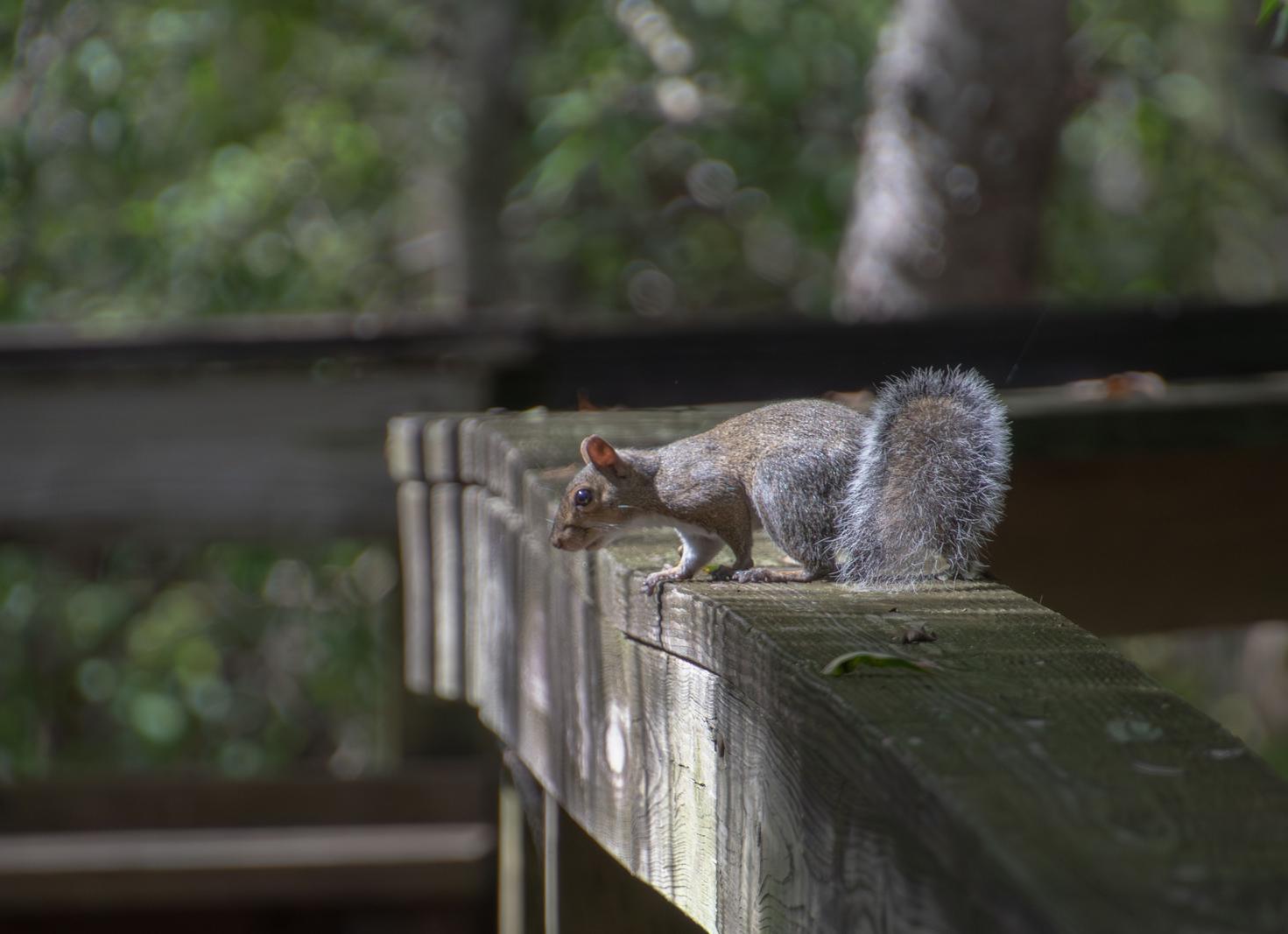
A clean, patient wildlife moment with strong depth of field control and a leading line that does real work.
You achieved both goals: the shallow depth of field isolates the squirrel nicely and the handrail is a textbook leading line pointing straight to your subject. This sits firmly in wildlife photography, and the moment—squirrel pausing on the edge—has a quiet tension. Where the image stumbles a bit is the dappled, contrasty light and a slightly tight placement of the tail near the right edge, which robs the scene of some breathing room. How deliberate was your choice of viewpoint and timing with the patches of sun—did you wait for the animal to step into a cleaner pool of light, or was this a grab? Small refinements there would lift the frame considerably.
TECHNICAL EXECUTION ★★★★
Focus looks good on the head with enough detail in the fur and eye to hold attention; your shallow depth of field is controlled and the bokeh stays smooth. Exposure is broadly solid, though the bright patch on the handrail draws the eye away from the face and could be tamed. I don’t see problematic noise or artefacts, and colour feels natural and restrained. If anything, a touch more micro‑contrast around the eye and masking down of the brightest wood grain would refine the file. For five stars I’d want the eye tack‑sharp with a crisp catchlight and no competing hotspots on the rail.
COMPOSITION ★★★★
The handrail forms a strong diagonal that carries the viewer from the lower left straight to the squirrel—good, intentional framing. Placing the animal on the right third works with the line, but the tail sits a bit close to the right edge, creating slight crowding. There’s also a dark horizontal band behind the body which isn’t fatal, yet it simplifies less than an entirely clean background would. The small leaf and speck on the rail near the foreground add minor noise. A touch more space to the right and slightly higher camera position to separate the body from the dark band would make this sing.
LIGHTING ★★★
Dappled woodland light gives atmosphere but also headaches. You’ve got pleasant separation with the darker background, yet the sunlit streaks on the rail are brighter than the squirrel’s face and pull attention. The face has usable light, but a stronger, cleaner patch of illumination—or a moment when the head turns to catch a brighter glint—would add life. Early/late light or open shade would reduce the harsh contrast and bring out texture in the fur. To reach five stars, aim for consistent, directional light with a clear catchlight and fewer competing hotspots.
STORY ★★★
The poised stance over the edge suggests a ready‑to‑leap moment—a simple, readable behaviour. It’s a good portrait with a trace of tension, though not a distinctive behaviour that deepens the narrative. A visible nibble, a mid‑leap, or interaction with another squirrel would elevate the story. Consider whether waiting another beat for a paw lift or head turn toward camera would add that extra flicker of character. What behaviour were you hoping for, and did you consider staying longer to chase it?
IMPACT ★★★
The image is pleasing and competent, with the leading line providing a strong visual hook. It doesn’t quite lodge in the memory because the light is busy and the moment is familiar. Clean up the distractions and refine the gesture and lighting, and it moves up a level. Right now it’s a good nature study that shows solid field craft rather than a standout frame.
CONSTRUCTIVE NEXT STEPS
✓ Give the subject breathing room: step half a pace left or widen slightly so the tail isn’t pressed against the right edge, and try a slightly higher angle to separate the body from the dark rail behind.
✓ Prioritise a cleaner pool of light: in woodland, wait for the squirrel’s head to hit an even patch of shade or soft sun; use AF‑C with a single point on the eye and aim for around 1/800–1/1000s to freeze micro‑movement.
✓ Post‑processing: burn down the brightest streak on the handrail and any hot bokeh spots; add a subtle dodge to the eye and a touch of local contrast/clarity on the head; clone the small leaf and specks on the rail.
✓ Chase a stronger gesture: hang on for a paw lift, a look back to camera with catchlight, or the instant before a jump—those micro‑moments add character and elevate a simple portrait into a story.
AI Version 2.0