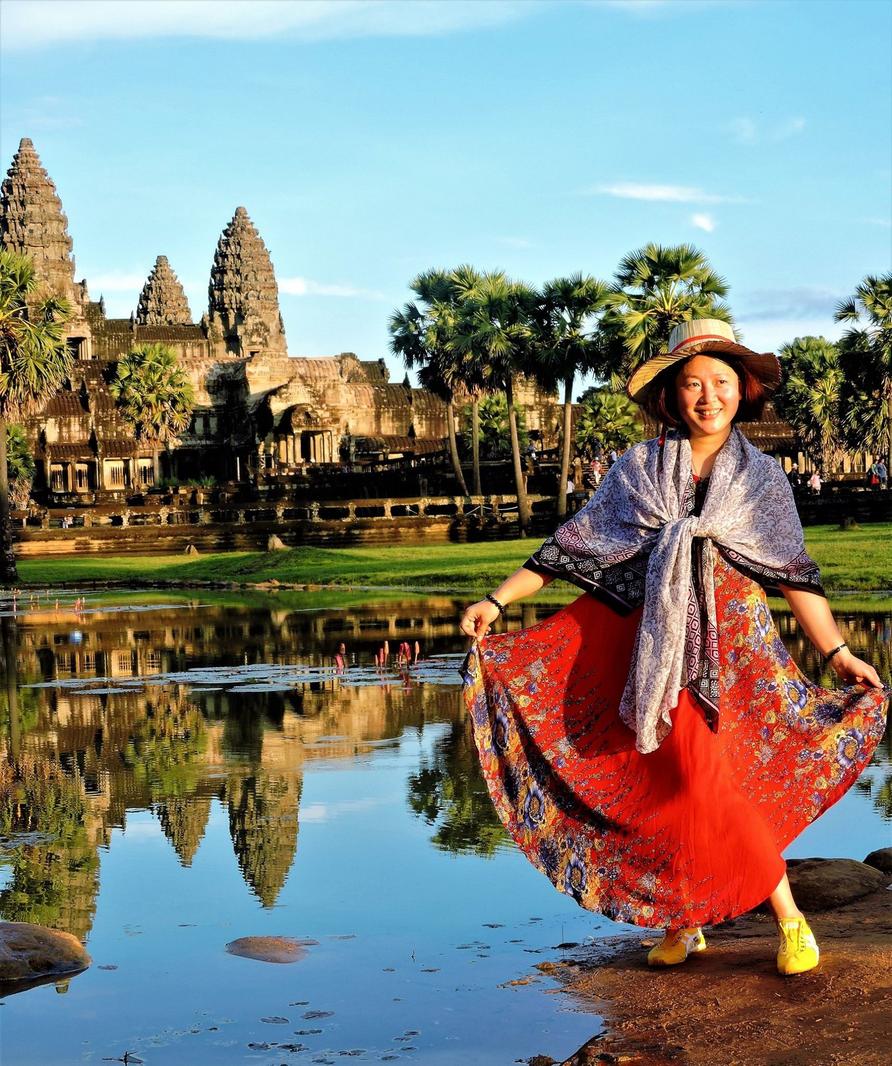
A lively travel portrait with a grand setting, but it leans more “I was here” than “here’s a moment.”
Short answer: no, looking at the camera doesn’t spoil the story — it changes it. A direct gaze turns this into an environmental portrait rather than a found travel moment. In your frame the sparkling dress, playful skirt hold and smile tell the story of a delighted visitor at Angkor Wat; it’s cheerful and clear. If your aim was a sense of place and atmosphere first, then the eye contact and pose make it feel tourist‑postcard and reduce tension. This sits between travel and portrait; decide which you want to lead. What would the picture feel like if she were absorbed in the scene — looking across the water, adjusting her hat, or mid‑step — rather than performing for us?
TECHNICAL EXECUTION ★★★
The exposure looks sound: skin retains detail and the temple isn’t blown out. Focus appears crisp on the subject with enough depth of field to keep the temple legible. Colours are pushed quite hard — the reds, greens and yellows feel oversaturated compared to the warm late‑day light, which nudges the image toward postcard rather than photograph. There’s no obvious noise or artefacts, and the reflection is clean. A little restraint in colour and contrast would increase polish and realism. To reach five stars, keep the same clarity but rein in saturation and local contrast so the processing disappears.
COMPOSITION ★★★
Placing the traveller on the right and Angkor Wat on the left creates a workable balance, and the reflection adds a second layer. However, the bright yellow shoes at the lower edge pull the eye out of the frame and the feet feel a touch cramped. The hat and shoulders merge a little with the palm trees; a small step left or lower viewpoint would separate her from the background and give the skirt more breathing room. The pond rocks and scattered tourists by the colonnade are small but high‑contrast distractions. For a stronger frame, consider backing up and using a slightly longer focal length to compress and simplify the relationship between person and temple.
LIGHTING ★★★★
The warm, low sun is doing you favours — it shapes the temple and gives the scene a pleasant glow. The light on her face is soft enough to be flattering and the reflection benefits from the angle. There are minor hotspots on the dress and hat brim, but nothing fatal. Timing here is good; with a touch more side light on her face or a small turn of her head you’d add more shape. Five stars would need slightly more modelling on the face and tighter control of the brightest reds.
STORY ★★
As travel storytelling it’s thin: a happy visitor posing at a famous site. The direct gaze and the skirt‑spread gesture read as performance, not a moment discovered in place. We learn where you are, but little about the atmosphere of Angkor or the relationship between person and site beyond “having fun here.” If the intent is a portrait, then adding a personal gesture — a pause, a look towards the towers, interacting with the water lilies — would add character. What specific feeling about Angkor were you hoping the viewer would carry away?
IMPACT ★★
The scene is colourful and pleasant, but it’s close to a trope seen thousands of times — visitor, temple, reflection, big smile. The vivid wardrobe overwhelms the ancient stone, so the place risks becoming a backdrop rather than a co‑star. Dialling back colour and finding a truer moment would lift memorability. A cleaner frame with stronger separation and a less performative gesture would move this toward a picture that sticks.
CONSTRUCTIVE NEXT STEPS
✓ Ask your subject to engage with the place rather than the camera: look across the water, walk slowly along the bank, or adjust the hat while facing the temple; shoot through that moment to suggest presence rather than performance.
✓ Change position: crouch lower to emphasise the reflection and give more space to the feet, or take one step left to separate the hat from the palms and avoid mergers.
✓ Post‑processing: reduce saturation of reds and yellows by 10–20% in HSL, add a gentle overall contrast curve, and selectively darken the shoes; clone out the bright foreground stones and a few tiny tourists near the colonnade.
✓ If possible, back up and use a slightly longer focal length (e.g., 70–100mm at f/4–5.6) to compress the scene and keep the temple prominent while simplifying the background around the subject.
AI Version 2.0