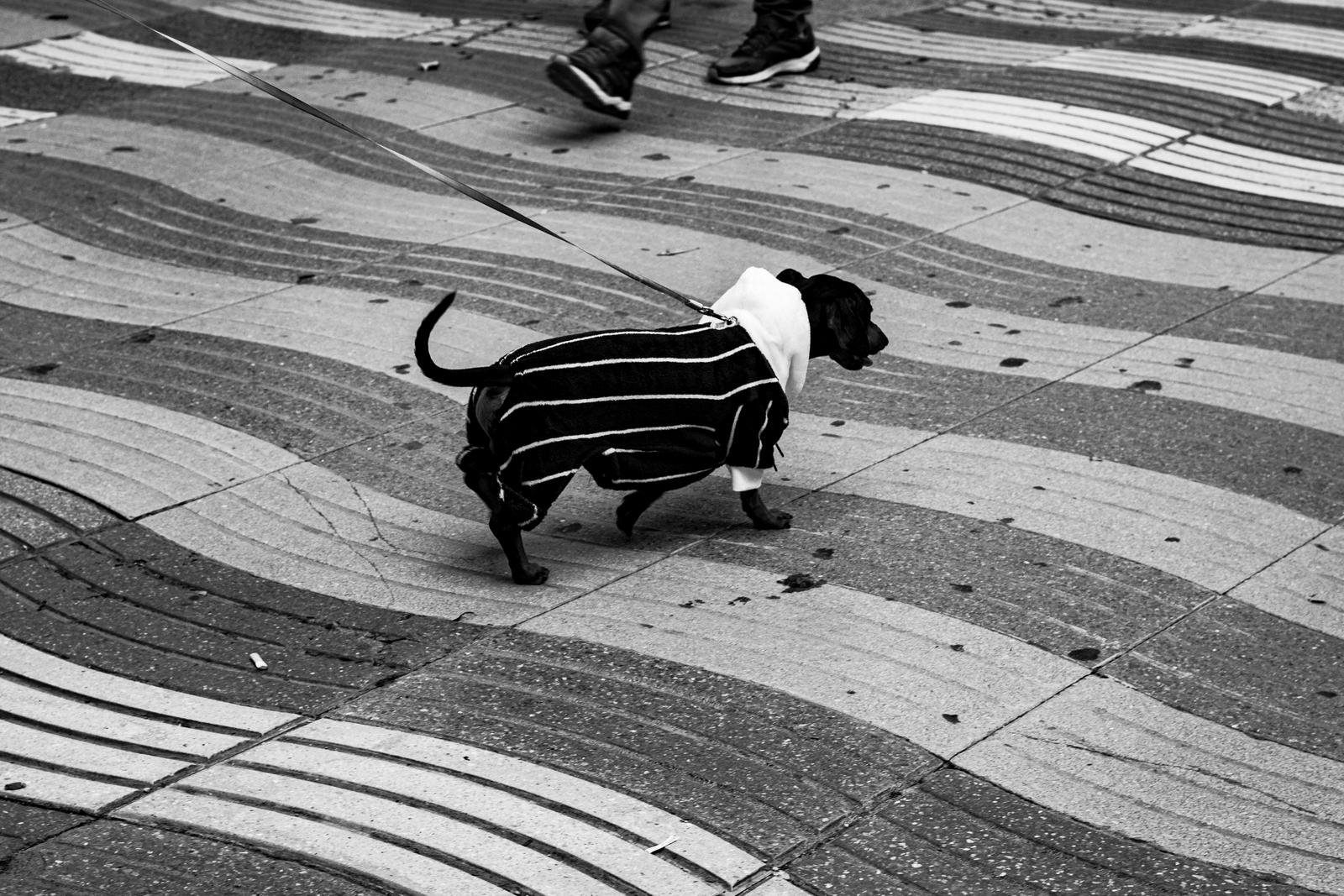
Clever geometry and a quirky subject make this engaging, but the moment and framing aren’t yet competition‑strong.
This is a street photograph centred on a small dog in a striped coat being walked across a patterned pavement. The wavy tiles and the two taut leads form pleasing lines, and your choice of black and white suits the graphic feel. To your questions: it’s a good spot and a competent frame, but for most street competitions it lacks a decisive human moment or a cleaner, more intentional composition. The strongest qualities are the rhythmic ground pattern, the diagonals of the leads, and the mid‑stride gesture of the dog. What holds it back are the cropped human legs at the top, the dog’s dark head merging into a mid‑tone background, and a generally thin story. Ask yourself: is this picture about the witty outfit, the relationship with the unseen owner, or the geometry of the street — and how could the framing reinforce that choice?
TECHNICAL EXECUTION ★★★★
Focus looks solid on the dog and paving, and the shutter speed has frozen the step nicely. The monochrome conversion is clean with a healthy tonal range and no obvious artefacts or heavy processing. Exposure is broadly accurate, though the dog’s head sinks into the mid‑tones, reducing separation. There’s no distracting noise, and the file holds up well for print. To reach five stars, I’d lift the dog’s head and eye slightly with local dodging and add a touch of micro‑contrast to the fur so the subject reads more immediately.
COMPOSITION ★★★
The diagonals of the two leads are strong and the wavy pavement provides a repeating structure that carries the eye. Placing the dog right‑of‑centre, moving into space, gives motion. However, the cropped shins and shoes at the top feel like accidental leftovers rather than an intentional layer; they interrupt the flow without adding meaning. The dog’s head overlaps tonally with the ground, and the leads exit the frame without a clear anchor, which weakens the narrative connection to the handler. A lower, closer viewpoint or a tighter crop that commits to excluding the walkers would give the image a clearer centre of gravity.
LIGHTING ★★★
Flat, overcast light keeps contrast manageable and suits the graphic floor pattern. The trade‑off is a lack of shape on the dog, especially the face and snout which blend into the surroundings. Slight directional light or waiting for the dog to pass over a lighter tile would have created separation and sparkle. In post, subtle dodging on the face and a small lift in mid‑tone contrast would help the subject stand out without looking forced. As captured, the light is serviceable but not helping the story.
STORY ★★
The humour of a small dog in a hooded, striped outfit is appealing and gives a hint of character. Yet the photograph stops short of a true moment: there’s no interaction with the handler, no glance, no tension beyond the leads. The cropped human fragments feel incidental rather than purposeful, so the relationship remains unclear. If the dog had looked up at the owner, pulled against the lead, or intersected more cleanly with a bright stripe, the frame would carry a stronger beat. For competitions that prioritise human connection and timing, this reads as a near‑miss.
IMPACT ★★★
It’s a likeable, tidy frame with graphic appeal and a touch of humour that will do well in a club critique or themed set. Against top‑tier street competition work — where layered human moments dominate — it’s unlikely to stand out as is. Strengthening either the human element or the graphic precision would lift memorability. Consider whether you want this picture to be about pattern or about relationship, and push it decisively in that direction for greater punch.
CONSTRUCTIVE NEXT STEPS
✓ Commit to the human presence: either include the handler up to the hands holding the leads, or crop out the partial legs entirely; avoid half‑limbs that add no story.
✓ Work the moment: stay with the dog and wait for a clearer gesture (a look up at the owner, a tug on the lead, a yawn) or position yourself so the head falls against a lighter tile for clean separation.
✓ Change perspective and distance: drop lower and get closer (35–50mm), letting the dog fill more of the frame while using the wavy pavement as a strong background rather than the main subject.
✓ Post‑processing: lightly dodge the dog’s face/eye and add a subtle contrast curve; clone a few bright specks near the paws to reduce distractions, and consider a modest top crop to remove the cut‑off legs if you don’t reframe in camera.
AI Version 2.1