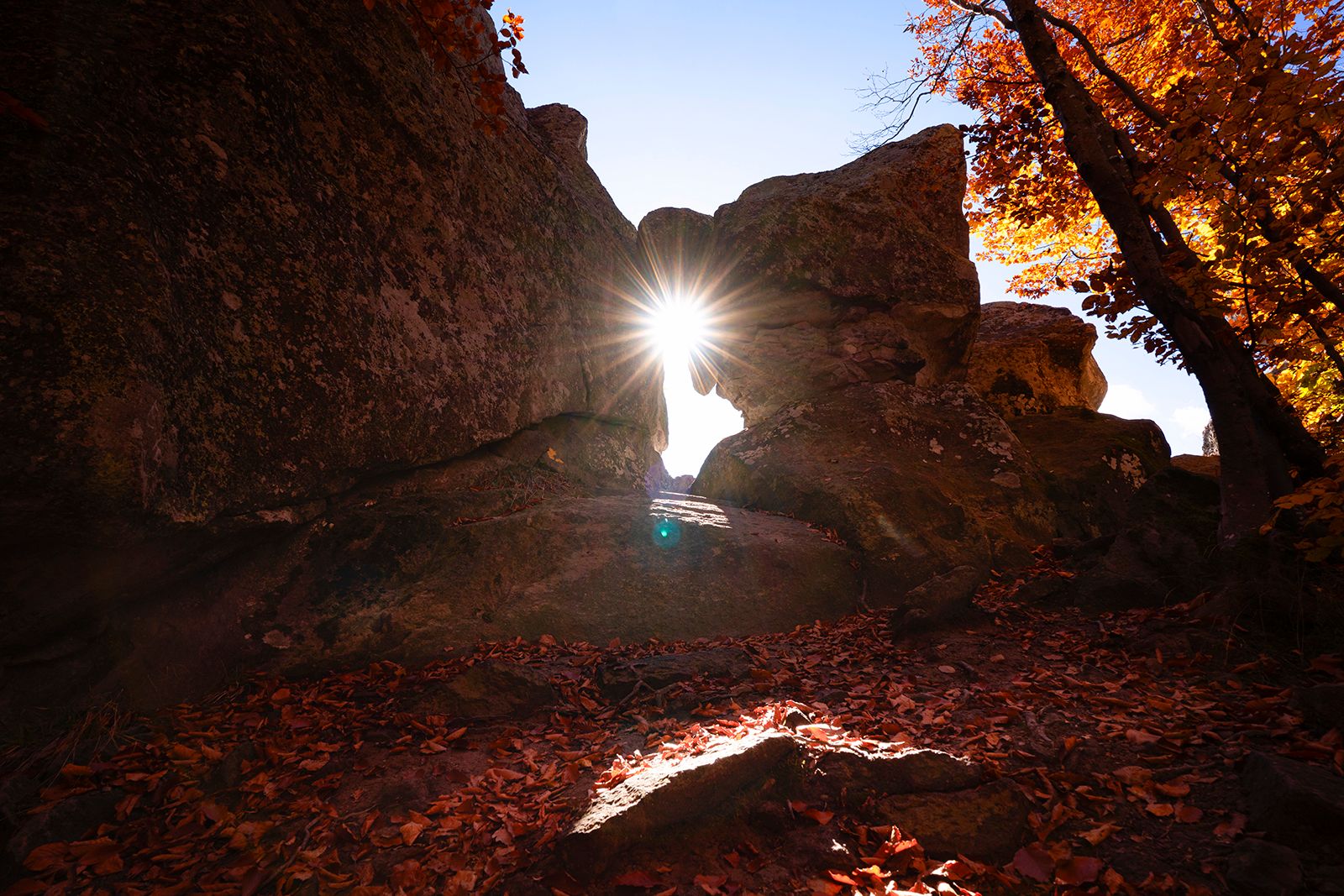
A bold sunstar pinned between ancient rock makes a striking “doorway to light.”
You’ve built a strong backlit landscape: autumn leaves on the right, a dark rocky corridor, and the sun bursting through the slit of stone. To brighten the frame without killing the star, don’t raise overall exposure; protect the highlight frame for the sun and lift the rest locally. The cleanest field method is a tripod and exposure bracketing: make one exposure for the star (the one you already have at a small aperture), then shoot two additional frames at +1.5 to +3 stops for the shadows, and blend with subtle masks so halos don’t appear around the rocks. If you only have one file, use local masks in Lightroom/ACR: a linear or brush mask over the foreground with Shadows +40–70, Blacks +10–20, and a gentle S‑curve; then place a small inverted radial mask on the sun to hold Whites back so the burst stays crisp. Also consider timing—catch the moment when the sun is just touching the gap or a thin cloud crosses it; contrast drops, the rocks fill with reflected light, and you keep the starburst at f/16–f/22. Does this location allow a quick step forward or lower angle to reduce the darkest foreground while keeping the burst centred?
TECHNICAL EXECUTION ★★★★
The small‑aperture sunstar is well controlled and suits the scene. Detail on the rocks looks sharp enough for a large print, and colour is natural with autumn warmth that doesn’t feel overcooked. The main technical weakness is the crushed foreground; there’s plenty of recoverable information but, as presented, it reads very dark. There’s a noticeable green flare dot below the burst; it’s a common by‑product of shooting into the sun and can be cloned or reduced. To reach five stars, either blend a brighter shadow exposure cleanly or lift the shadows locally while removing the flare artefact.
COMPOSITION ★★★★
Placing the burst dead centre works here because the rock walls form a natural frame leading straight to it. The curved, stepped rock in the middle acts as a path, and the warm leaves on the right counterbalance the heavy left wall nicely. However, the bottom quarter holds a lot of near‑black space; it weighs the image down without adding much texture. A crop of roughly 10–15% from the bottom, or physically stepping forward a pace to compress that area, would tighten the design. Did you try shifting a few centimetres to align the burst precisely on the narrowest part of the gap to maximise the “doorway” shape?
LIGHTING ★★★
The light gives you drama—the burst and rim light are the photograph’s hook. At the same time, it creates extreme contrast that hides the foreground textures and introduces lens flare. Shooting a few minutes earlier/later, or when a thin cloud feathers the sun, would lower the dynamic range and lift the rocks naturally. In post, selective shadow lifting can restore texture without flattening the burst if you mask carefully. For a future visit, flagging stray off‑axis light with your hand just outside the frame (even with the sun in shot) can reduce veiling flare and increase local contrast on the rocks.
STORY ★★★★
The scene carries a simple but effective narrative: moving from dark, leaf‑strewn ground into a slice of bright day. Autumn colour against cool sky adds seasonal mood and a sense of place. What’s missing is scale or a secondary element to deepen the moment—imagine a small human silhouette or a hand touching the rock on the way through. Even without a figure, brighter readable texture in the foreground would help the viewer “walk” into the gap. Consider what story you want this doorway to tell—escape, discovery, or serenity—and whether a small human presence would serve that aim.
IMPACT ★★★★
The starburst framed by stone has instant pull and is supported by rich autumn tones. It’s a familiar device, but executed with care and a clean horizon of light through the gap. The heavy shadows soften the punch a little; opening them judiciously will let the textures and colours carry more weight. Removing the green flare spot will also keep attention where it belongs—on the doorway and the sun. With those refinements, this could be a portfolio keeper.
CONSTRUCTIVE NEXT STEPS
- On location, bracket three to five exposures on a tripod: one for the sun star (e.g., f/16, base ISO, expose to protect highlights), then +1.5 to +3 stops for the rocks; blend with luminosity masks or HDR merge, and manually mask edges to avoid halos.
- If working from a single RAW, use a foreground mask with Shadows +40–70, Blacks +10–20 and a gentle curve lift; add a small inverted radial mask over the sun to hold Whites and keep the burst crisp.
- Clone/heal the green flare spot beneath the star; if you reshoot, slightly adjust angle and use a clean front element to minimise internal reflections.
- Consider a tighter crop from the bottom (around 10–15%) or step closer on location to reduce the dead, dark area and increase the sense of stepping into the light.
AI Version 2.12