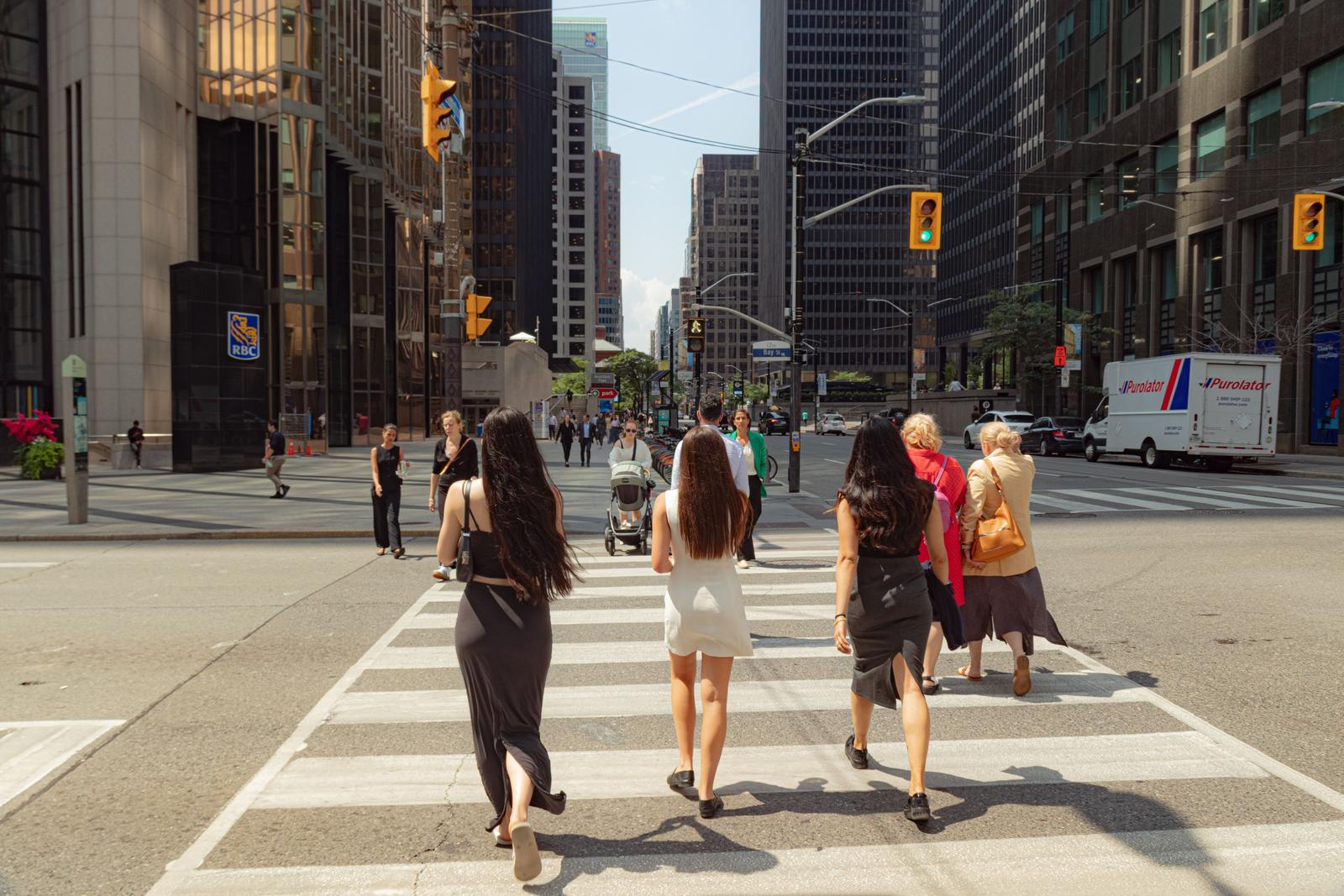
A clean, summery city slice with good layering but a thin moment.
Based on what’s visible, this is primarily a street photograph with a travel flavour — a candid crossing scene on a downtown avenue. The strongest elements are the three women in the foreground stepping across the zebra lines and the secondary layer of the pram‑pusher and office workers beyond. I’ll judge it against the street criteria, focusing on timing, layering and how the environment is handled. What drew you to press the shutter at this exact instant — was there something specific about the gestures or the arrangement you wanted to preserve?
TECHNICAL EXECUTION ★★★★
Exposure is well controlled for midday; reflective façades and road highlights hold detail without obvious clipping. Overall sharpness is good from foreground to background, suggesting a moderately stopped‑down aperture that suits this wide scene. Colours look natural and not over‑pushed, which preserves realism. There’s no distracting noise or artefacts, and motion is frozen cleanly on the walkers. To push this to five stars, a touch more micro‑contrast and clarity on the central figures would give them a stronger anchor without over‑crisping the whole frame.
COMPOSITION ★★★
The zebra lines provide strong leading structure and the three central figures form a loose triangle that works. However, the right‑hand white delivery truck and bright traffic signals pull the eye away from the walkers, and the cluster of poles around the centre adds visual noise. The left edge feels cleaner, while the right edge is busy with near‑edge subjects (two women in beige/red) that don’t contribute much to the main story. A step or two left, or a tighter crop from the right, would reduce those distractions and keep the focus on the trio and the pram‑pusher. How might a lower viewpoint, exaggerating the stripes and separating heads from the building edges, have clarified the hierarchy?
LIGHTING ★★★
This is hard, high‑sun light typical of midday streets. You’ve handled it competently—skin tones aren’t blown and the scene reads clearly—but it’s not adding mood or shape. Shadows are short and unhelpful for drama, and the luminous traffic lights compete with faces and clothing. Waiting for a cloud edge or moving to a shaded crossing would have introduced softer contrast and richer tones. A mild, selective reduction of highlights on the road and traffic lights could also calm the frame.
STORY ★★
We have place and activity, but little in the way of a decisive moment. The three women’s similar flow of hair and stride almost gives you a unifying gesture; it just doesn’t land as a clear beat. The pram provides a human note, yet there’s no interaction or glance connecting the layers. If you’d waited half a second for synchronised steps, a turn of a head, or an encounter at the crossing line, the frame would carry more narrative tension. Ask yourself: what was the specific micro‑moment you were hunting for, and did you give it enough time to appear?
IMPACT ★★
It’s pleasant and readable, but it doesn’t stick. The abundance of bright municipal elements (signals, truck branding, cones) dilutes the human centre. With a cleaner background or a stronger gesture, this could rise from descriptive to memorable. Right now it functions as a competent city slice rather than a photograph you’d return to. To reach the top tiers, the frame needs either a stronger moment or a bolder visual decision that gives it a signature look.
CONSTRUCTIVE NEXT STEPS
- Reframe to simplify: from this spot, two steps left and a slight rightward pan would cut most of the white truck and keep the trio centred over the strongest zebra stripes.
- Wait for a beat: hold the frame until you get a unifying gesture — e.g., the three women taking the same stride or one glancing back while the pram draws closer to them.
- Use height to separate: drop to a lower stance to amplify the crosswalk lines and lift heads clear of the building edges; this adds depth and reduces mergers with poles.
- Post-processing: crop a little from the right, clone or heal the small orange cones on the left, and selectively desaturate yellows/reds (traffic lights, signage) by ~10–15% to reduce competing hotspots while adding a touch of local contrast to the central figures.
AI Version 2.12