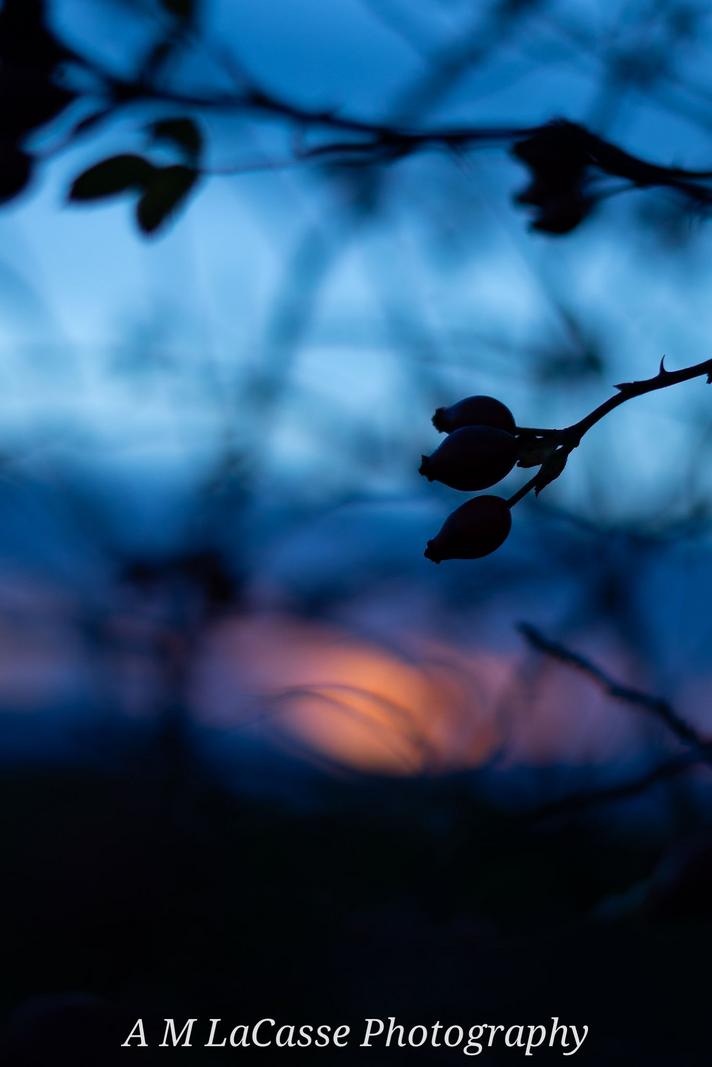
Moody colour and a delicate silhouette, but the frame is too busy to land the idea.
Short answer: it’s a decent start, but not yet a strong “sunset through a hedgerow” image. The cool blue hour and the warm glow low in the frame work nicely, and the little cluster of berries on the right is the most engaging shape. As a nature/landscape study, however, the composition feels cluttered and the subject is small, so the idea doesn’t read clearly at first glance. If your intent was to show the sun glowing through the hedge, the sun needs to relate more directly to the berries or be placed more decisively. What did you want the viewer to notice first—the berries or the sun?
TECHNICAL EXECUTION ★★★★
Focus on the berries appears solid and the silhouette edges are clean, which is important at dusk. Exposure is controlled; the highlights in the orange glow are held and the shadows are intentionally deep. Colour feels natural for blue hour and not overcooked, which keeps the mood honest. I do notice the very large watermark across the bottom, which is a post‑processing element that pulls the eye and cheapens the presentation. For five stars I’d want the watermark removed or made subtle, and a touch more separation in the midtones to avoid the blacks blocking up entirely.
COMPOSITION ★★
The berries are small and pushed to the right edge, while a tangle of out‑of‑focus branches occupies much of the frame. The brightest shape—the orange patch near the bottom centre—steals attention but doesn’t connect to the berries, so the eye bounces rather than flows. Top‑edge leaf shapes and diagonal twigs add clutter without purpose. The big watermark dominates the lower third and competes with the picture. A tighter, cleaner framing with the sun placed behind or just below the berries would create a clear visual anchor and reduce the chaos.
LIGHTING ★★★
The timing is good—cool ambient blues against a warm sinking sun. As a silhouette, though, the berries lack a rim of light or a brighter backdrop to define their shape; they read as a dark blob rather than a crisp icon. A slight shift to line the sun directly behind or adjacent to the berries would have given them a glowing edge and stronger separation. The overall light supports mood but doesn’t yet elevate the subject. To push this higher, aim for that brief moment when the sun’s disc is small and clean, then position it carefully.
STORY ★★
The frame suggests “day ending” and “wild fruit in winter,” but it stops at atmosphere. There’s no decisive relationship between the sun and the hedge—no alignment, gesture, or contrast that gives the scene a memorable moment. Because the berries are small and the sun is vague, the narrative feels generic rather than specific. Consider what you want to say: the resilience of the hedge against the fading light, or the last glow kissing the fruit—then compose to show that clearly.
IMPACT ★★
The cool‑warm palette is pleasant, but the image blends into many dusk silhouettes. The cluttered frame and oversized watermark reduce its presence. With a clearer subject and a bolder sun‑to‑berry relationship, this could move from “nice colours” to something that makes a viewer pause. Originality here will come from precision: a cleaner line, a stronger shape, and a conscious placement of elements.
CONSTRUCTIVE NEXT STEPS
✓ Decide the hero and compose for it: move closer and make the berry cluster larger; place the sun directly behind or just kissing the berries to create a halo. A small left/right shift of 30–60 cm can make the alignment click.
✓ Simplify the frame: find a cleaner gap in the hedge and avoid overlapping twigs near the subject. A longer focal length (85–135mm) at around f/2.8–f/4 will compress and smooth the background while keeping the berries crisp.
✓ Tame distractions in post: remove or greatly reduce the watermark; crop slightly from the bottom to minimise the bright orange blob and burn it down subtly; clone small bright specks and the top‑edge leaf to tidy edges.
✓ Lock in crisp silhouettes: use manual focus with live‑view magnification, a shutter of at least 1/200s (or a tripod), ISO as low as practical, and underexpose by about 2/3 stop to keep colour rich without crushing detail.
AI Version 2.0