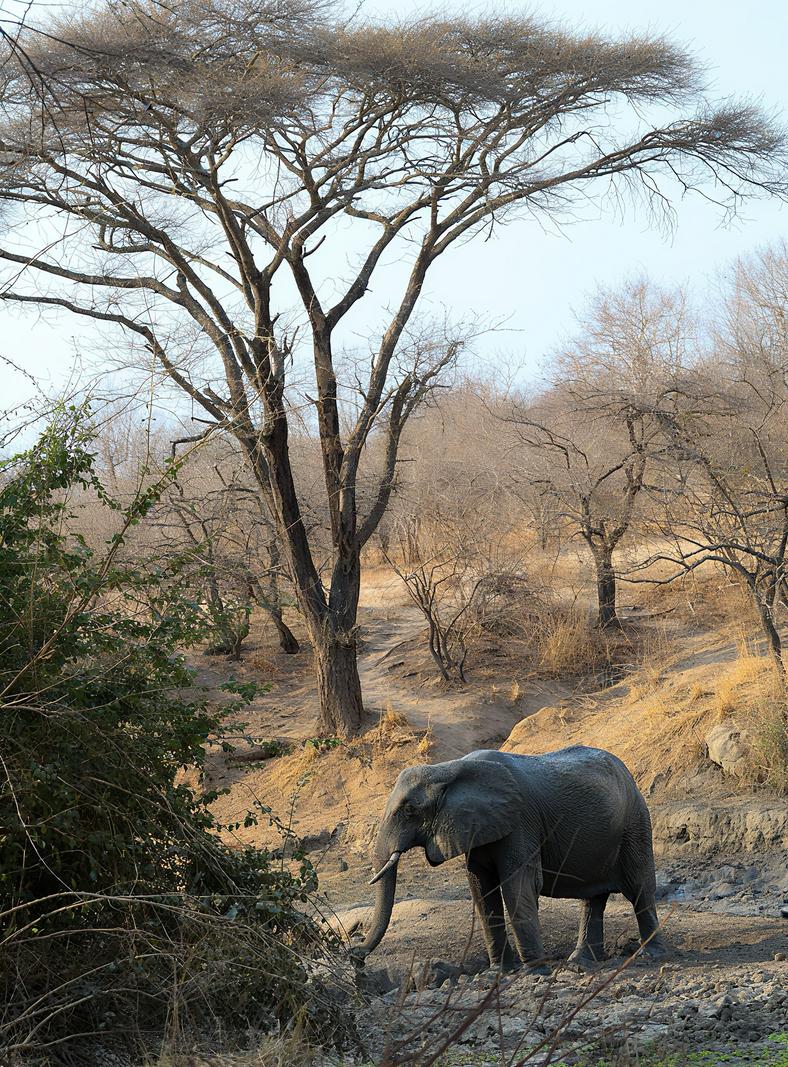
A strong habitat scene with a majestic subject, but the frame feels busy and a little cramped where it matters.
Short answer: decide whether this is a habitat portrait of an elephant in the bush, or a portrait of the elephant itself. Right now it sits between the two. For a habitat-led image, go lower and give the elephant more room to walk into on the left, while cleaning the messy foreground bush and bottom edge; let the big acacia become the counterweight rather than the dominant element. For a subject-led image, step a little closer or zoom longer, open the aperture to blur the background, and avoid the slope merging with the elephant’s back. As wildlife, the key is clarity and separation of the animal; your current framing has the elephant pressed against the bottom edge with intrusive foliage on the left and a lot of empty, pale sky on top. Which story do you want the viewer to read first: the tree, or the elephant?
TECHNICAL EXECUTION ★★★★
Exposure is well handled; there is readable texture across the elephant’s skin and no garish colour work. Focus appears solid on the head, with enough detail in the tusks and ear to carry the frame. Noise is controlled and the natural, muted palette suits the dry season feel. There’s a touch of veiling contrast from the bright sky and dust, which flattens the mid‑tones slightly, but nothing that can’t be lifted with selective contrast. Overall clean capture with tasteful processing; further refinement would centre on micro‑contrast and local dodging rather than global changes.
COMPOSITION ★★★
The elephant is placed to the right, facing left, which is a good start—viewers like space in front of the subject’s movement. However the animal is tight to the bottom edge and its trunk points into clutter from the foreground twigs; this cramps the gesture. The large acacia dominates the upper half and pulls the eye away, while the pale sky adds weight without adding information. The thorny bush on the left edge and the stray branches at the bottom are distractions. A lower viewpoint and a step right would clear the bush, give the elephant cleaner separation, and rebalance the tree as context rather than the main act. Consider a crop removing some sky and left foliage to concentrate the story.
LIGHTING ★★★
The light is serviceable but flat—likely late afternoon or open shade against a bright sky. It renders the environment truthfully, yet the elephant lacks a catchlight and sculpting shadows that would add depth. Side or backlight at golden hour would give rim light along the ears and trunk, separating it from the dusty background. Even on this outing, shifting position so the light grazed across the head would help modelling. As it stands, the scene is readable but not shaped.
STORY ★★★
We understand the place—dry riverbed, thorn scrub, classic umbrella thorn—and the subject, a lone elephant moving through. It’s a calm moment rather than behaviour; there’s no raised trunk, dust bath, or interaction to lift the frame. The environmental context is strong, but the hesitation between habitat and portrait weakens the narrative clarity. Waiting for a small gesture (step forward with a lifted foot, trunk curl, ear flare) could add that needed beat. What behaviour did you observe just before or after this frame, and could you anticipate it next time?
IMPACT ★★★
The image is pleasant and honest, but the busy frame and flat light limit the punch. The subject is impressive by nature, yet the viewer’s eye wanders between the huge tree crown and the elephant rather than locking on one. A cleaner edge and stronger separation would lift memorability considerably. With either a tighter behavioural portrait or a more deliberate habitat composition, this could move from descriptive to commanding.
CONSTRUCTIVE NEXT STEPS
✓ If aiming for habitat: drop your viewpoint and step a metre or two right to remove the left bush, include a little more ground under the feet, and leave more negative space in front of the elephant’s path; then crop 10–15% off the top to reduce empty sky.
✓ If aiming for portrait: use a longer focal length and a wider aperture (e.g., 300mm at f/4–f/5.6), focus on the eye, and wait for a small gesture (trunk curl, lifted foot) to add life; position so the background behind the head is clean.
✓ Post‑processing: clone the stray twigs at the bottom-left edge, add a gentle local dodge on the eye and tusk, and a touch of local contrast/clarity on the elephant only to separate it from the mid‑tones without crunching the whole scene.
✓ Light strategy: plan for side/backlit golden hour passes at similar spots; even a subtle rim light will define ears and trunk and give you that catchlight which anchors wildlife portraits.
AI Version 2.0