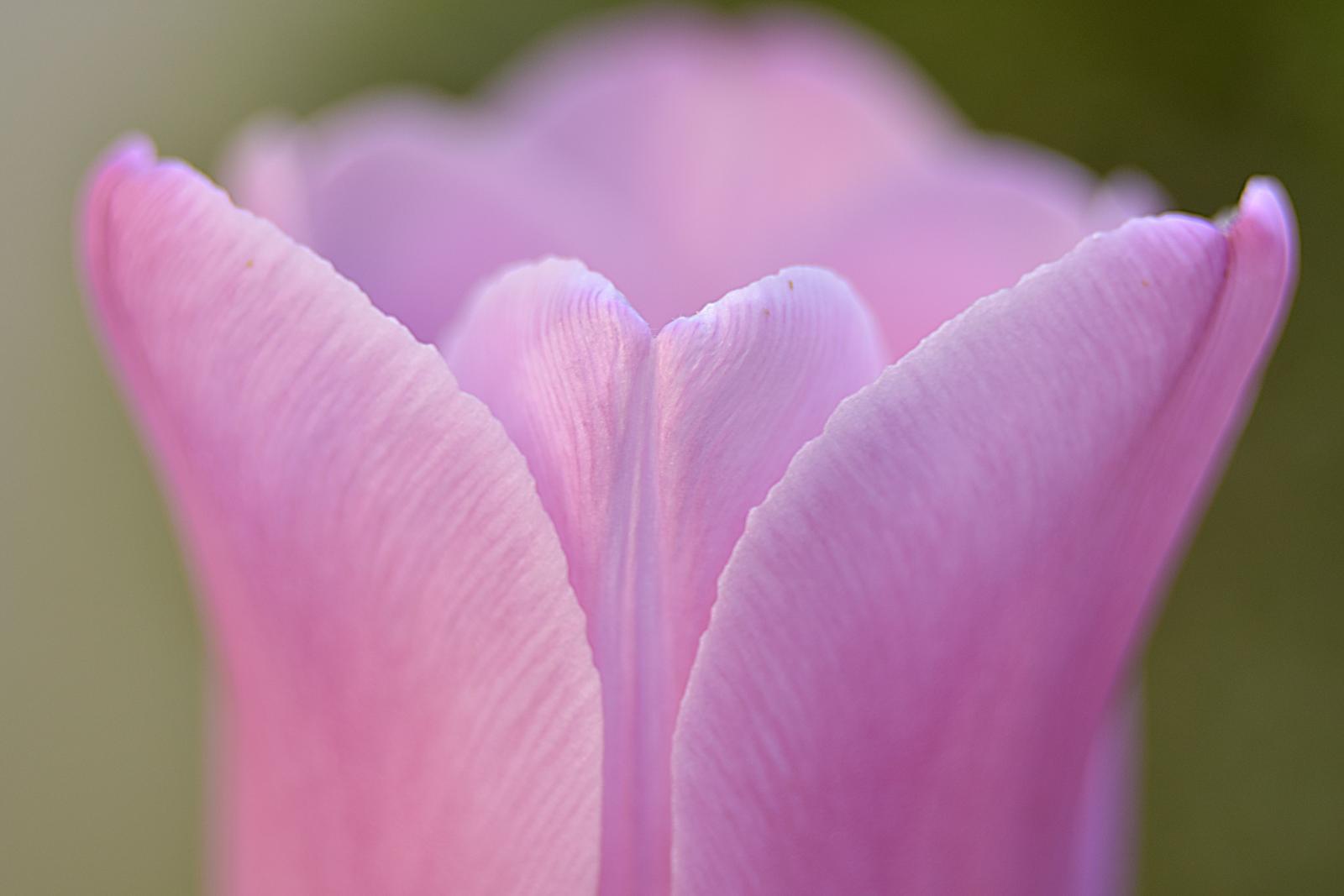
A calm, pastel study of curves and texture that sits somewhere between macro and soft floral abstraction.
You’ve committed to a centred composition, and that choice fits the tulip’s natural symmetry. The frame leans toward macro/abstract rather than a botanical record, with the central ridge and soft petal striations doing the heavy lifting. The background is clean and the colour palette is gentle, which keeps attention on the form. The question is: do you want this to read as a pure shape study, or as a crisp macro revealing petal detail? Your decision on depth of field and how tight you crop should be driven by that answer.
TECHNICAL EXECUTION ★★★
Exposure and colour look natural and restrained—no heavy-handed saturation, which suits the subject. The plane of focus lands near the central crease, but it isn’t razor-sharp; the critical edge detail softens quickly and the outer petals melt away perhaps more than intended. There’s no distracting noise or artefacts, and the background blur is smooth. A couple of tiny specks on the inner right petal could be cleaned in post. To reach five stars you’d need either perfect micro-sharpness on the chosen focal line or a deliberate focus stack that holds the key petal edges while retaining that buttery background.
COMPOSITION ★★★
The centred approach builds calm and works with the tulip’s symmetry. However, the crop is tight: the right petal tip grazes the edge and the left side feels slightly heavier, which introduces tension without intention. The strongest line—the vertical split in the central petal—is nicely placed but would benefit from a touch more breathing room above and to the sides. Consider whether you want strict, mirrored symmetry (then commit and align clinically) or a more dynamic offset (then shift the seam off-centre). How might a square or 4:5 crop change the balance of those curves?
LIGHTING ★★★★
Soft, diffuse light flatters the subject and reveals fine ribbing on the petals without harsh specular highlights. The gentle falloff helps the background recede, and the slight luminosity on the central ridge gives a subtle focal cue. It is a little flat toward the lower half, where a hint more direction could add shape. A small reflector or gentle side light would emphasise texture without breaking the mood. To hit five stars, you’d want that sculpting to be more intentional while keeping the pastel feel.
STORY ★★
This reads as a pleasant floral study, but it doesn’t push beyond “a pretty tulip close-up.” There’s no clear conceptual hook—no revealing of the flower’s interior, no strong graphic tension, no seasonal or environmental cue. Macro can either show exquisite detail or create a compelling abstraction; this sits in between, which dilutes the message. Ask yourself: what is the one idea you want the viewer to take away—delicate structure, sensual curves, or botanical precision?
IMPACT ★★★
The pastel tones and clean background make for a soothing image that many will find pleasing. However, the subject and treatment are familiar, and the near-miss on critical sharpness keeps it from landing a strong punch. With either bolder geometry or crisper micro-detail, it would rise from pleasant to memorable. Aim for a clearer stylistic stance—graphic symmetry or rich texture—and the presence will increase.
CONSTRUCTIVE NEXT STEPS
✓ For a detail‑driven macro, stop down to around f/5.6–f/8 or shoot a 6–12‑frame focus stack on a tripod to keep the central ridge and front petal rims crisp while maintaining a soft background (avoid windy conditions).
✓ Revisit the framing: step back 1–2 cm so petal tips don’t touch the edges, then choose either perfect symmetry (align the central seam precisely and consider a square crop) or a deliberate offset with negative space.
✓ Shape the light: use a small white card to bounce gentle side light onto the central ridge to enhance texture; a translucent diffuser above the flower will keep the softness consistent.
✓ Post‑processing: remove the tiny brown specks on the inner right petal and apply selective, low‑radius sharpening or texture only along the central crease to emphasise the intended focal point without crunching the bokeh.
AI Version 2.0