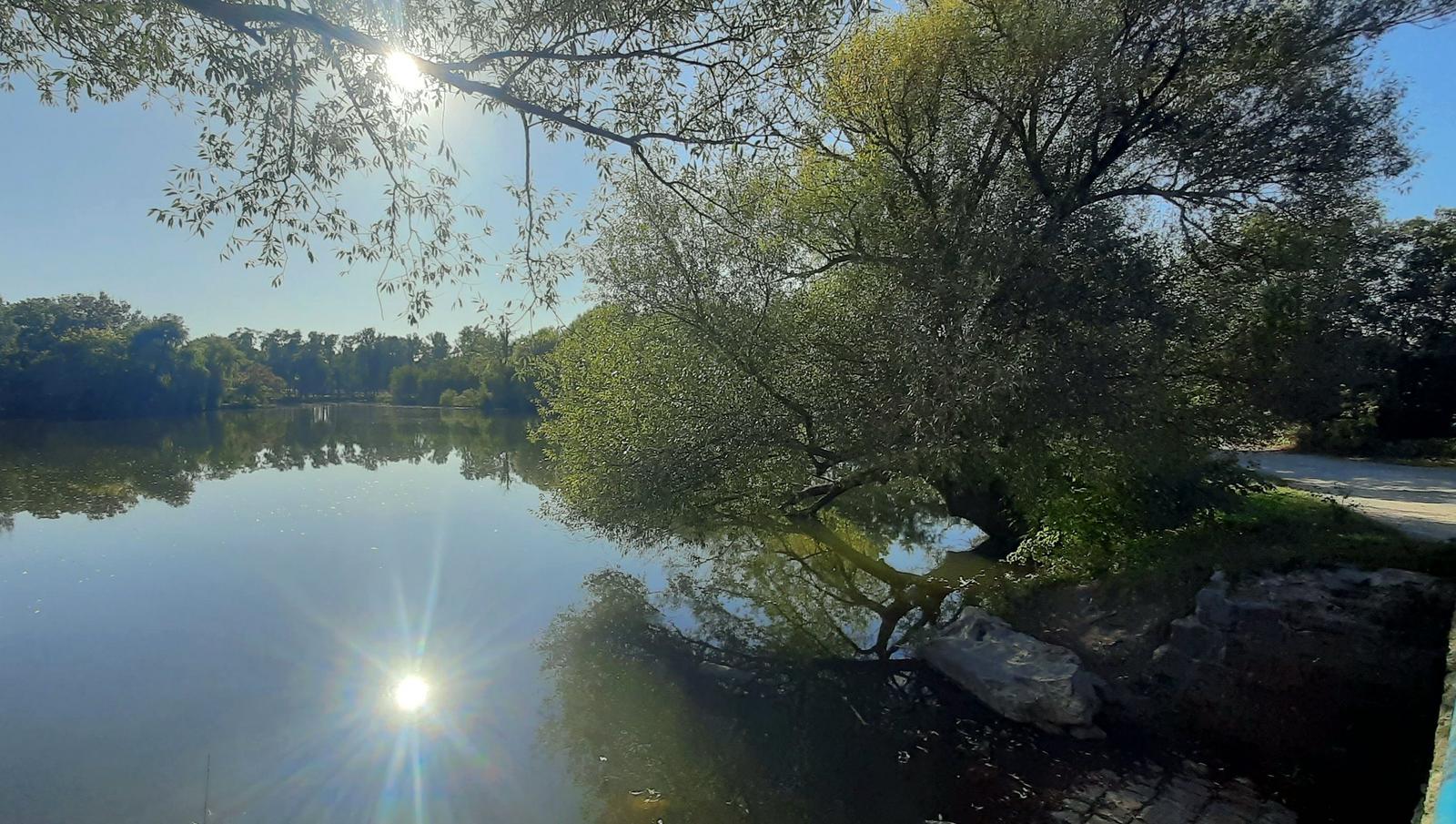
You’ve caught a lovely mirror of the sun, but the frame is fighting the light and the clutter.
Yes—the reflection of the sun on the water is clear and eye‑catching, and there is some play of light and shade under the big tree on the right. The left side is illuminated by open sky; it reads as bright and clean, especially where the reflected sun creates that star. What’s working is the “two suns” (real and reflected) and the sweeping tree leaning over the lake. This is a landscape, and the challenge here is the very hard, high‑contrast midday light with the sun in frame: it compresses detail in the shadows on the right and creates veiling glare on the left. Deciding what your main subject is—the reflection, the tree, or the pair of suns—would help simplify the choices around framing and exposure. What did you want the viewer to notice first?
TECHNICAL EXECUTION ★★★
The reflection’s starburst suggests a small aperture, which works nicely. Highlights around the sun are clipped (expected and acceptable) but there’s also veiling flare that lowers contrast across the left half. Deep shadows in the right-hand tree are close to crushed, so texture is lost. Focus is fine across the lake and there are no obvious artefacts or heavy processing. Next time, use −1 to −2 EV to protect highlights and a lens hood or hide the sun just behind a leaf to reduce flare; then lift mid‑tones locally in post rather than globally.
COMPOSITION ★★
The scene has strong ingredients—the leaning tree, calm water, and the twin suns—but the frame feels busy and unbalanced. The concrete/rock edge and road at the bottom right pull attention and don’t add to the story. The heavy mass of foliage on the right outweighs the empty left, and the top branch plus bright sun competes with the reflection below. A vertical orientation aligning the real sun and its reflection, or a tighter crop excluding the road and rock, would simplify and strengthen the message. Consider stepping a metre or two forward and left so the tree forms a clean diagonal into the lake and the shoreline clutter disappears.
LIGHTING ★★
The midday sun is harsh, creating extreme contrast and flattening colour. While you do show some shade and sparkle, the dynamic range exceeds what the sensor can comfortably hold, so the right-hand shadows are heavy and the left is slightly washed by glare. To show “play of light and shadow” more convincingly, aim for early or late light when the sun is lower and softer, or hide the sun behind denser leaves to tame intensity and reveal texture. A gentle underexposure for the highlights with selective dodging on the tree would keep depth without the muddy look.
STORY ★★
The photograph communicates a calm lake on a bright day, but there isn’t a clear moment beyond the light effect itself. Without a focal event—ripples breaking, a bird skimming the water, or a person entering the frame—the image reads as a pleasant record rather than a scene with tension or mood. The strongest thread is the conversation between the sun and its reflection; everything else feels incidental. Leaning into that single idea would give the frame a clearer purpose.
IMPACT ★★
The mirrored sun catches the eye briefly, but the competing elements and hard light reduce staying power. The right-edge clutter and deep shadows dilute the serenity that the glassy water could provide. With cleaner framing and better timed light, this location could produce a striking, memorable image. Aim for fewer elements, stronger light, and a single, confident subject.
CONSTRUCTIVE NEXT STEPS
✓ Reframe from closer to the water and 1–2 m left to exclude the road/rock; consider a vertical composition that stacks the real sun and its reflection while using the leaning trunk as a diagonal lead.
✓ Shoot within an hour of sunrise/sunset or hide the sun behind foliage; expose for the highlights (−1 to −2 EV, ISO 100, f/11–f/16) to keep the starburst and then locally lift mid‑tones on the shaded tree.
✓ In post, crop off the right/bottom edge to remove the concrete and road; add a subtle dehaze/contrast on the left to counter flare and a gentle dodge on the tree canopy to reveal texture without flattening.
✓ If conditions are still and you want more story, wait for a small element (a bird, a floating leaf trail, or a passing canoe) to interact with the reflection—one small gesture can transform the scene.
AI Version 2.0