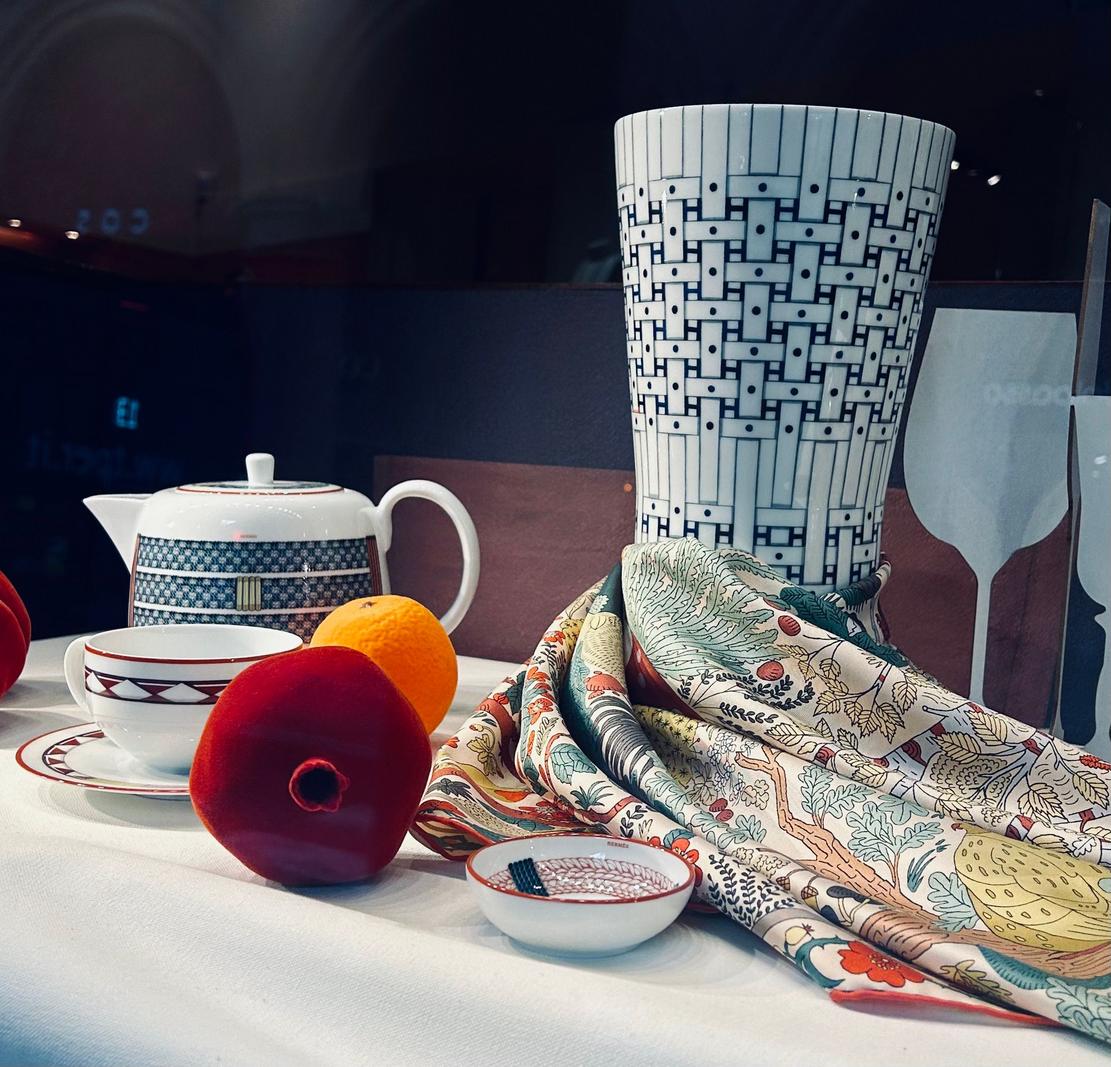
A visually rich shop‑window still life that leans strongly on pattern and shape.
Yes—the viewpoint does communicate a mix of geometric forms: the tall cylindrical vase with its grid, the circular rims of the cup and teapot, and the spherical orange all read clearly. This is a still life/product scene and your angle slightly above table height gives pleasing ellipses that suggest circles without flattening them. Where it falters is the clarity of the frame: the half‑seen red object on the far left, shop‑window reflections, and the wine‑glass silhouette on the right dilute the “geometry” idea. If your goal is to celebrate shapes, a cleaner, more orthogonal viewpoint (keeping verticals upright and avoiding partial objects) would make the geometry more obvious. What single shape did you most want the viewer to notice first—the grid on the vase, or the circles of the tea set—and how might you reframe so that one leads and the others support it?
TECHNICAL EXECUTION ★★★★
Focus is crisp across the key items—the vase, teapot, and cup—suggesting a mid aperture around f/5.6–f/8, which works well for this depth. Exposure is controlled with clean whites on the porcelain and good detail in the scarf’s fabric. There’s a mild cool cast from mixed lighting and a few small reflections and bright dots in the dark background that betray the window. Noise and artefacts are minimal and sharpening looks natural. To reach five stars, neutralise the colour balance, remove the background specks, and reduce window reflections with a polariser or by sealing the lens hood to the glass.
COMPOSITION ★★★
The tall vase on the right anchors the frame nicely and the draped scarf leads the eye diagonally back to it—good use of flow. The teapot and cup counterbalance the height of the vase, and the repetition of patterned ceramics supports your “geometry” theme. However, the partially cropped red object on the far left is a strong distraction and feels accidental; the hole in the front red piece also pulls attention away from the main set. The silhouetted wine‑glass shape on the right background merges with the vase’s edge, creating a visual tug. A tighter crop that excludes the left edge object, or a step to the right to bring cleaner spacing between objects, would tidy the story of shapes.
LIGHTING ★★★
Soft, even light gives gentle highlights on the porcelain and preserves texture in the scarf—pleasant and workable for product‑style still life. Shadows are modest and don’t block up, which keeps the scene readable. The downside is a flatness in the background, where reflections and the faint wine‑glass silhouette compete with the subject. The overall tone is slightly cool, which cools down the warmth of the orange and scarf. Warmer white balance and controlling reflections would add shape and depth without resorting to harsh contrast.
STORY ★★★
The narrative suggests refined domesticity—a patterned tea set, a draped designer scarf, and fruit as accents. The repeating grids and circles hint at a concept of order versus softness in the fabric folds. Still, the shop‑window context and stray elements make it feel more like a record of a display than a deliberate scene built by you. Introducing a clearer hierarchy—one lead object with supporting shapes—would strengthen the message. Consider whether you want to tell a “geometry study” or a “luxury teatime” and remove anything that doesn’t serve that choice.
IMPACT ★★★
The patterned vase and the sweep of the scarf catch the eye first and hold interest for a moment. Colour contrast between the red object, orange, and the cool porcelain is pleasing. Impact drops due to the partial object on the left and background reflections, which make the image feel less intentional. With a cleaner frame and a bolder decision about which geometry leads, this could jump a level. Aim for fewer, stronger shapes presented with surgical clarity.
CONSTRUCTIVE NEXT STEPS
- Shoot through the glass with a circular polariser and press a deep lens hood to the window while wearing dark clothes; this will dramatically cut reflections and background clutter.
- Reframe to exclude the partially cropped red object on the far left; either include it fully and give it space, or remove it via a tighter crop.
- If the goal is “geometry,” try a more orthogonal viewpoint: step back and use a slightly longer focal length to keep verticals straight; raise the camera a little so the cup/teapot rims read as cleaner circles.
- Post‑process: warm the white balance slightly, clone out the bright dots in the dark background, and use a gentle local dodge to lift texture in the scarf without over‑brightening the whites.
AI Version 2.12