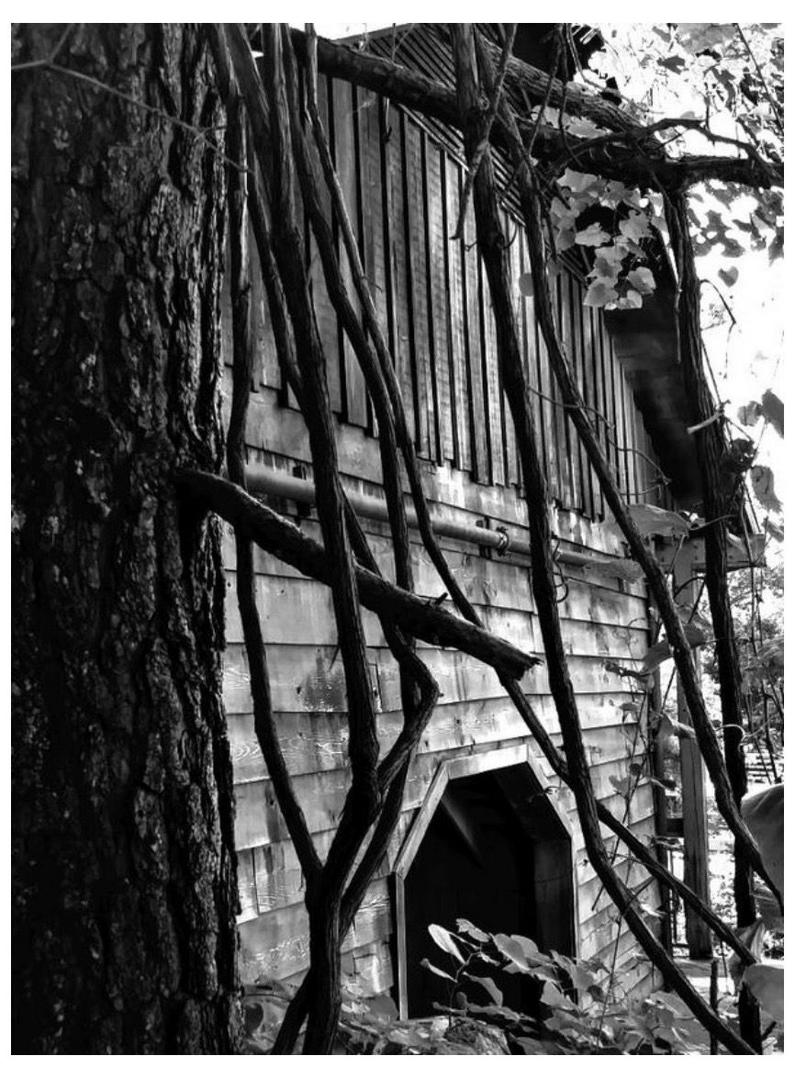
Strong textures and a moody subject, but the frame needs clearer intent to land.
Short answer: a global contrast boost isn’t the fix here. It would likely crush the shadows in the doorway and tree while blowing the bright patch of sky on the right. What will help is targeted contrast—use curves, dodge/burn and mid‑tone clarity on the wood siding and vines—paired with a cleaner composition. You’ve got a compelling subject: nature overtaking a weathered building, shot as a black‑and‑white architectural/fine‑art study. The heavy trunk on the left and the diagonals of the vines are strong ingredients; right now they overwhelm the doorway, which feels like it wants to be the anchor. What did you want the eye to land on first—the doorway, or the tangle of vines?
TECHNICAL EXECUTION ★★★
The file looks reasonably sharp with good detail in the bark and timber cladding, suggesting a stable shutter and appropriate aperture. Tonally it sits in a mid‑contrast place; textures read well but the brightest area of sky on the right is near clipping and pulls the eye. There’s no obvious noise or artefacts, and the monochrome conversion is restrained rather than crunchy. However, the tonal separation between vines and siding is a little muddy, which flattens depth. To reach five stars, control the dynamic range (expose for the highlights or burn them in) and add selective micro‑contrast to the vines and siding while preserving shadow detail in the doorway.
COMPOSITION ★★
The scene is visually busy and lacks a decisive focal point. The thick tree trunk on the left dominates and crowds the frame, while several dark vines cut straight across the doorway, blocking the natural entry point for the eye. The bright exit of sky and foliage on the right edge becomes an unintended magnet, pulling attention away from the structure. A small step to the right or a tighter crop around the doorway would let the vines frame rather than obscure it. Consider a vertical orientation that uses one strong vine as a lead into the door. Ask yourself: if the doorway is the subject, how can you keep it clean of mergers and give it breathing room?
LIGHTING ★★★
The light appears soft, which suits the textures and the black‑and‑white approach. It renders the wood grain and bark nicely, but the hole of bright sky on the right creates imbalance and distracts. There’s minimal modelling across the siding; raking side‑light at a different time of day would carve more depth into the boards and vines. A subtle burn on the highlights and a lift in the door’s midtones would direct attention where you want it. For a higher rating, aim for light that creates clear separation and sculpts the forms rather than illuminating everything evenly.
STORY ★★★
The theme is clear: nature reclaiming a man‑made structure. The angular doorway hints at a past life; the vines feel like they’re tightening their grip. Yet the story is diluted because no single element is allowed to speak; everything competes for attention. Giving the doorway clearer prominence, or finding a small gesture—fallen leaf in the threshold, a shaft of light inside—would add a moment. What small detail on site could you have emphasised to make the “reclaiming” feel more immediate?
IMPACT ★★
The ingredients are strong but the image doesn’t quite stick. The viewer’s eye ping‑pongs between the busy vines and the bright right edge, never settling. With a cleaner anchor and tidier borders this could be a compelling, print‑worthy monochrome study. Right now the tension reads as clutter rather than intent. Tighten the frame, control the highlights, and the textures will do the heavy lifting.
CONSTRUCTIVE NEXT STEPS
- Post‑processing: apply a gentle S‑curve, then add local mid‑tone contrast (clarity or texture) to the wood siding and vines only; burn the bright sky/leaves on the right by about −0.5 to −1 stop to keep attention in the frame.
- Reframe on location: step a metre to the right and slightly forward so the doorway is not crossed by a thick vine; use one or two diagonals to lead into it, not across it. Try a vertical orientation focused from the lintel down.
- Time the light: return when low side‑light hits the wall (early or late) to create shadow relief on the boards and separate vines from background; overcast works, but raking light will add shape.
- Edge discipline: either crop or physically exclude the bright sky patch on the right; keep all edges dark and purposeful so the doorway becomes the natural visual destination.
AI Version 2.12