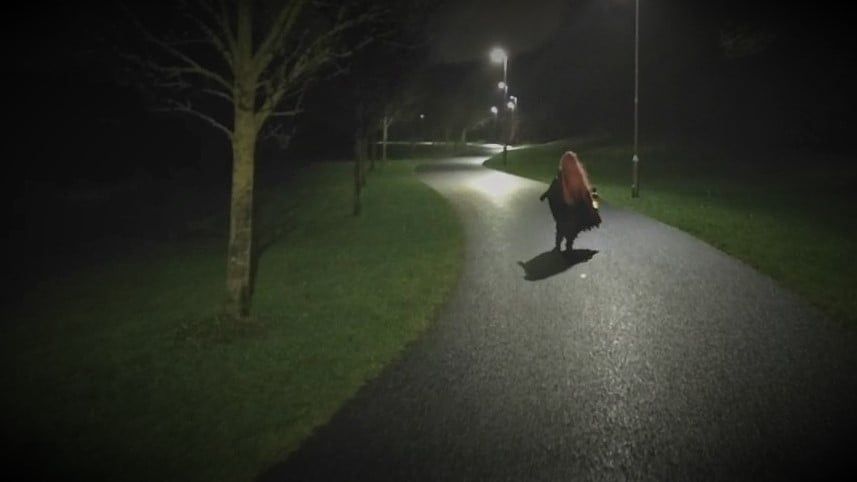
Moody, rain‑slicked path with a solitary walker — a strong atmosphere, close to something compelling.
Thanks, Kit. You’ve leaned into the quiet tension of a night walk — the wet tarmac reflecting the lamps, the curve of the path, and that lone figure with bright hair are the anchors. This sits between street and travel: a candid human moment that also describes a place. The repetition of lampposts and the glistening path are your best assets here. What held you most — the curve or the person? If it was the person, consider how waiting a beat for them to step into a brighter pool of light would strengthen their presence without losing the mood.
TECHNICAL EXECUTION ★★★
Exposure is handled reasonably well for a difficult scene; the wet path has texture and the deep shadows feel natural. The streetlights are clipped, but that’s acceptable in night work and they don’t dominate. The figure is a touch soft and small, suggesting a slow shutter or focus priority on the path rather than the subject. There’s mild noise in the grass and darker areas as expected at high ISO. White balance trends cool-green under the lamps, which suits the scene but could be nudged warmer on the subject to separate them. To reach five stars the person would need cleaner sharpness and local noise control, with highlight roll‑off around the lamps handled more delicately.
COMPOSITION ★★★
The S‑curve path is a solid spine leading the eye, and the lampposts provide rhythm into the distance. Placing the walker on the right works, but they’re small relative to the frame, so the story leans more “empty path” than “human at night.” The heavy dark top corners act like a vignette, which contains the scene but also eats space that could be trimmed. The tree on the far left is borderline dead space and could be cropped without loss. A lower stance closer to the right edge of the path would exaggerate the curve and give the walker more presence. For a higher score, simplify the edges and commit to either the person or the geometry as the primary subject.
LIGHTING ★★★
The wet surface catching the lamp glow is the hero — you’ve used available light to create texture and direction. Pools of light step down the path nicely, but your subject sits between them, so they blend into the shadow more than they should. The brightest lamps are a little hot; pulling their highlights back would reduce pull from the top of the frame. A small timing shift to catch the walker under the second or third lamp would model their shape and hair while keeping the background moody. To reach four or five stars, place the subject decisively within a pool of light and manage the hotspots to keep attention in the mid‑frame.
STORY ★★
There’s a clear mood of solitude and a night journey, but the moment isn’t quite there. The figure’s gesture is neutral and turned away; nothing specific is happening, so we’re left with atmosphere more than narrative. If the person were mid‑stride beneath a lamp, opening a coat, or interacting with rain or wind, the frame would feel like a scene rather than a setting. Consider whether you wanted anonymity — if so, could a second element (a distant cyclist, a dog, a puddle splash) add tension or context? Right now it’s a “nearly” moment that hints at a story without delivering it.
IMPACT ★★
The image is calm and brooding, but it doesn’t quite demand a second look because the subject lacks weight. Many viewers will appreciate the ambience, yet it risks blending into a common “night path” motif. A tighter or more decisive human moment would lift memorability significantly. Originality could also come from a stronger angle — crouched low, or shooting through branches to frame the walker. To hit the top tiers the frame needs either a standout gesture or a bolder compositional choice that makes this scene unmistakably yours.
CONSTRUCTIVE NEXT STEPS
✓ Time the subject to enter a pool of light; aim for 1/125–1/200s by raising ISO (e.g., ISO 3200–6400) so their stride is crisp and the hair glows.
✓ Refine the frame: crop a little from the left and top to remove the near tree and excess darkness, bringing the walker closer to the viewer.
✓ Post‑process locally: lower highlights on the lamps, add a subtle dodge on the walker and immediate path, and apply noise reduction to the grass while keeping texture on the tarmac.
✓ Explore a lower viewpoint on the inside of the curve to amplify leading lines and let the lamppost rhythm carry the eye to your subject — would that make the person feel more significant without losing the mood?
AI Version 2.1